The AAISM passing score, explained
Vishwen Labs

The AAISM exam is scored on a scale from 200 to 800, and 450 is a pass. That is a scaled score rather than a percentage: 450 does not mean 56% of the questions correct, and ISACA does not publish how many raw marks it takes. The practical consequence is that no practice tool can tell you your exact margin, and the honest ones say so.
How the AAISM scaled score works
ISACA uses the same 200 to 800 scale across its certification exams. Your raw count of correct answers is converted to that scale through a statistical process that accounts for the difficulty of the particular set of questions you were given. Two candidates who sit different forms of the exam, one slightly harder than the other, can answer different numbers of questions correctly and receive the same scaled score.
The point of the scale is fairness across forms, not secrecy, but the effect is the same: the conversion is not published, and it can differ from one form to the next.
Why 450 out of 800 is not 56 percent
The arithmetic is tempting and wrong. Dividing 450 by 800 gives 56.25%, and it is easy to conclude that a little over half the questions will do. Nothing in ISACA's material supports that. The bottom of the scale is 200, not 0, and the mapping from raw marks to scaled score is neither linear nor disclosed.
Third-party estimates for ISACA exams generally cluster between 65% and 75% of questions answered correctly, based on candidates comparing notes. Treat those as folklore with a plausible centre rather than a target to aim at. Aiming at the folklore is how people arrive with no margin.
What practice scores can and cannot tell you
A practice tool can measure the percentage you get right on its own questions. It cannot convert that to ISACA's scale, because the conversion is ISACA's and depends on the real questions. So the useful question to ask of any mock is not whether you passed it but whether your percentage on 90 mixed questions, under time, is comfortably above the folklore range and stable across attempts.
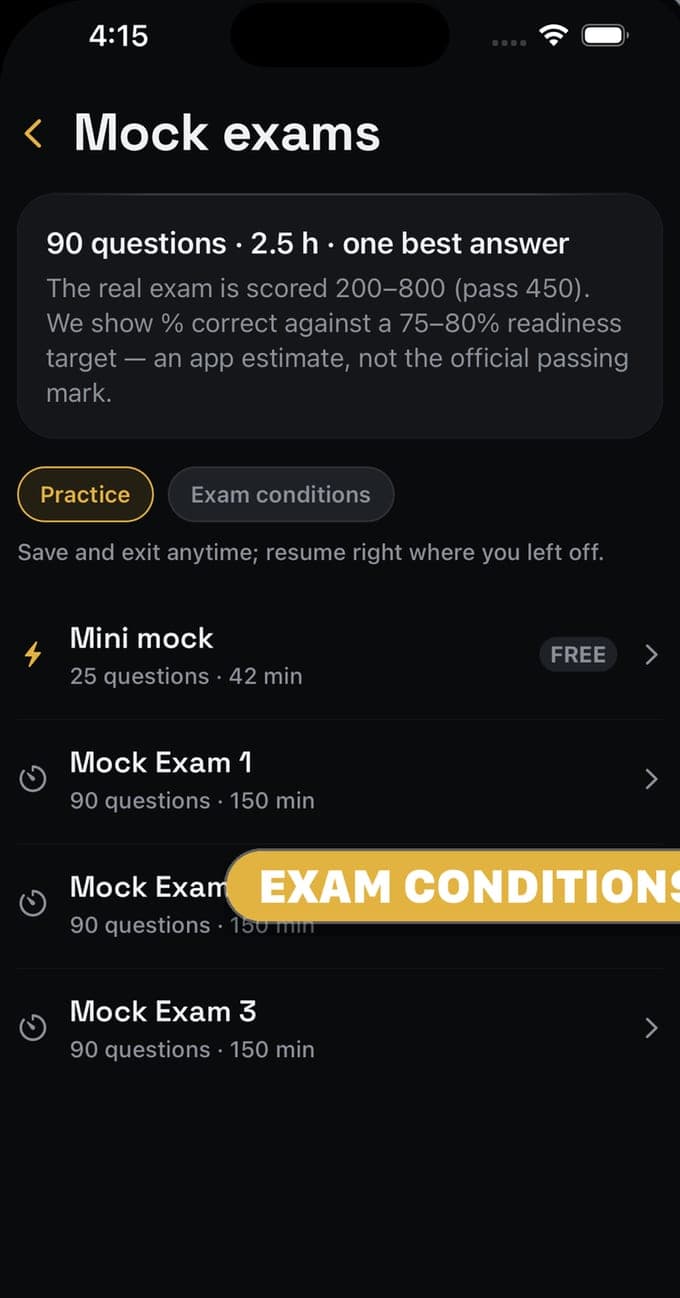
AAISM Exam Prep shows the percentage correct against a 75 to 80% readiness target, and the Mock exams screen states in plain text that this is an app estimate and not the official passing mark. That sentence is worth more than a green tick would be.
Reading your AAISM results by domain
ISACA reports scores for its exams by domain as well as in total. Passing is decided on the total scaled score, so a weak domain does not fail you on its own, but three weak domains cannot be rescued by one strong one either. Domain 3 carries 38% of the questions, and a low score there drags the total further than the same score in Governance or Risk.
Before the exam, the same logic applies to practice. A readiness score that weights the domains 31, 31 and 38, as the app's does, is a better predictor than an unweighted average, because it is built the way the paper is built.
When you find out whether you passed AAISM
For its other certification exams ISACA has shown candidates a preliminary result on screen at the end of the session, with the official scaled score following later. Check the current AAISM candidate guide for exactly what you will see on the day, since the details are ISACA's to set. Whatever the timing, a pass starts the five-year window in which to apply for the certification.
AAISM™ and CISM® are trademarks of ISACA. This app is an independent study aid and is not affiliated with, endorsed by, or sponsored by ISACA.
Questions people also ask
What percentage do you need to pass the AAISM exam?
ISACA does not publish one. The pass mark is a scaled score of 450 on a 200 to 800 scale, and the raw-mark conversion depends on the exam form. Third-party estimates for ISACA exams cluster between 65% and 75% correct, which is a reason to aim well above that in practice rather than a figure to rely on.
Can you fail one AAISM domain and still pass the exam?
Passing is decided on the overall scaled score, and ISACA reports domain scores for feedback rather than as separate hurdles. A weak domain lowers the total in proportion to its weight, so a poor Domain 3 result, at 38% of the exam, costs more than the same result in either of the other two.