Failed the Life in the UK test? What happens next
Vishwen Labs

If you fail the Life in the UK test you are told at the centre, nothing is reported to the Home Office, and you can book again and pay the £50 fee again. Most guidance says the earliest you can rebook is seven days later, though sources differ, so check the dates the booking service offers. There is no limit on attempts.
What a failed Life in the UK test means
Less than it feels like. The result is given to you at the centre and, according to every account, is not passed to the Home Office; there is no record of a fail on your immigration file. What a fail does is delay you, because an application for settlement or citizenship cannot be submitted without a pass, and the application will not be considered on the promise of a pass to come.
It also costs another £50 and another booking made at least three days ahead. Third-party guidance mostly puts the earliest rebooking at seven days after the failed attempt; a few sources say there is no wait. The booking service will only offer dates it allows, so book from what it shows rather than from either claim.
Why people fail the Life in the UK test
Rarely because of time. Forty-five minutes for 24 questions is generous, and almost nobody runs out. The usual cause is a practice score that was never far above 18. A candidate scoring 18 or 19 on mocks is one bad draw of questions from failing, and the real test is always a draw from a bank you have not seen, weighted by nothing you can control.
The second cause is a chapter skimmed rather than learned, usually history because it is long, or modern society because it is names without a story. A test that happens to lean on that chapter uses up six wrong answers quickly.
Study differently before the second attempt
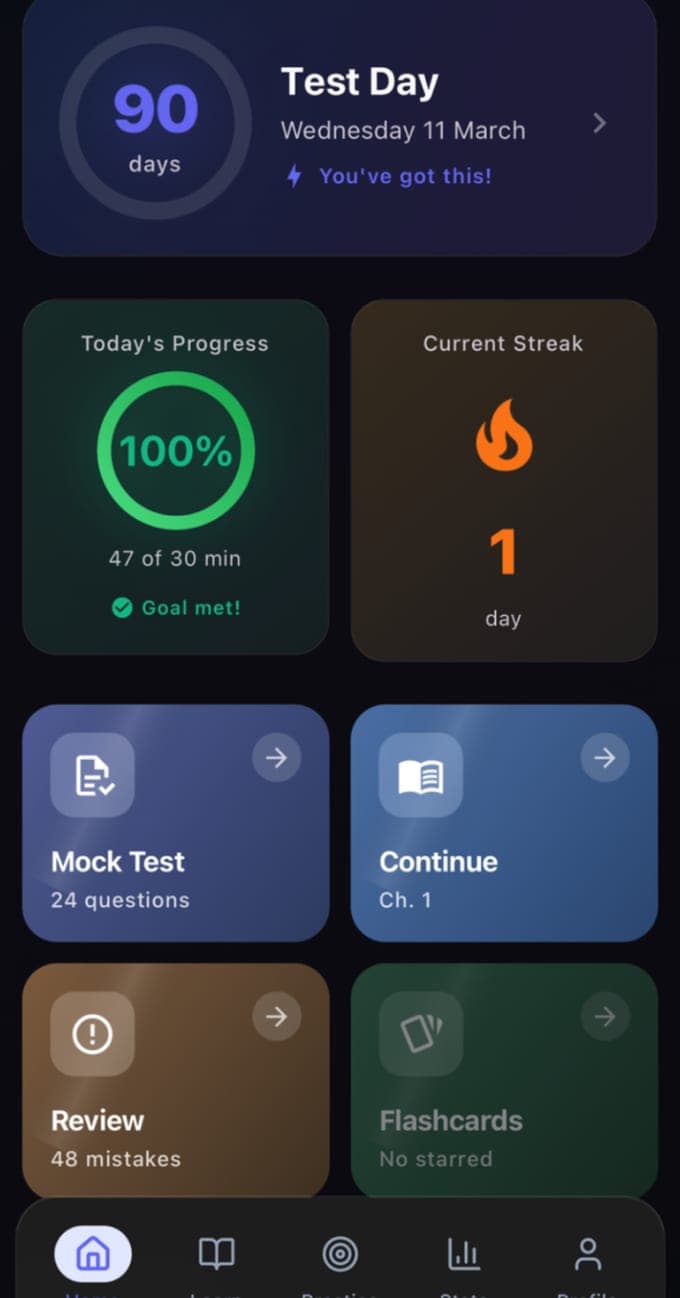
Not the same thing again, harder. Start from what went wrong: the review list of missed questions, and the chapter scores in practice-by-topic, which show where the misses cluster. Drill those topics with the weak-areas mode until their scores match the others, then go back to mixed 24-question mocks under the clock.
Change the booking rule too. Do not rebook when a mock scrapes 18; rebook when several timed mocks in a row hold at 21 or more. That is the difference between the first attempt and a second one that passes.
Rebooking the Life in the UK test
The same GOV.UK service, the same £50, the same three days' notice and the same ID rules apply. Treat any waiting period as a floor rather than a target: seven days is enough to rebook, and rarely enough to fix a weak chapter. Two or three weeks of the loop above, then a booking, is the pattern that tends to end in a pass.
After you pass
The centre tells you, and you are given a unique reference number. Keep it. It is what the settlement or citizenship application quotes, and a pass does not expire, so it is the last time the test needs to be thought about. The fail before it leaves no trace anywhere that matters.
Life in the UK Test is an independent educational app and is not affiliated with, endorsed by, or connected to the UK Home Office or any government body. Its content is based on the official Life in the UK handbook.
Questions people also ask
How many times can you take the Life in the UK test?
There is no limit. Each attempt is booked and paid for separately at £50, at least three days ahead, and most guidance puts the earliest rebooking after a fail at seven days. A fail is not counted against you; only a pass is recorded, and it never expires.
Does failing the Life in the UK test affect my visa or settlement application?
Not directly. Every account agrees a fail is not reported to the Home Office and leaves no mark on your immigration record. The practical effect is delay: an application that needs the test cannot be submitted until you have passed, so a fail pushes the application back by however long the next attempt takes.