The Finnish citizenship test in 2027: what has been decided, and what has not
Vishwen Labs

Finland's citizenship test is law. Parliament approved the amendments to the Citizenship Act on 10 June 2026, the President confirmed them on 16 June, and they enter into force on 1 January 2027 for applications submitted from 1 March 2027. What the law and Migri have fixed is who must show civic knowledge, how it can be shown, what the test covers and how it is taken. What they have not published, as of September 2026, is the number of questions, the duration, the pass mark, any fee and the test places, all promised for autumn 2026.
The legislative record
The government proposal, HE 54/2026, went to Parliament on 16 April 2026. Parliament passed it on 10 June 2026 by 153 votes to 21, the President confirmed the amendments on 16 June, and the amending act was published as 552/2026, an act amending the Nationality Act of 2003. Migri's customer bulletin of 17 June set out the dates: in force 1 January 2027, applied to applications submitted on or after 1 March 2027, with the two months in between as a transition period. The law followed a Ministry of the Interior study published in February 2025 that mapped the options and looked at how comparison countries run their tests.
What is fixed
From Migri's pages and the releases around the law:
- A requirement for civic knowledge for applicants aged 18 to 64, met by the test, a Finnish- or Swedish-language matriculation examination in Finland, or a Finnish- or Swedish-language higher education degree in Finland.
- A test taken in digital form, on site, with multiple-choice questions, answered in Finnish or Swedish.
- Topics: key legislation governing life in Finnish society, fundamental and human rights, equality including gender equality, and Finnish history and culture.
- Questions based on learning material published on Migri's website well in advance of the first test, the same material for everyone.
- Migri responsible for the official duties; the University of Helsinki commissioned to build the test and its material, with about 800,000 euros for development and four years of maintenance, according to Yle.
- Derogations for health, disability or other very serious reasons; special arrangements such as extra time, an oral test or an assistive device.
- A first test expected in March 2027.
What is not yet published
Five things, and they are the five most searched: how many questions, how long, how many correct answers to pass, what it costs, and where and how to register. Migri's page says only that most of the answers must be correct for the test to be passed, and that more information about preparing for the test, places where it can be taken and taking it will come during the autumn of 2026. The learning material itself is also unpublished; the University of Helsinki has started writing it, in clear Finnish aimed at readers at level B1, according to its vice rector in September 2026.
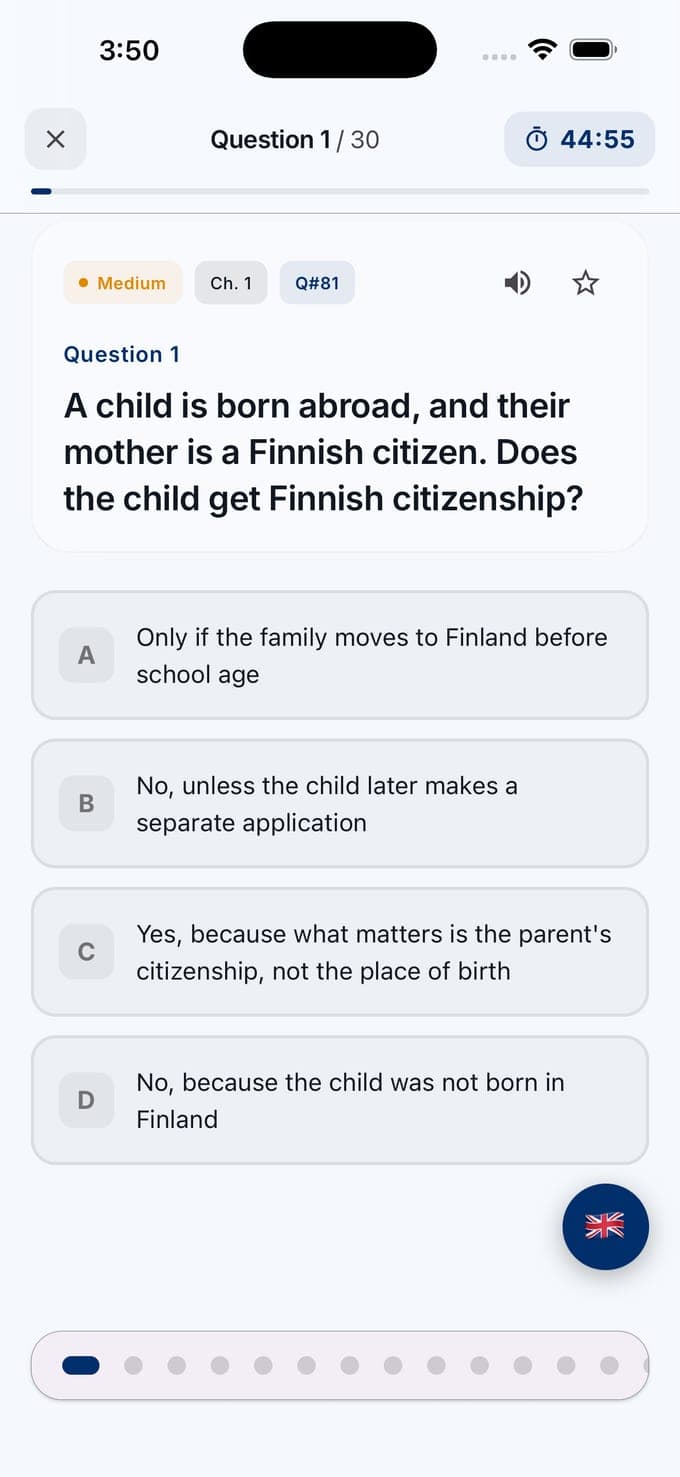
Until those are published, any specific figure you read is a guess. Several visa blogs and news aggregators state a range of 20 to 40 questions and a pass mark around 70%; none cites a source, because there is none. The app uses 30 questions, 45 minutes and 75% for its mock and labels them preliminary in the app, on this site and in the store listing, so that they can be replaced the week Migri publishes the real ones.
Why the material matters more than the format
Migri has said that the questions will be based on the published learning material, and that everyone will have the same material. That is the structure of a fair test: the syllabus is public, and the questions do not stray from it. It also means the most useful preparation is to know the material rather than to guess at question counts. The government has said the material will be developed from the existing civic orientation material used in integration training, which is already free and multilingual, so the ground can be learned now and the official wording added when it arrives.
What to watch, and where
Migri's page on the amendments to the Citizenship Act is the one that will change: the material, the places, the registration and the fee will appear there, and Migri has said it will also update its application forms when the amendments enter into force. The Ministry of the Interior's project page and FAQ carry the legislative background. Nothing from a preparation site, this one included, should be read as the specification until Migri has published it.
Kansalaisuuskoe is an independent study aid and is not affiliated with the Finnish Immigration Service (Migri) or any other Finnish authority. Migri will publish the official learning material for the citizenship test before the first test in March 2027, and the test's questions will be based on it; the app's lessons and questions are its own, written from the civic orientation and InfoFinland material that the official material will draw on.
Questions people also ask
Has the Finnish citizenship test law been passed?
Yes. Parliament approved the amendments to the Citizenship Act on 10 June 2026 by 153 votes to 21, the President confirmed them on 16 June 2026, and they were published as act 552/2026. They enter into force on 1 January 2027 and apply to applications submitted from 1 March 2027.
Who writes the Finnish citizenship test?
The University of Helsinki, which won Migri's tender to develop the test and its learning material and to maintain them for four years, with a budget of about 800,000 euros according to Yle. Migri is responsible for organising the test and publishing the material.