How to prepare for the Finnish citizenship test before March 2027
Vishwen Labs

Prepare for the Finnish citizenship test by learning the civic orientation material the official material will be built from, in Finnish as well as your own language, and by practising multiple-choice questions on the four areas the law names. The first tests are expected in March 2027 and Migri's official material arrives in autumn 2026, which leaves time for a plan rather than a cram. And check the transition rule first: if you already meet every other requirement, an application submitted before 1 March 2027 needs no test.
A plan for the Finnish citizenship test
- Check whether you need the test at all. You need it if you are 18 to 64 and apply from 1 March 2027 without a Finnish- or Swedish-language matriculation examination or degree from a Finnish institution. If you already meet the residence, language and other requirements, Migri processes applications submitted before 1 March 2027 under the current Act, with no test.
- Get the civic orientation material. The yhteiskuntaorientaatio material at yhteiskuntaorientaatio.fi is free and available in several languages. The government has said the official test material will be developed from it. Read it once in a language you read easily, then again in Finnish.
- Weight the four areas the law names. Key legislation and everyday rules, fundamental and human rights, equality, and Finnish history and culture. Give those most of your time; geography, sport and nature are background.
- Learn the Finnish words for the rights. The test is answered in Finnish or Swedish, and the material is being written in clear Finnish for readers at level B1. Perusoikeudet, yhdenvertaisuus, tasa-arvo, eduskunta, kunta, verotus: know them as words, and know what each one covers.
- Practise multiple-choice questions by chapter. Answer questions on one chapter at a time and keep the misses. Recognising the right option among plausible wrong ones is a different skill from knowing the fact, and it is the one the test measures.
- Watch Migri's site in autumn 2026. Migri will publish the learning material, the test places, the registration process, the format and any fee during autumn 2026. Read the official material the week it appears and check what it adds to or changes in what you have learned.
- Run timed mocks in the final month. Once the format is known, run mocks in the real format in Finnish, daily, until three in a row are well clear of the pass mark with no chapter left weak. Until then, use the preliminary format and read the score as a percentage.
Why start before the material is out
Because the material's content is largely known even though its wording is not. The Ministry of the Interior said the test's learning material would be produced on the basis of the existing civic orientation material, and Migri named the four areas the questions will cover. Someone who knows the civic orientation material in Finnish by autumn 2026 has to learn only what the official material adds or phrases differently, and has months to do it. Someone who waits for the official material starts from zero with the first test a few months away.
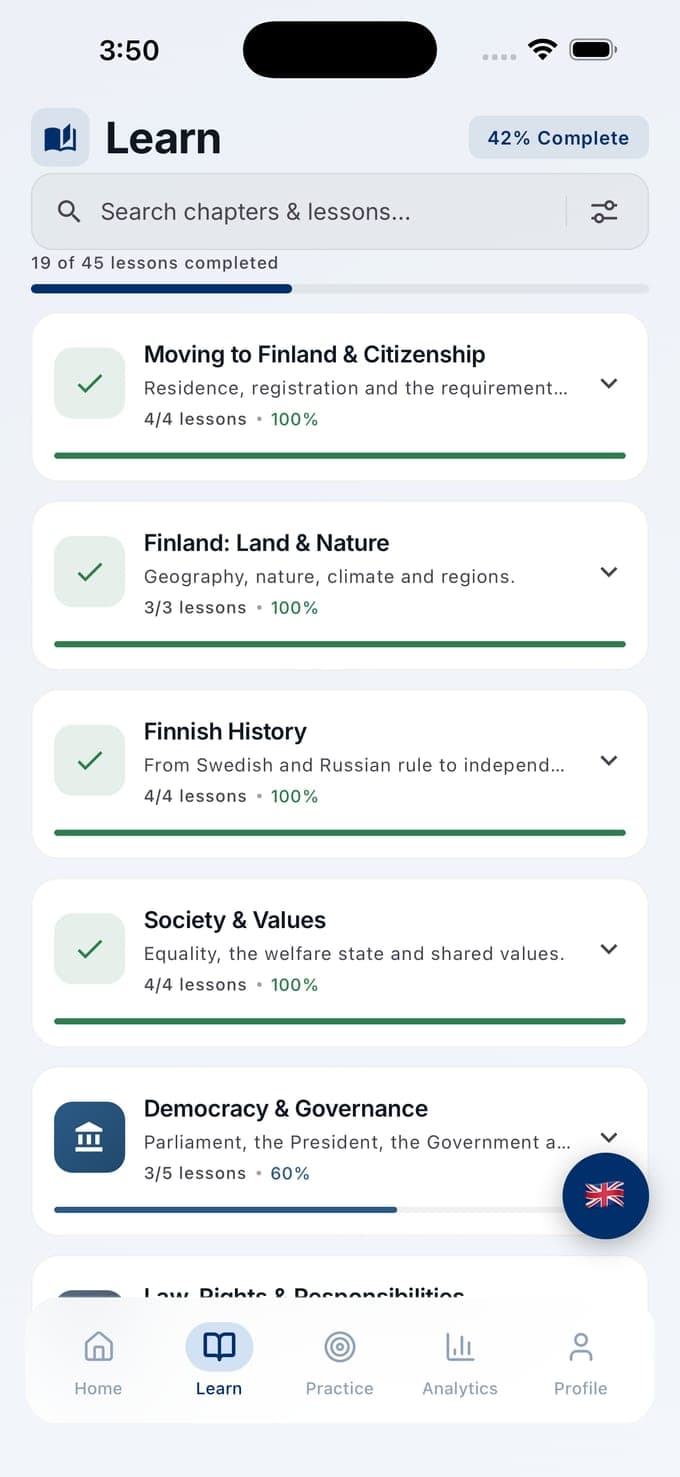
Learn it in both languages, deliberately
If English or another language is faster for you, use it first: the point of the first pass is to understand how Finnish society works, and that is easier in a language you read well. Then switch. The app shows Finnish and English side by side and reads the Finnish aloud, so the second pass can be done sentence by sentence, matching the Finnish term to the idea you already have. By the time you run mocks in Finnish only, the words that matter should be familiar rather than translated on the fly.
Use the mocks for measurement
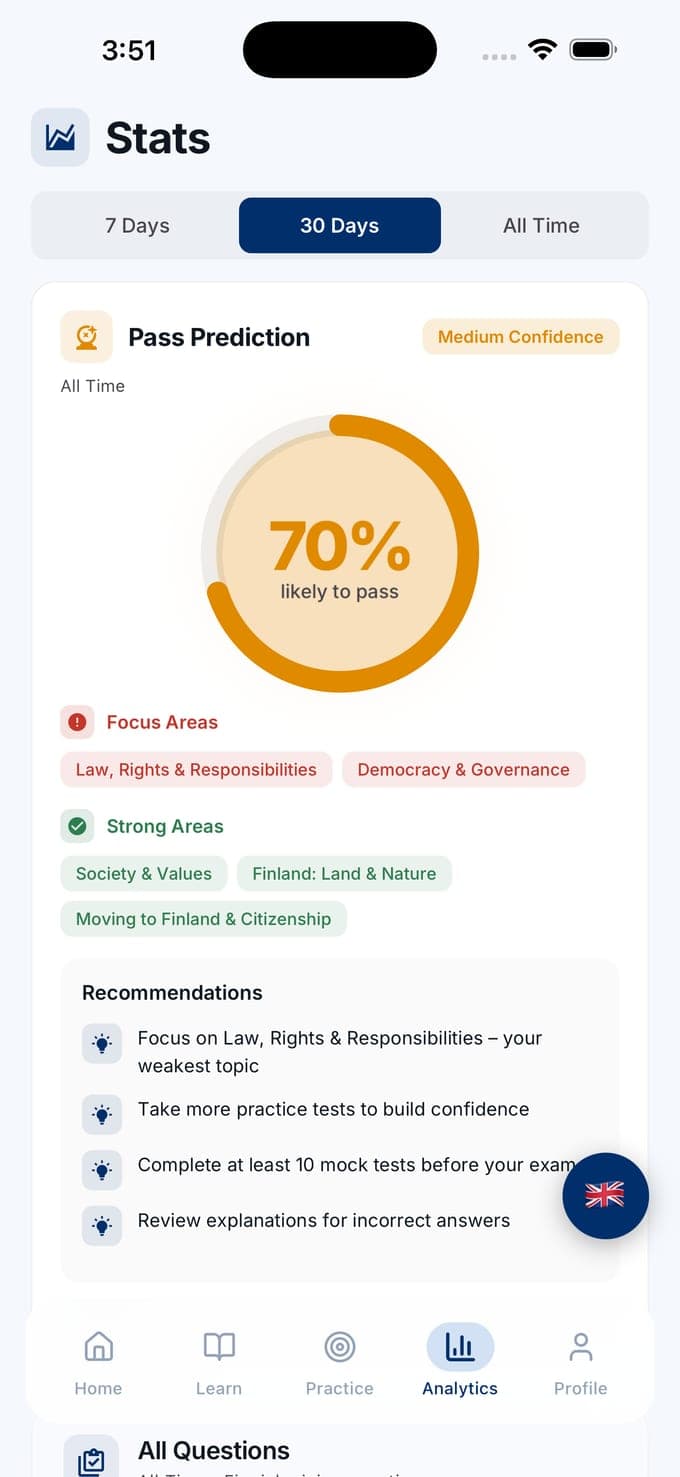
A mock's job is to tell you where you stand. Run it under conditions, in Finnish, and read two things: the percentage against the pass line, and which chapters the misses came from. The first says whether you are ready; the second says what to reread. Three consecutive mocks comfortably above the pass mark with no weak chapter is a fair signal; one lucky pass is not.
The language requirement runs alongside
Passing the test does not prove language skills, and the language requirement does not prove civic knowledge. For citizenship you normally need a YKI certificate at level 3 in Finnish or Swedish, or an equivalent, and you need it before you apply. If you are still working towards YKI 3, the civic orientation material is good reading practice at exactly the right level, and the vocabulary overlaps heavily with the test's. Planning the YKI test and the citizenship test together is sensible; the language guide sets out the rules.
Kansalaisuuskoe is an independent study aid and is not affiliated with the Finnish Immigration Service (Migri) or any other Finnish authority. Migri will publish the official learning material for the citizenship test before the first test in March 2027, and the test's questions will be based on it; the app's lessons and questions are its own, written from the civic orientation and InfoFinland material that the official material will draw on.
Questions people also ask
How long does it take to prepare for the Finnish citizenship test?
Nobody has sat it yet, so there are no reports. The civic orientation material is sized for about 70 hours of teaching, and learning it in Finnish as well as your own language takes longer than that. Starting in autumn 2026 for a test in spring 2027 is comfortable; starting the month before is not.
Should I apply for citizenship before March 2027 to avoid the test?
If you meet every other requirement now, yes: Migri processes applications submitted before 1 March 2027 under the current Act, even if your identity appointment comes later. If you do not yet meet the residence or language requirement, applying early only risks a negative decision, and the test is the better plan.