Can you take the German citizenship test in English?
Vishwen Labs

No. The Einbürgerungstest is taken in German, the Testheft has no translation, and no Prüfstelle offers an English version, because the naturalisation it serves requires German at level B1 in any case. The good news is that the test's German is simple and its 310 possible questions are public, so the language work is bounded: understand each question in your own language, then learn to recognise its German wording. That is what the app's ten languages are for.
What the law says about language
§ 10 Abs. 4 of the Staatsangehörigkeitsgesetz sets the language requirement for naturalisation at level B1 of the Common European Framework, shown with a certificate such as the Zertifikat Deutsch, the Deutsch-Test für Zuwanderer at B1, or a German school qualification. Exceptions exist for illness, disability and age, and since 2024 for the Gastarbeiter generation, for whom oral German suffices. Because every applicant who sits the Einbürgerungstest is expected to read German at B1, the test is written in German and nothing else.
How much German the test itself needs
Less than B1 would suggest. The questions are one or two sentences, the options are short, and the vocabulary is fixed: the same institutions, rights and dates recur across the 300 general questions, and the ten Bundesland questions use a dozen terms. You are asked to recognise the right option, not to write or speak. Someone who can read Grundgesetz, Bundestag, Bundesrat, Bundesverfassungsgericht, Wahlrecht, Meinungsfreiheit and Sozialstaat, and knows what each means, has most of the language the Testheft demands.
Learning in two languages, in the right order
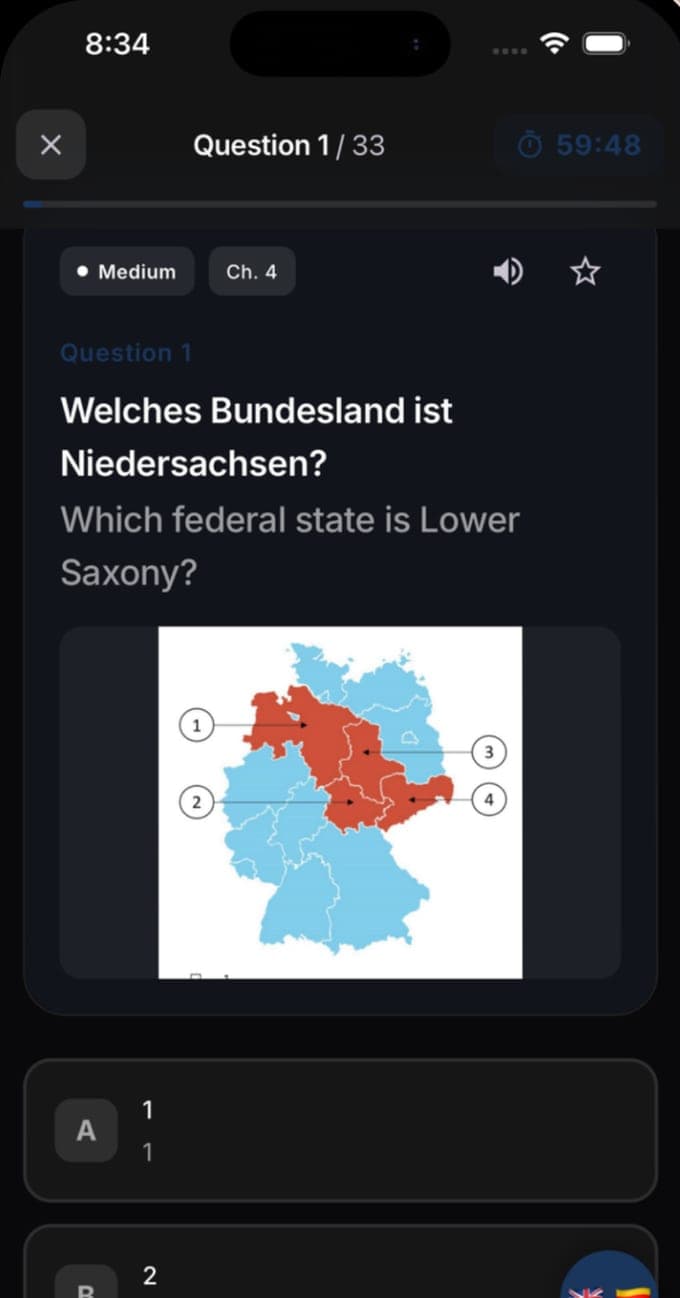
Understanding first, vocabulary second, recognition third. Read the catalogue in the language you read best, so that the ideas land: what the Bundesrat does, why 1949 and 1990 matter, what the Grundgesetz guarantees. Then read the same questions in German, matching terms to ideas. Finally practise in German only, because the Testheft will be. The app shows every question, option and explanation in German and, a tap away, in English, Turkish, Arabic, Polish, Ukrainian, Romanian, Italian, Russian or Persian, with the German read aloud, and lets you switch the translation off for the final mocks.
Other languages, and BAMF's own material
BAMF publishes the Gesamtfragenkatalog and the Online-Testcenter in German only; there is no official translation into English or any other language. Translations of the questions, the app's included, are study aids built on the public German text. That is a reason to treat them as a bridge rather than a destination: the wording that counts is BAMF's, and it is the wording you will meet on the day.
Exemptions and adaptations
There is no language accommodation for the test, but the requirement itself can be waived: § 10 Abs. 6 exempts people who cannot meet the language or knowledge requirements because of a physical, mental or psychological illness, a disability or their age, and the naturalisation office decides on medical evidence. For everyone else the path is the same: B1 German for the application, and the German wording of 310 questions for the test.
Einbürgerungstest bestehen is an independent study aid and is not affiliated with the Federal Office for Migration and Refugees (BAMF) or any other German authority. The test questions are BAMF's published Gesamtfragenkatalog, which anyone may practise free at BAMF's Online-Testcenter; the app's lessons, explanations and translations are its own.
Questions people also ask
Is there an official English translation of the Einbürgerungstest questions?
No. BAMF publishes the Gesamtfragenkatalog in German only, as a PDF and in its Online-Testcenter. Translations, including the app's, are study aids; the Testheft you sit is German.
What level of German do I need for the Einbürgerungstest?
The test sets no level of its own, but naturalisation requires B1 and the questions are written in plain German at about that level, with public wording. If you can read at B1, the language is not the obstacle; the 310 questions are.