How to prepare for the German citizenship test
Vishwen Labs

Prepare for the Einbürgerungstest by working through the questions you can be asked, all of which are public: the 300 general questions and the 10 for your Bundesland, 310 in total. Understand each in your language, then learn to recognise it in German, because the Testheft is German only and the wording does not change. Then run 33-question mocks in the official format until 17 correct is routine and 30 is normal. Most people need a few weeks of short sessions; the pass mark is 51.5 percent and the questions are known, so the test is mostly a matter of doing the work.
A plan for the Einbürgerungstest
- Check whether you need the test at all. A German school-leaving certificate or a German degree replaces it, and so does a Leben in Deutschland certificate with 17 or more correct. Children under 16 do not sit it. If none of that applies, you do.
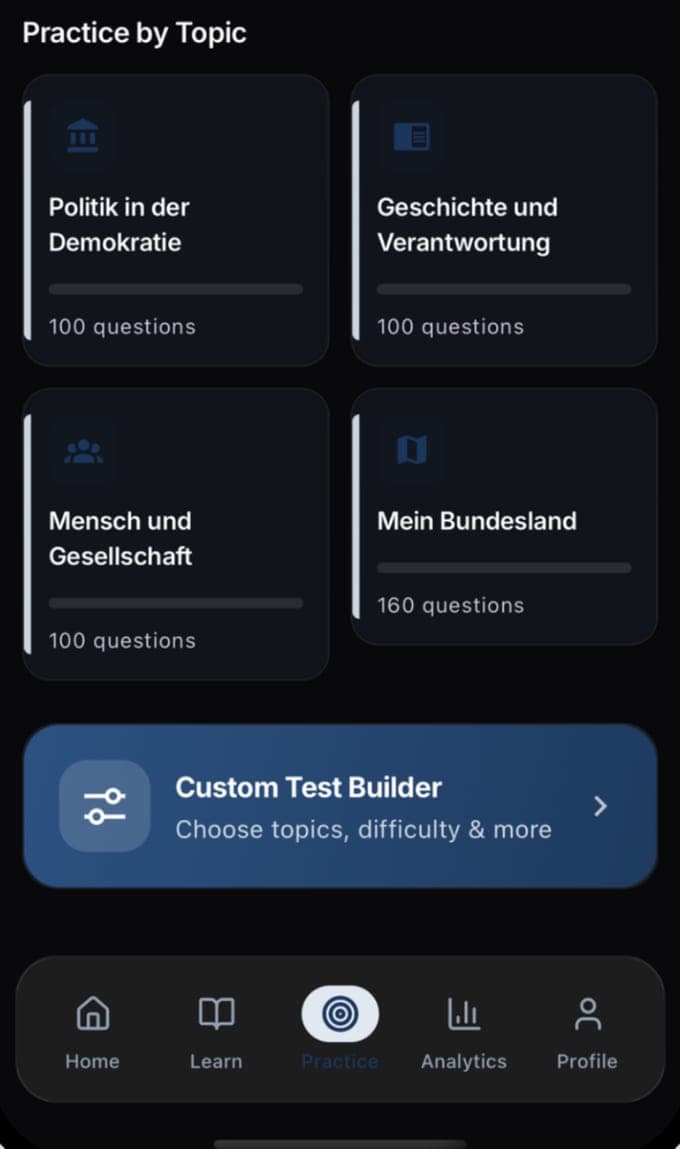
- Set your Bundesland. Three of your 33 questions come from the ten for the Land where you have your Erstwohnsitz. Pick it first, in the app or on BAMF's Online-Testcenter, so that you practise the right ten.
- Read all 310 questions once, in your language. The catalogue is the syllabus and it is short. Read every question with its correct answer and explanation in a language you read fast, so that the facts land before the German does.
- Learn the German wording. Go through the same 310 in German with read-aloud. The terms repeat: Grundgesetz, Bundestag, Bundesrat, Bundeskanzler, Wahlrecht, Gewaltenteilung, Sozialstaat, Meinungsfreiheit. Knowing them as words is most of the language work.
- Drill by chapter and clear the review list. Practise each of the three general areas and your Land's ten until the review list of misses is empty. Every question has an explanation; read the explanation of the ones you got wrong, rather than the answer alone.
- Run mocks in German, under the clock. 33 questions, 60 minutes, German only. Three in a row well above 17, ideally near 30, with no chapter left weak, is the signal that you are ready.
- Book the Prüfstelle and keep practising until the date. Register at a Volkshochschule or other BAMF Prüfstelle several weeks ahead, bring your ID and the 25 euro fee, and keep a mock a day going so the wording stays fresh.
Why the catalogue is the whole syllabus
Germany's test is unusual in publishing every question it can ask. BAMF's Gesamtfragenkatalog holds the 300 general and 160 Bundesland questions with their four options, and the Online-Testcenter lets you practise them interactively and fill in a Musterfragebogen, a sample Testheft. The 33 questions you sit are drawn from that pool unchanged. So preparation is not about guessing what a citizenship test might ask; it is about knowing 310 specific questions well enough to recognise them in German under a 60-minute clock.
Learn it in both languages, deliberately
If English, Turkish, Arabic or another of the app's languages is faster for you, use it first: the point of the first pass is to understand how Germany is governed, what the Grundgesetz protects and what the history questions are about. Then switch. Every question and explanation exists in German and nine other languages a tap apart, and the German is read aloud, so the second pass can be done sentence by sentence, matching the German term to the idea you already hold. By the time you run mocks in German only, the wording should be familiar rather than translated on the fly.
Use the mocks for measurement
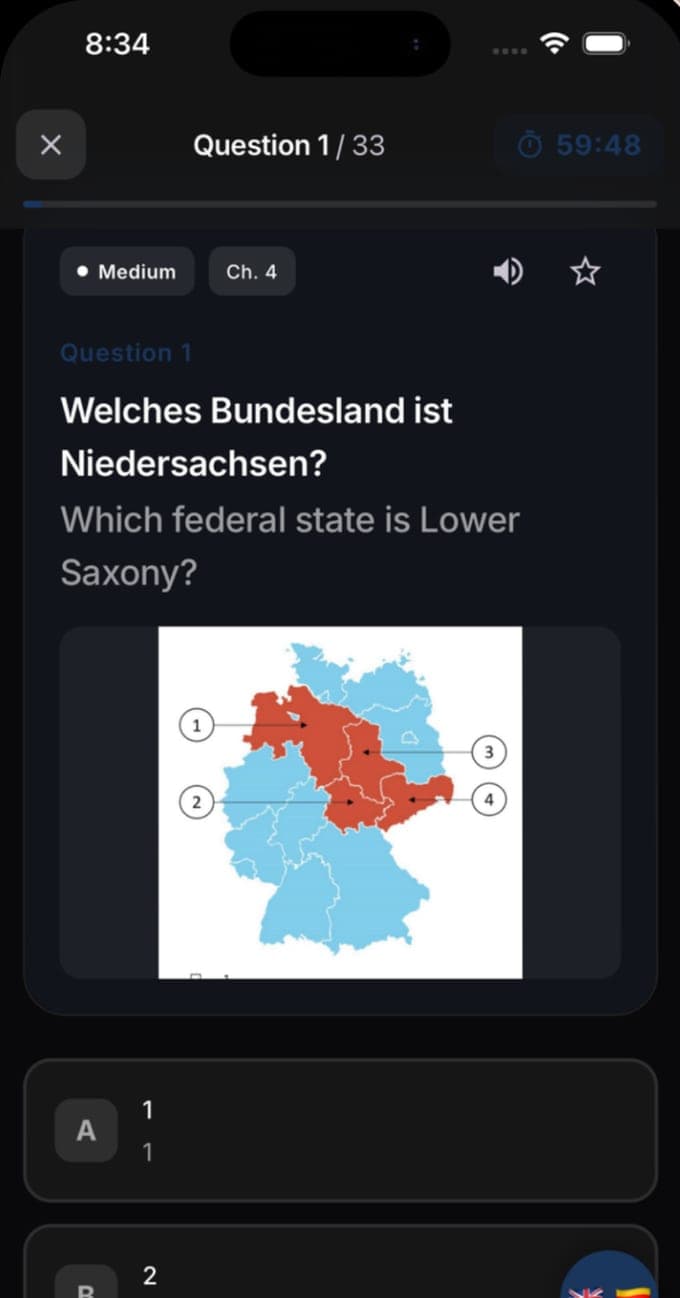
A mock's job is to tell you where you stand. Run it under conditions, in German, with the timer on, and read two things: the number correct against 17, and which chapter the misses came from. The first says whether you would pass today; the second says what to reread. Because the app's format is the official one, 33 questions and 17 to pass on the same 310, a mock result reads directly onto the real test.
The language requirement runs alongside
Passing the test does not prove German, and B1 German does not prove civic knowledge; naturalisation needs both. The test's German is plain and its vocabulary is fixed, so working through the catalogue in German is useful B1 reading practice, but it is not a substitute for the language certificate. If you are still working towards B1, treat the 310 questions as part of that study, and the language guide sets out what the law requires.
Einbürgerungstest bestehen is an independent study aid and is not affiliated with the Federal Office for Migration and Refugees (BAMF) or any other German authority. The test questions are BAMF's published Gesamtfragenkatalog, which anyone may practise free at BAMF's Online-Testcenter; the app's lessons, explanations and translations are its own.
Questions people also ask
How long does it take to prepare for the Einbürgerungstest?
A few weeks of short daily sessions for most people: 310 questions, many of them easy, learned in your language and then recognised in German. Someone who already reads German at B1 can be ready in a week or two; someone who does not should treat the wording as vocabulary work and allow longer.
Is the Einbürgerungstest hard?
The pass mark is 17 of 33 and every question is published, so the difficulty is in the German wording rather than the content. Work through the catalogue in German and the test holds no surprises; guess at unfamiliar wording and it does.