The five Life in the UK handbook chapters, explained
Vishwen Labs

The official handbook, Life in the United Kingdom: A Guide for New Residents, 3rd edition, has five chapters: The Values and Principles of the UK; What is the UK?; A Long and Illustrious History; A Modern, Thriving Society; and The UK Government, the Law and Your Role. Test questions can come from any of them, and the history chapter is by far the longest.
Chapter 1: The Values and Principles of the UK
The shortest chapter, and the one most candidates read first. It sets out the values the handbook says British society is founded on, the responsibilities and freedoms that come with living in the UK, and the process of becoming a permanent resident or citizen, including the test you are preparing for. Questions from it tend to be definitions and lists: which of these is a fundamental principle, what does someone applying for citizenship have to do.
Chapter 2: What is the UK?
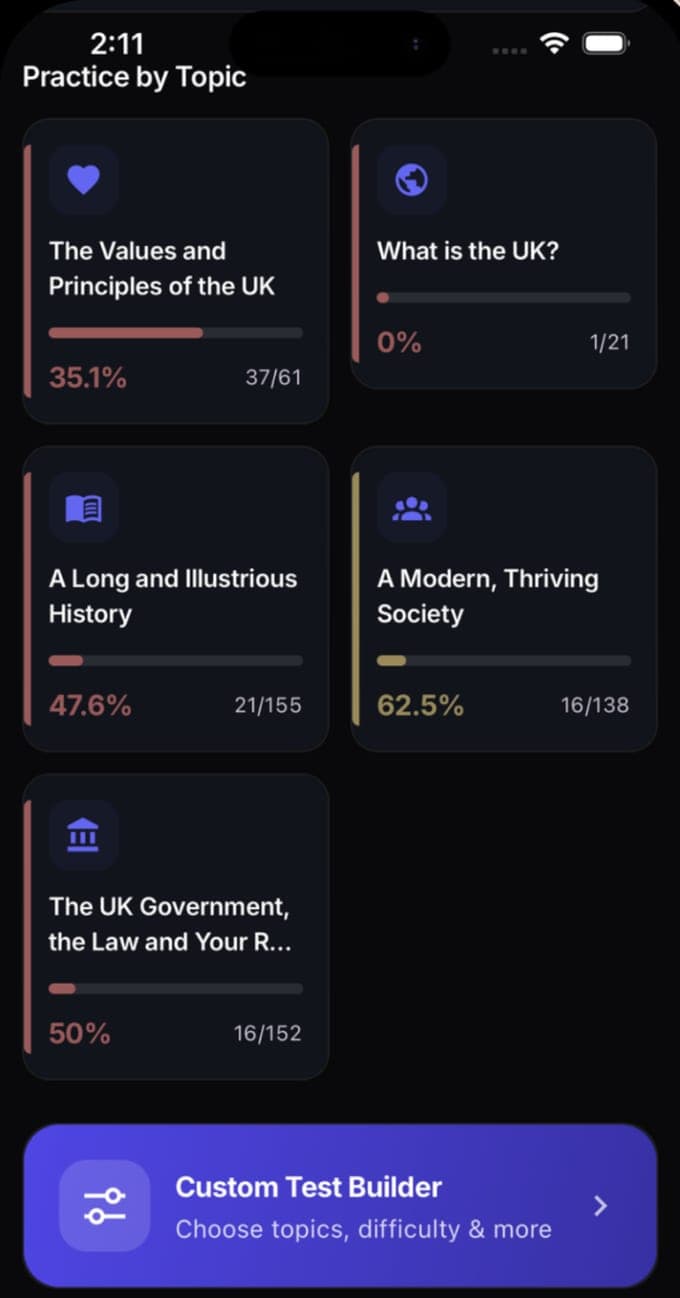
Also short. It explains what the United Kingdom is, which countries make it up, the Crown dependencies and overseas territories, and where things are. The questions are factual and easy to drill, and in the app this chapter has 21 questions, the fewest of the five.
Chapter 3: A Long and Illustrious History
The chapter that decides most results. It runs from Stone Age Britain through the Romans, the Anglo-Saxons and Normans, the Middle Ages, the Tudors and Stuarts, the Union, the industrial revolution, the empire, both world wars, and the post-war decades to the present. It is the longest chapter by a distance, and its questions are the kind that cannot be reasoned out: which century, which king or queen, which came before which.
In the app the history chapter has 155 questions, more than any other and about the share of the whole bank the chapter's length suggests. Its lessons open with Stone Age Britain, lesson 1 of 25.
Chapter 4: A Modern, Thriving Society
Population and religion, customs and festivals, sport, music, theatre, art, architecture, literature, leisure and places of interest. It is a chapter of names: which writer, which sportsperson, which painter, which festival falls when. It is second in length, and in the app it carries 138 questions. People who grew up outside the UK often find it harder than the history, because there is no story to hang the names on.
Chapter 5: The UK Government, the Law and Your Role
How the UK is governed: the constitution, the monarchy, parliament and elections, devolved government, the role of the media and of the UK in the wider world. Then the law: the courts, everyday laws, the police, and the responsibilities that come with living here, including the small claims procedure whose limits the app's example question asks about. It ends with community and how to take part. In the app it has 152 questions, close behind history.
Which edition, and whether it will change
The 3rd edition, published in 2013, is the current handbook and the only source the test questions are written from. The Home Office has said it intends to update the test, and as of September 2026 no new edition or question bank has appeared on GOV.UK. Until one does, the five chapters above are the whole syllabus, and any study material that follows them is following the right thing.
Life in the UK Test is an independent educational app and is not affiliated with, endorsed by, or connected to the UK Home Office or any government body. Its content is based on the official Life in the UK handbook.
Questions people also ask
Which edition of the Life in the UK handbook is current?
The 3rd edition, Life in the United Kingdom: A Guide for New Residents, published in 2013. As of September 2026 it remains the only source for the test's questions; the Home Office has announced an intention to update the test but has not published a new edition or question bank.
Which chapter has the most Life in the UK test questions?
The Home Office does not publish a breakdown. The history chapter is the longest in the handbook by far, and question banks built from the handbook reflect that: in the app it has 155 of the 500-plus questions, with government and law at 152 and modern society at 138.