Life in the UK test questions: what to expect
Vishwen Labs

The Life in the UK test asks 24 multiple-choice questions drawn from the official handbook, in 45 minutes. Most give four options with one right answer; some are true or false, and some ask you to pick two answers. The real questions are not published, so every practice question you meet is somebody's reconstruction from the handbook's facts.
The types of question in the Life in the UK test
Three shapes appear in every account of the test. The most common is a question with four options and one correct answer. The second is a statement to mark true or false. The third asks which two of four options are correct, and both must be chosen for the mark. All 24 are answered on a computer at the centre, and you can move back and forth between them before submitting.
None of the questions asks for a written answer, and none asks you to reason from a scenario the way a professional exam would. They ask what the handbook says.
A worked example from the handbook
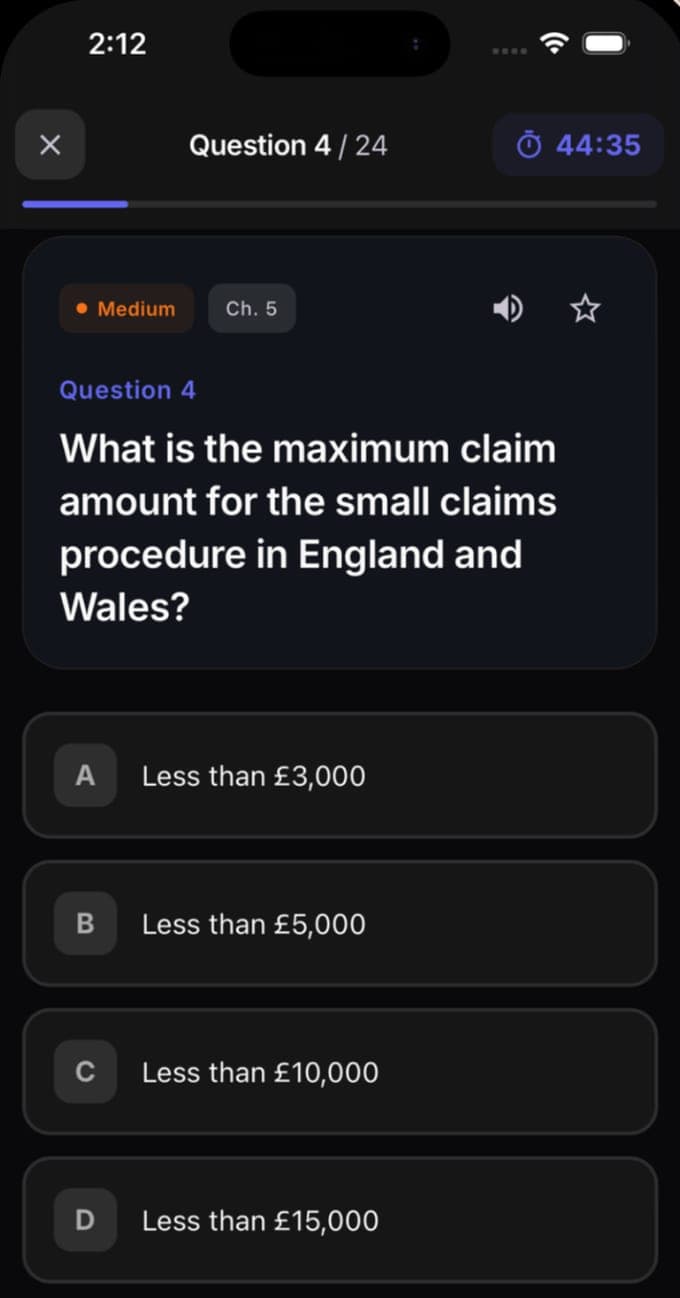
One of the app's questions, shown in its store listing: what is the maximum claim amount for the small claims procedure in England and Wales? The options are less than £3,000, less than £5,000, less than £10,000 and less than £15,000.
The answer is less than £10,000. The handbook's chapter on government and the law describes the small claims procedure as the informal way to settle minor disputes, and gives the limits by nation: £10,000 in England and Wales, £5,000 in Scotland, and £3,000 in Northern Ireland. Two of the wrong options are the right figures for the wrong place, which is exactly how the test tends to build its distractors.
Where Life in the UK test questions come from
From the 3rd edition of the handbook, and only from there. Questions can be drawn from any of its five chapters, and there is no published breakdown of how many come from each, but the chapters are very different sizes. A Long and Illustrious History is the longest by far; in the app's question bank it accounts for 155 of the 500-plus questions, and a mock that leans on it is not unusual.
The facts the test likes to ask about
Figures, dates and names. The year of an event, the order of monarchs, which body does what, the age at which something becomes legal, the number of members in an assembly, the nation-by-nation figures like the one above. Understanding the chapter is the starting point, but the mark comes from the specific.
That is why practising with questions works better than re-reading. A question exposes exactly which figure you did not retain, and a good explanation puts it back in context so it stays. The app's questions each carry one, and every miss goes on a review list.
How to practise Life in the UK test questions
Take them by chapter first, so a weak chapter shows up as a low score rather than as a bad day. Then take mixed 24-question mocks under the clock, because the real test mixes chapters and the clock is part of the format. Read every explanation, including the ones you got right by elimination, and let the review list drive what you study next.
Life in the UK Test is an independent educational app and is not affiliated with, endorsed by, or connected to the UK Home Office or any government body. Its content is based on the official Life in the UK handbook.
Questions people also ask
Are the Life in the UK test questions the same every time?
No. Each test is a set of 24 drawn from a bank that is not published, so two people at the same centre on the same day can see different questions. Practice questions from any source, including the app, are reconstructions from the handbook; the handbook is what stays constant.
Are there trick questions in the Life in the UK test?
Not tricks, but precision. A wrong option is often the right figure for a different nation or a different year, as in the small claims example, so reading all four options and the exact wording of the question matters more than speed. The 45 minutes is ample for that.