How to identify a Pokémon card: the set symbol, the set code and the collector number
Vishwen Labs

Everything you need to identify a Pokémon card is printed along its bottom edge. The collector number, written like 4/102 or 025/198, gives the card's position in its set and the set's advertised size. Beside it sits the set symbol (a small picture on cards from the 1999 Jungle expansion onward) or, on English cards from Scarlet & Violet onward, a three-letter set code. A regulation mark, a single letter, says which tournament format the card is legal in. The copyright line dates the print. Together these separate a Base Set Charizard from every other Charizard, which is the difference between a few dollars and a few thousand.
The collector number
TCGplayer's help centre puts it plainly: “Every Pokémon card has a collector card number. It's usually formatted as XXX/YYY, where XXX is the card's number and YYY is the advertised number of cards in the set.” The advertised size is not always the real size: “Secret Rare cards have a collector number higher than the advertised number of cards in the set,” so a 199/198 is not a misprint but a secret rare. The earliest cards are the exception; the first Base Set had numbers, but some very old promo cards carry none, and those are identified by symbol and text instead.
The set symbol, and the set code
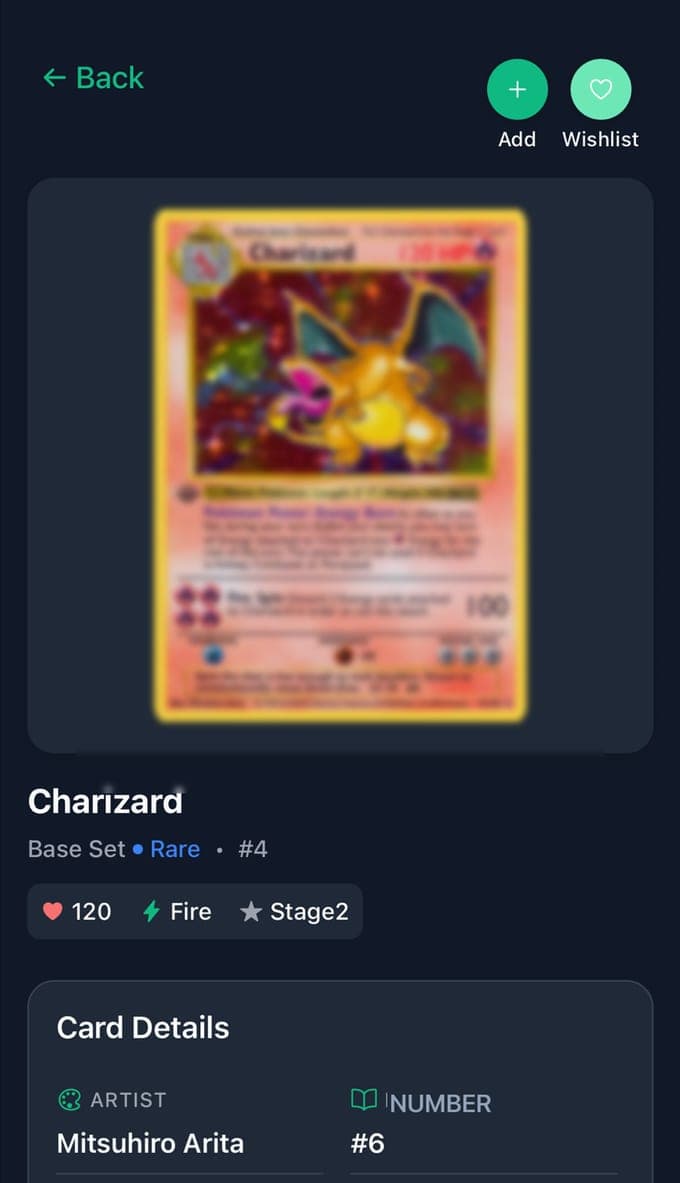
From Jungle in 1999 to the end of Sword & Shield, an English card's set is a small symbol near the number: a rocket, a leaf, a crystal, a gear, one per expansion. Base Set has no symbol at all, which is itself the tell. English cards from Scarlet & Violet onward print a three-letter code in the same place, such as SVI for the base Scarlet & Violet expansion, and the symbol moves to the set's packaging. Set lists on pokemon.com, TCGplayer's set guide and the card database in the app all map symbol and code to the set name, and the app shows the set on the card's page after a scan.
The regulation mark
Since the Sword & Shield era a letter in a small box on the bottom edge marks tournament legality. pokemon.com's 2026 rotation notice sets the current rule: from 26 March 2026 in Pokémon TCG Live and 10 April 2026 at Play! Pokémon events, cards with the G mark left the Standard format and cards with H, I and J marks remain legal. The notice is explicit that “A card's legality status is not based on which expansion it's from”: the mark on the card decides, and an older printing with no mark can still be played if a current printing of the same card carries a legal one, as with Rare Candy from Sun & Moon. The mark has nothing to do with rarity or value; it matters to players, not to pricing.
The copyright line, the artist and the rest
The fine print along the bottom carries the copyright and the year of the print, which distinguishes an original from a later reprint that shares set and number. The illustrator's name is printed near it, and the app shows it under Card Details. Above the number, the rarity symbol (circle, diamond or star) tells you the tier; the rarity guide covers the modern variants. The card's language is obvious, and it matters: TCGplayer lists Japanese Pokémon cards as their own product line, and prices differ.
When two cards share a name
Most names do. Pikachu appears on well over a hundred English prints, and even within one set a card can exist as a regular rare and as a holo or illustration rare under a different number. The app's scan reads the number for this reason, and when a photo is unclear it lists the same-name prints for you to choose from. If the number is worn or hidden, the set symbol, the copyright year and the art narrow it down; the marketplaces' set pages show every card in a set with its image.
TCG Card Scanner is an unofficial, independent app from Vishwen Labs. It is not affiliated with, endorsed by or associated with The Pokémon Company, Nintendo, Creatures Inc. or GAME FREAK. Pokémon and all related names, marks and card artwork are trademarks and copyrights of their owners. Card data and prices come from the public sources named on these pages, and nothing here is advice to buy, sell or grade a card.
Questions people also ask
What does 025/198 mean on a Pokémon card?
Card 25 of a set advertised as 198 cards. Numbers above the advertised size, like 200/198, are secret rares. The set itself is named by the symbol or the three-letter code printed beside the number.
How do I know which set my Pokémon card is from?
Look for the set symbol or the three-letter set code beside the collector number on the bottom edge and match it to a set list. No symbol at all on a 1999-style card means Base Set. A scan in the app returns the set from the name and number.