How much are my Pokémon cards worth, and how do you check?
Vishwen Labs

A Pokémon card is worth what buyers have recently paid for the same print in the same condition, and that number is public. TCGplayer publishes a Market Price compiled from sales on its marketplace; Cardmarket publishes a Trend price and daily, weekly and monthly averages for the European market. To check a card you need three things: which print it is (set and collector number), which variant (holo, reverse holo, 1st Edition), and its condition. Most cards in a shoebox are worth cents; a few are worth the shoebox, and the only way to tell them apart is to identify each one.
What the price is a price of
Marketplace prices are per print, per variant and per condition. TCGplayer says its price points “reflect any selected printings and conditions filters applied to the product page,” so the number for a Near Mint holo is not the number for a Lightly Played non-holo of the same card. Its Market Price “is compiled from recent sales completed on TCGplayer.com,” “updated as transactions complete,” and, in its own words, shows “the value of a collectible based upon actual recent sales.” Listed prices are something else: TCGplayer's Listed Median “can vary significantly from the actual price that people are paying,” especially on older cards with few copies for sale.
Five things that move the number
In rough order of how much they matter:
- Which print. The same name appears on many cards; Base Set, a reprint, a promo and a modern illustration rare are different products with different prices. The set symbol or set code and the collector number identify the print.
- The variant. Holo, reverse holo, non-holo, 1st Edition and shadowless copies of one card are priced separately; TCGplayer's price data keys them apart, and so does the app.
- Condition. Near Mint, Lightly Played, Moderately Played, Heavily Played, Damaged. The gap between Near Mint and Moderately Played can be most of the value on an old card.
- Grading. A card in a PSA, CGC or BGS slab with a high grade sells in a different market from a raw card, and a raw Near Mint card is not priced as a PSA 10.
- Demand, which is why prices move week to week: a Pokémon's popularity, a tournament result, a set going out of print, a reprint. The 1-, 7- and 30-day averages show the direction.
How to check a card in a minute
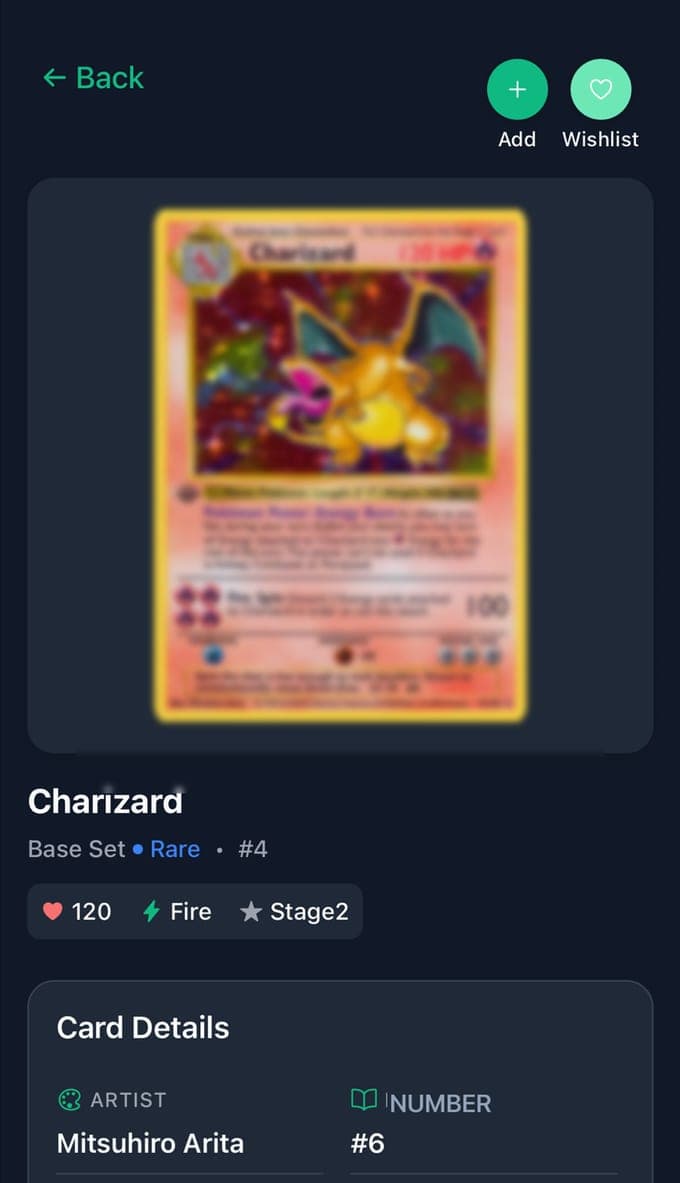
Identify the print from the bottom of the card: the set symbol or three-letter set code and the collector number, written like 4/102 or 025/198. Note the variant: a foil illustration means holo, foil everywhere except the illustration means reverse holo, a 1st Edition stamp is on the left under the illustration on cards from 1999 to 2003. Judge the condition honestly under a bright light, front and back. Then look the print up: TCGplayer for dollars, Cardmarket for euros, and eBay's sold listings for a third opinion on anything expensive. The app does the first step from a photo and shows the two marketplaces on the card's page.
The traps
Asking prices are not values; a card can be listed at $600 for months while copies sell at $350, which is exactly the example TCGplayer uses to explain its Market Price. A low-volume card's Market Price can rest on a handful of sales, so check the 30-day average and the sold listings before believing a spike. Japanese and other-language prints are separate products on both marketplaces, with their own prices; the app matches a foreign-language card to its English print, so treat that price as a pointer rather than the answer. And a price is not money until someone pays it: marketplace fees, shipping and the condition the buyer sees at their end all come off the top.
When a card is worth grading, or selling
Grading pays only when the graded price minus the fee, shipping and a realistic grade beats the raw price, which for most cards it does not; the grading guide runs the arithmetic. Selling is a question of venue: a marketplace for anything with a reliable price, a local shop for bulk, an auction for the genuinely rare. Whatever you do, the value of a collection is the sum of identified cards, not a feeling about a box, and the cataloguing guide is the way to get to the sum.
TCG Card Scanner is an unofficial, independent app from Vishwen Labs. It is not affiliated with, endorsed by or associated with The Pokémon Company, Nintendo, Creatures Inc. or GAME FREAK. Pokémon and all related names, marks and card artwork are trademarks and copyrights of their owners. Card data and prices come from the public sources named on these pages, and nothing here is advice to buy, sell or grade a card.
Questions people also ask
Are old Pokémon cards from 1999 worth money?
Some. Holo rares from Base Set, especially 1st Edition and shadowless copies in good condition, sell for serious sums; most commons and uncommons from the same era are worth very little. The print, the variant and the condition decide it, so identify each card before assuming either way.
Why does TCGplayer show a different price from Cardmarket?
They are different markets in different currencies. TCGplayer's Market Price is compiled from sales on its US marketplace in dollars; Cardmarket's Trend comes from sales in Europe in euros, where supply, shipping and demand differ. The prices guide explains each figure.