TCGplayer Market Price vs Cardmarket Trend price: what each number means
Vishwen Labs

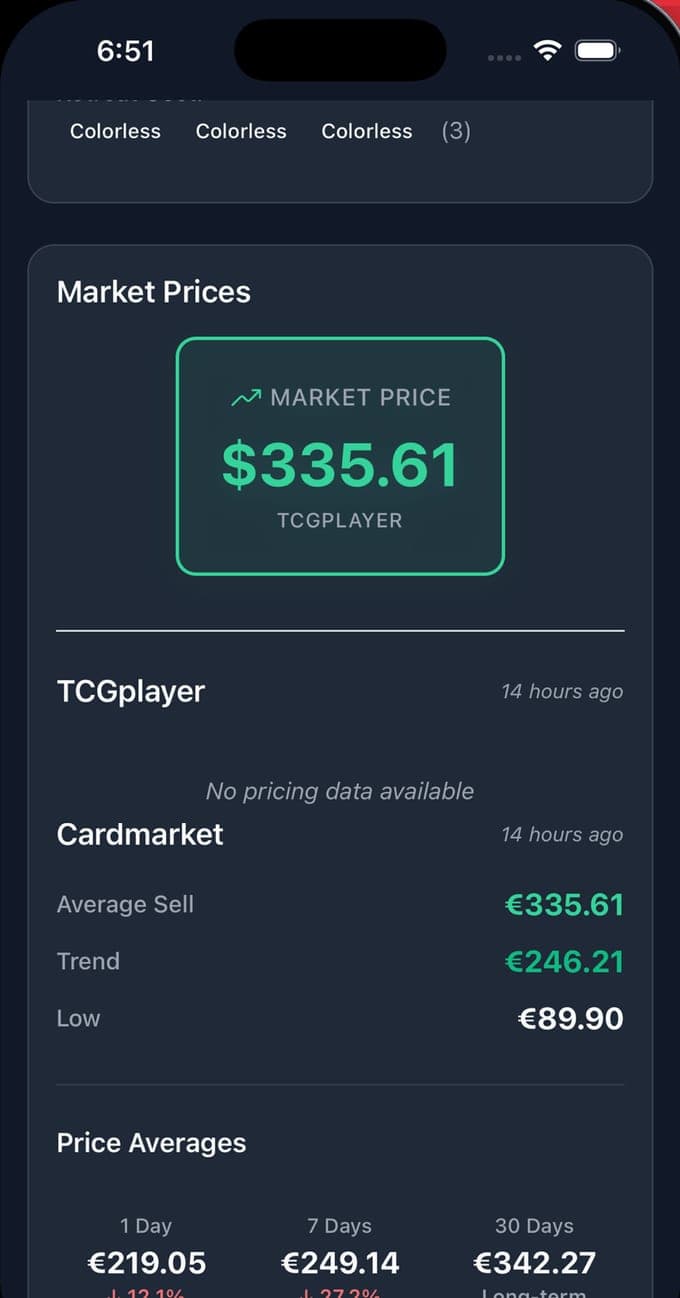
TCGplayer's Market Price “shows you the value of a collectible based upon actual recent sales, drawing from thousands of transactions daily across thousands of individual sellers on our platform,” in dollars, from the US marketplace. Cardmarket's Trend price is its own smoothed figure from recent sales on the European marketplace, in euros, published alongside an Average Sell price, a Low price and averages over the last day, seven days and thirty days. They differ because they are two markets in two currencies with different supply, and both are right about their own market. The app shows them side by side for the print you scanned.
TCGplayer's price points, in its words
Market Price “is compiled from recent sales completed on TCGplayer.com,” “is updated as transactions complete and reflects the best suggested retail price of a product.” It uses sold prices rather than asking prices: “Instead of relying on currently listed prices, Market Price uses the value at which a product has recently been selling as a key data point,” “while ignoring outliers that would affect the traditional LO-MID-HI scale.” Most Recent Sale “reflects the price of the most recently sold product for the filters applied.” Listed Median “is the median from all listed prices for a product based on listed prices only,” and “especially on older products with lower quantities, it can vary significantly from the actual price that people are paying.” TCGplayer's example is a card with a Market Price of $354.66 and a Listed Median of $654.72: the sellers asking $600 are not the price.
Volatility, and per-condition prices
TCGplayer also rates a product's price volatility over 30 days, from low (“stays around the same relative price”) to high (“changes more significantly”) and indeterminate (“did not have enough sales volume within 30 days”), counted per order rather than per copy. And every price point “will reflect any selected printings and conditions filters,” so a Near Mint holo and a Lightly Played non-holo have their own Market Prices. The app carries TCGplayer's low, mid, high and market figures per variant.
Cardmarket's figures
Cardmarket, based in Germany, is where most of Europe buys singles, and its prices are in euros. Its Price Trend is a weighted, smoothed figure from recent completed sales that filters outliers and reacts to swings with a delay; the Average Sell price and the Low price are what they say; and the 1-day, 7-day and 30-day averages are averages of completed sales in those windows, useful for direction: a 7-day average above the 30-day average is a card on its way up. Reverse holo copies get their own trend, sell and low figures, which is why a card's page in the app can show two sets of Cardmarket numbers.
Why they differ, and which to use
Different buyers, different shipping costs, different supply: a card printed heavily in one region is cheaper there. Currency moves add noise. Neither is more true; TCGplayer's Market Price is what a US buyer pays and Cardmarket's Trend is what a European buyer pays. Use the one for the market you will sell or buy in, and glance at the other as a sanity check. For a rare card with few sales, read the 30-day average and the sold listings rather than a single Market Price, and remember that a listed price is an ambition.
How fresh the numbers are
The app takes its card data and prices from a public Pokémon TCG data service that refreshes marketplace prices about once a day, and each price row shows how long ago it was read: “14 hours ago” on the card page in the screenshots. Prices for cards you own are kept as a history, so the app can chart a card and alert you when it crosses a threshold you set. For a decision worth real money, open the marketplace itself and look at the sold listings; the app's numbers are the map, not the sale.
TCG Card Scanner is an unofficial, independent app from Vishwen Labs. It is not affiliated with, endorsed by or associated with The Pokémon Company, Nintendo, Creatures Inc. or GAME FREAK. Pokémon and all related names, marks and card artwork are trademarks and copyrights of their owners. Card data and prices come from the public sources named on these pages, and nothing here is advice to buy, sell or grade a card.
Questions people also ask
Is TCGplayer Market Price the same as what a card sells for?
It is compiled from recent completed sales on TCGplayer, per printing and condition, ignoring outliers, so it is close to what copies have been selling for there. Your own sale nets less after fees and shipping, and a low-volume card's Market Price can rest on a few sales.
What is Cardmarket's Price Trend?
Cardmarket's smoothed price for a card from recent completed sales on its European marketplace, in euros, designed to filter outliers and lag sudden swings. It is published with an Average Sell price, a Low price and 1-, 7- and 30-day sale averages.