How many calories do pushups burn?
Vishwen Labs

A pushup burns roughly half a calorie, so twenty pushups are about ten calories and a hundred somewhere between fifty and sixty-five depending on how fast they are done. Every figure like that is an estimate: it depends on bodyweight, on the pace, on how deep the reps are and on how long the rest between sets is, and no phone app can measure any of it directly. Push Up Counter uses half a calorie a rep, adds 15 percent when you average more than 15 reps a minute and 30 percent above 20, rounds the result, and writes it to Apple Health as active energy. The number is honest about being rough; treat it as a way to compare your own sessions rather than as a fact about your body.
The estimate the app makes
The formula is short enough to write out:
- Base: 0.5 calories per rep.
- Pace: multiplied by 1.15 when the workout averaged more than 15 reps a minute, by 1.3 above 20 a minute, including rest time.
- So 30 reps in 3 minutes (10 a minute) is 15 calories; 30 reps in 90 seconds (20 a minute) is 17; 60 reps in 2 minutes (30 a minute) is 39.
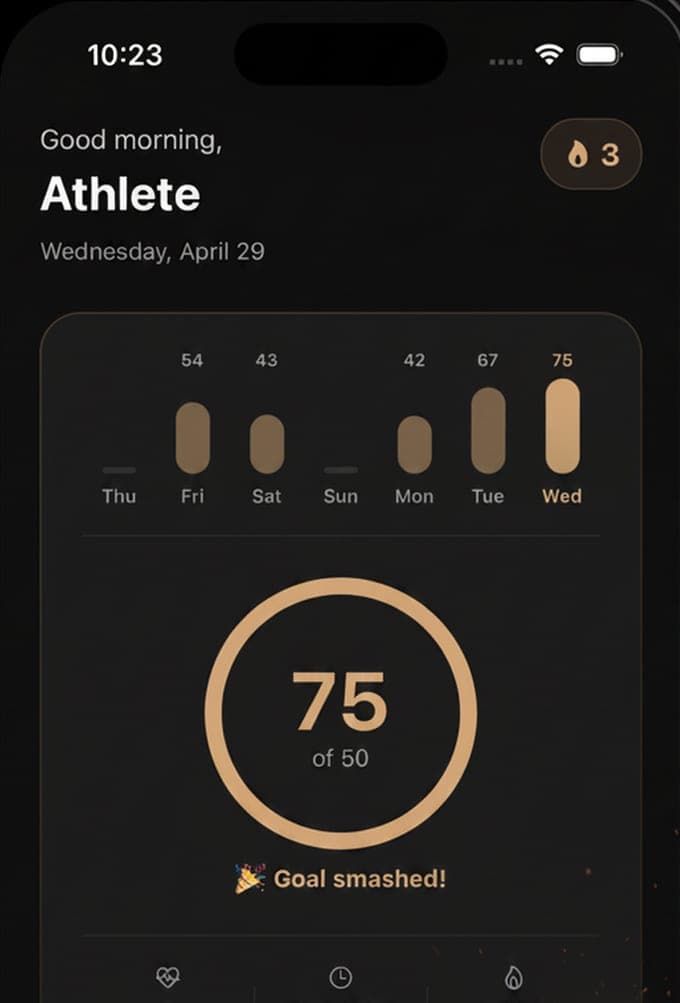
- The results screen shows the rounded figure, and the same figure is written to Apple Health as active energy for the workout's start and end time.
Why the real number varies so much
Lifting a body costs energy in proportion to the body, so a 90-kilogram person burns more per rep than a 60-kilogram one, and the app does not know your weight. Depth matters, since a full-range rep moves the body further than a half rep. Pace matters twice, because faster reps cost more per minute and because the recovery after a hard set keeps burning for a while. General exercise tables put moderate calisthenics at a few calories a minute for an average adult, and a minute of continuous pushups is at the high end of that, but a session of three sets with rests between spends most of its minutes resting. Half a calorie a rep, nudged up for pace, sits inside that range without pretending to precision it cannot have.
What pushups are good for, and what they are not
Pushups are a strength exercise that happens to burn a little energy, not a way to burn a lot of it. A hundred a day is around 50 to 65 calories, the size of an apple; the value is in the pressing strength, the core work and the habit, and in what a stronger body does to the rest of your day. If the goal is energy, the same twenty minutes of brisk walking, cycling or rowing burns several times more. If the goal is a chest and arms that work and a number that goes up every month, pushups are the right tool, and the calorie figure is a footnote.
What goes to Apple Health
With Health access allowed, each finished workout writes one active-energy entry, the estimated calories over the workout's start and end time, and the app reads back today's active energy to show it. It does not write a workout record, whatever the store listing says, so the session appears in the Health app under Active Energy rather than under Workouts, and it will not show up in a fitness ring as a strength workout. If that record matters to you, log the session in the Fitness app as well; the calorie entry from Push Up Counter will still count toward the energy figure.
Using the number well
Compare like with like. The estimate is consistent, so a session of 60 reps at 20 a minute will always read higher than 60 reps at 10 a minute, and the weekly calories on the Progress tab move with your volume and your pace. That makes it a fair way to see whether a week was bigger than the last one. It is not a fair way to decide what to eat, and the app does not pretend otherwise: the figure is shown with a tilde on the screens for a reason.
Questions people also ask
How many calories do 100 pushups burn?
About 50 by the app's base rate, up to about 65 if they are done fast enough to average more than 20 a minute including rests. A heavier person burns more, a lighter one less; the figure is an estimate.
Do pushups burn belly fat?
Not specifically. No exercise burns fat from one place, and pushups burn too little energy to move bodyweight much on their own. They build the chest, shoulders, arms and core; a calorie deficit from food and larger movements does the rest.