The English test for US citizenship: what the speaking, reading and writing parts ask
Vishwen Labs

The English test for naturalization has three parts, and none of them is graded on a scale. Speaking: “An officer determines an alien's ability to speak and understand English based on the alien's ability to respond to questions normally asked in the course of the naturalization examination.” Reading: “You must read aloud one out of three sentences correctly.” Writing: “You must write one out of three sentences correctly.” The sentences are built from vocabulary lists USCIS publishes, so the words can be learned before the day.
Speaking: the interview is the test
There is no separate speaking exam. The officer forms a view from the review of your N-400: whether you understand the questions about your address, your trips, your job and the eligibility items, and whether you can answer them. Short, clear answers are fine, and so is asking for a question to be repeated or said another way. What the officer is listening for is understanding, not accent. Someone who can hold this conversation will not fail the speaking part; someone who answers questions they did not understand may.
Reading: one sentence out of three
The officer shows you a sentence and you read it aloud. If you read it in a way that shows you understood it, the reading test is over; if not, you get a second sentence, then a third. USCIS's reading vocabulary is short and public: names (Abraham Lincoln, George Washington), civics words (American flag, Bill of Rights, capital, citizen, city, Congress, country, Father of Our Country, government, President, right, Senators, state, White House), places (America, United States, U.S.), holidays (Presidents' Day, Memorial Day, Flag Day, Independence Day, Labor Day, Columbus Day, Thanksgiving), question words (how, what, when, where, who, why), a few verbs and function words, and content words like colors, dollar bill, first, largest, most, north, south, one and people. A sentence such as “Who was the first President?” or “What is the capital of the United States?” is typical.
Writing: one sentence out of three
The officer says a sentence and you write it down. As with reading, one correct sentence out of three passes. The writing vocabulary overlaps with the reading list and adds names (Adams, Lincoln, Washington), places (Alaska, California, Canada, Delaware, Mexico, New York City, Washington, D.C.), months (February, May, June, July, September, October, November), the holidays, verbs like elect, vote, pay, live, meet and want, and words like taxes, free, freedom of speech, Civil War, American Indians, blue, red and white. In practice the officer is checking that the meaning is on the page; a spelling slip or a missing capital letter in an otherwise correct sentence is generally not counted against you, while a sentence that says something different is.
Who does not take the English test
Applicants who were 50 or older with 20 years as a permanent resident at filing, or 55 with 15 years, are excused from all three parts and take the civics test in their own language through an interpreter. At 65 with 20 years the civics test also shrinks to 10 of 20 marked questions. A physical, developmental or mental condition that prevents learning English can be certified on Form N-648 by a licensed doctor or clinical psychologist. The exceptions guide sets each of these out.
How the app drills it
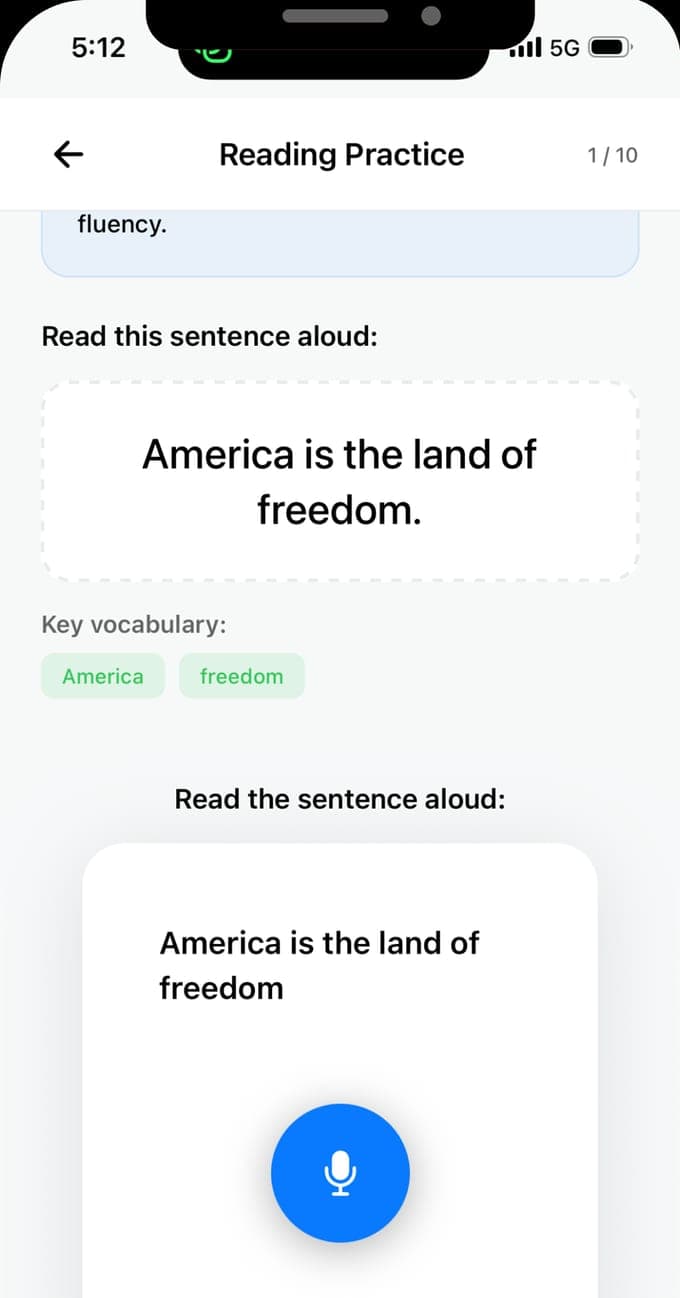
Reading Practice shows a sentence built from the official vocabulary, marks the key words, and listens while you read it aloud; the transcript shows what it heard, so you can hear your own slips. Writing Practice dictates a sentence and checks what you type against it. Both are five free sessions, then Premium. The vocabulary itself is small enough to learn in a week of short sessions, which is the point: the English test is the part of the interview most within your control.
USCIS Interview Practice (US Citizenship Test 2026 App, called Citizen Pro inside) is an independent study aid from Vishwen Labs and is not affiliated with U.S. Citizenship and Immigration Services or any U.S. government agency. The civics questions, the reading and writing vocabulary and the test rules are USCIS's published study materials, free at uscis.gov/citizenship; the interview practice, hints, cultural context and translations are the app's own. Nothing on these pages is legal advice.
Questions people also ask
How many sentences do you have to read and write for US citizenship?
One of each. USCIS gives you up to three sentences to read aloud and up to three to write; reading one correctly passes the reading test and writing one correctly passes the writing test.
What if I make a spelling mistake on the writing test?
One correct sentence out of three is what counts, and a minor spelling, capitalisation or punctuation error in a sentence whose meaning is clear is generally accepted. A sentence that changes the meaning, or leaves out the content words, is not, and you move to the next sentence.