How to practice for the US citizenship interview
Vishwen Labs

Practice for the citizenship interview by learning the questions you can be asked, all of which USCIS publishes, and then by answering them out loud, because the civics test is oral and the speaking test is the interview itself. The 2025 test draws 20 questions from a list of 128 and needs 12 right; the English test needs one sentence read and one written out of three each. Learn the list by topic, drill the vocabulary, rehearse spoken answers until they come without a pause, look up the current officials for your address, and reread your N-400, since the officer will go through it with you. A few weeks of short daily sessions is enough for most people.
A plan for the citizenship interview
- Confirm which test you take. Filed on or after 20 October 2025: the 2025 test, 20 of 128, 12 to pass. Filed before: the 2008 test, 10 of 100, 6 to pass. The Received Date on your I-797C receipt decides. Set the same version in the app so you drill the right list.
- Learn the 128 questions by topic. Work through American Government, American History, and Symbols and Holidays in that order, with the flashcards. Read the hint, try the answer, then read the acceptable answers and the context note. Learn to give an answer, not to recognise one; the officer offers no options.
- Play the questions when your hands are busy. Listen Mode reads questions and answers aloud, five to a whole topic at a time, at 0.8x if the English is fast. Hearing the question in the officer's phrasing is half the work, since you must understand it before you can answer it.
- Drill the reading and writing sentences. Read a sentence aloud a day into the microphone and write one from dictation. The vocabulary lists are public and small; a week of five-minute sessions covers them.
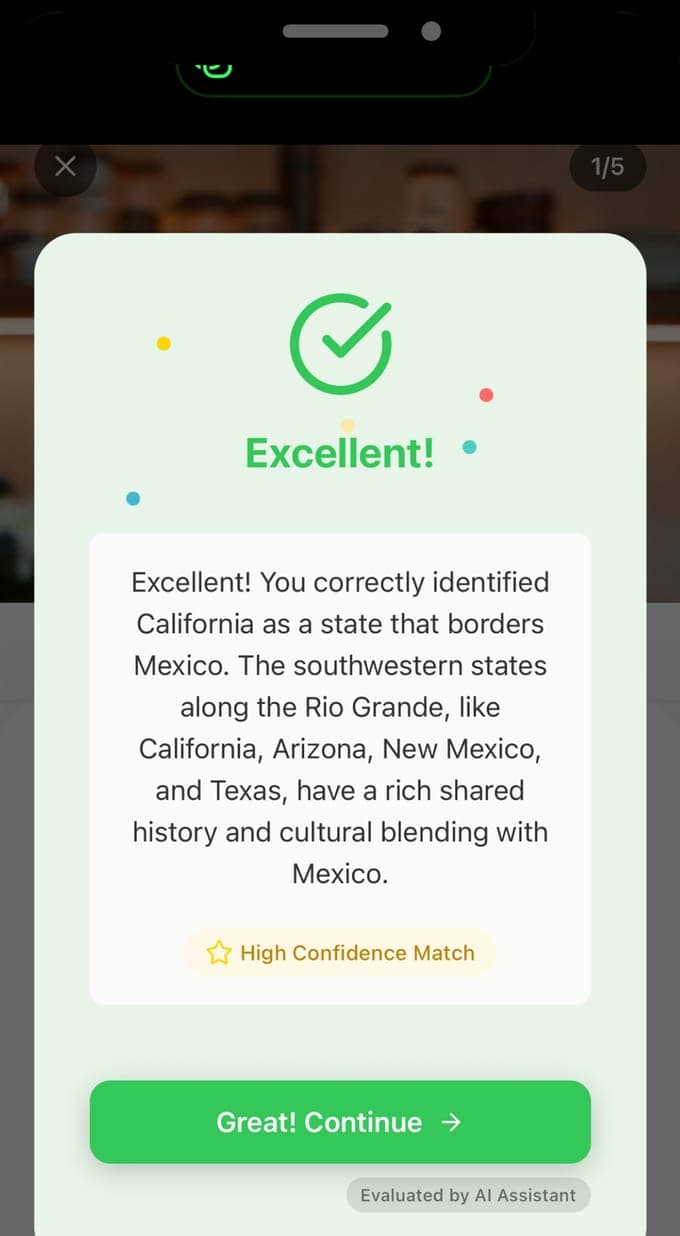
- Answer out loud, to an interviewer. Run the voice interview: 5, 10, 15 or 20 questions, asked on video, answered into the microphone, graded against the acceptable answers with feedback. Keep answers short and complete. Repeat until 12 correct out of 20 is routine and 18 is normal.
- Fix the answers that depend on your address. Enter your ZIP code so the questions about your senators, your representative and your governor carry the current names, and check USCIS's test-updates page for the President, Vice President, Speaker and Chief Justice in the week of the interview.
- Reread your N-400 and gather the documents. The officer reviews every answer on the form under oath. Note anything that changed since filing: address, trips, job, marriage, arrests. Bring the appointment notice, your green card, every passport and what the notice lists.
Why the published list is the whole civics syllabus
USCIS prints all 128 questions with the answers it accepts, in a PDF and on its study pages, and the officer asks questions from that list. So the civics test is not about American history in general; it is about 128 specific questions and their listed answers. That is why preparation is a matter of hours spread over weeks rather than a course. The same is true of the 2008 list of 100 for earlier filers. What the list does not give you is the current officials, which change, and the English, which is tested on you rather than on the list.
Learn to answer, not to recognise
Most practice apps, this one included, offer quizzes with options, and they are useful for a first pass. The interview has no options. The officer reads the question and waits. The habit to build is recall out loud: cover the answer, say it, then check. Flashcards with a hint are the middle step, and the voice interview is the final one, because it grades what you actually said rather than what you would have picked. Any acceptable answer counts, so learn one good answer per question rather than all of them, except where the question asks for two or three.
The English part is small, and fatal if skipped
One sentence read, one written. People who fail the interview on English usually fail the writing sentence, and usually because they never practised writing from dictation. The vocabulary is a few dozen words for reading and about a hundred for writing, published by USCIS, and the sentences are short and civic: who the first President was, where the capital is, when Independence Day is. Five minutes a day with the microphone and the keyboard is enough, and the speaking part takes care of itself if you can talk through your own N-400.
Rehearse the whole interview, test included
The officer will ask, in English, the questions on your form: where you have lived, when you travelled and for how long, where you work, whether you have paid taxes, whether you have been arrested, whether you are willing to take the oath. Read your N-400 aloud to yourself and answer each question as the officer would put it. If a date or an address has changed, write the correction down and bring it. The interview is far calmer when nothing on the form surprises you.
The week before
Check the current officials once more, run a full 20-question voice interview and a reading and a writing sentence each day, and stop cramming the night before. Lay out the appointment notice, the green card, the passports and the documents the notice asks for. Plan to arrive early. The test is public, the pass mark is 60 percent, and by this point the only unknown is which 20 of the 128 you will hear.
USCIS Interview Practice (US Citizenship Test 2026 App, called Citizen Pro inside) is an independent study aid from Vishwen Labs and is not affiliated with U.S. Citizenship and Immigration Services or any U.S. government agency. The civics questions, the reading and writing vocabulary and the test rules are USCIS's published study materials, free at uscis.gov/citizenship; the interview practice, hints, cultural context and translations are the app's own. Nothing on these pages is legal advice.
Questions people also ask
How long does it take to prepare for the citizenship test?
For most people a few weeks of short daily sessions: the civics list is 128 questions with published answers, and the English vocabulary is small. Longer if English is new, since the speaking test is the interview itself. Interviews are usually scheduled months after filing, so there is time.
Do I have to answer the civics questions in full sentences?
No. The officer is listening for an acceptable answer, and a short one counts: “the Constitution”, “Thomas Jefferson”, “July 4, 1776”. A full sentence does no harm and helps the speaking assessment, but the content is what is graded.