How many questions are in the Canadian citizenship test?
Vishwen Labs

The Canadian citizenship test has 20 questions, a mix of multiple choice and true or false, and you have 45 minutes to answer them online. Fifteen correct answers, 75%, is a pass. Every question is based on Discover Canada: The Rights and Responsibilities of Citizenship, the guide IRCC publishes free and calls the only official one.
Twenty questions, 45 minutes, two formats
The count has been 20 for years, and IRCC states it wherever it describes marking: 20 questions, 15 needed. The two formats are multiple choice, usually with four options, and true or false. There is no essay and no oral component in the standard online sitting, and there is no penalty for a wrong answer beyond the mark itself, so no question should be left blank.
Forty-five minutes is the online timer, printed on IRCC's page for the online test: citizenship tests are 45 minutes long, once the timer starts you cannot stop it, and at the end the test submits itself. Older guides and many practice sites still say 30 minutes, which was the in-person figure; the online sitting gives you more time than that. It works out at more than two minutes a question, and most people use well under half of it.
What the questions are about
IRCC's eligibility page lists the subject matter in one line: the rights and responsibilities of Canadian citizens, and Canada's history, geography, economy, government, laws and symbols. Those map onto the ten chapters of Discover Canada: Rights and Responsibilities of Citizenship, Who We Are, Canada's History, Modern Canada, How Canadians Govern Themselves, Federal Elections, The Justice System, Canadian Symbols, Canada's Economy and Canada's Regions. The guide says all the citizenship test questions are based on the subject areas noted in the Citizenship Regulations, and all required information is provided in this study guide.
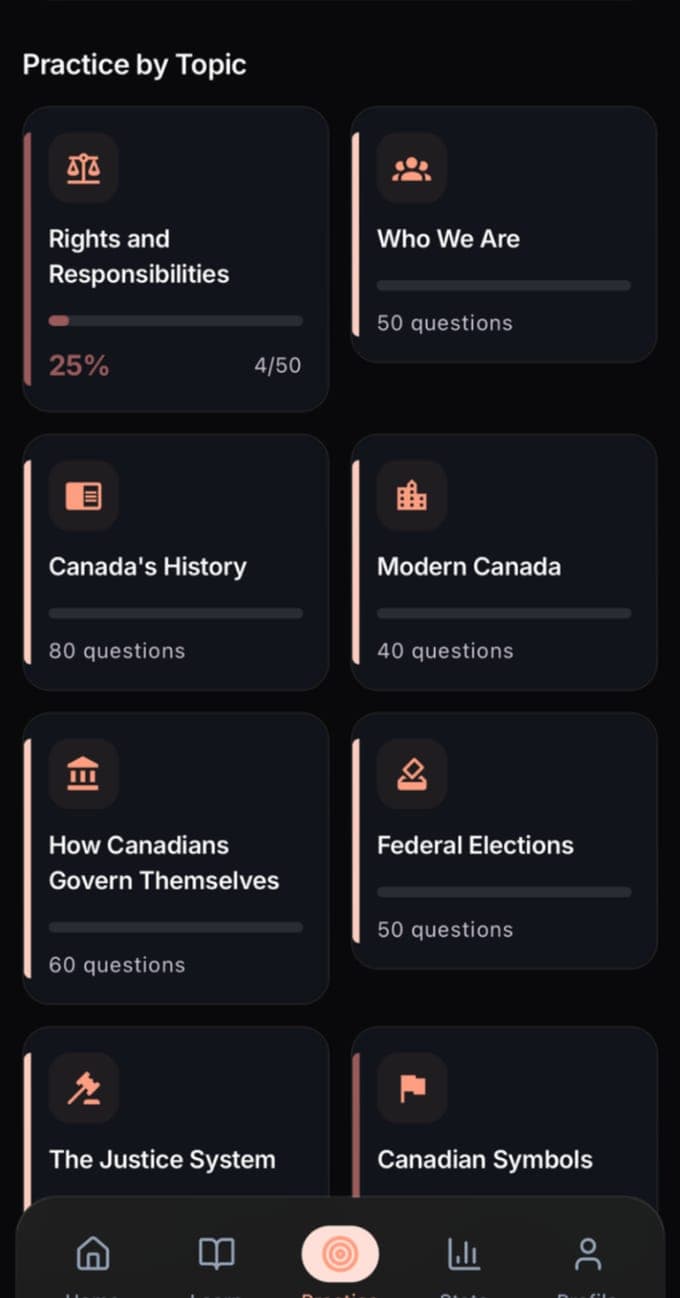
IRCC does not publish how the 20 are split between chapters. Applicants and preparation sites consistently report that history and government carry the most questions, and the guide's own weighting agrees: history is its longest chapter, and government, elections and justice together are three more. The app's question bank leans the same way, with 80 questions on history and 60 on how Canadians govern themselves against 40 on symbols or the economy.
A worked example
Here is a question from the app's first chapter, as it appears in the store listing. What is one way Canadian citizens can influence government between elections? A, only through voting. B, only by joining a political party. C, citizens cannot influence government between elections. D, by contacting elected representatives and participating in public discussions.
The answer is D. Discover Canada treats taking part between elections as ordinary civic life: helping others in the community is one of the responsibilities of citizenship it lists, and knowing who your member of Parliament is one of its own 31 study questions. Options A and B are the classic wrong pattern on this test, a true thing made false by the word only. Option C contradicts the whole chapter. Real questions are written in this register, plain statements about the guide's content with one distractor that overstates and one that denies.
Where the questions come from, and why the app's are different
IRCC does not publish the live question bank. CIC News reported in March 2026 that tests are generated from a bank of roughly 300 to 400 questions, weighted so that each sitting is of similar difficulty; that is a report rather than an IRCC statement. What IRCC does publish is 31 study questions at the back of Discover Canada, described as similar to the questions that are found on the citizenship test: name four fundamental freedoms, what does Confederation mean, who is entitled to vote in Canadian federal elections, what is the capital of your province or territory.
The app's 510 questions are written from the same ten chapters, each tagged with its chapter and difficulty and each followed by an explanation. They are practice for the material rather than a copy of the test, and the honest way to use them is with the guide open beside them.
How to use the count
Twenty questions means each one is worth five percentage points, and the pass mark leaves room for five mistakes. Read every option before answering, because the distractors are built from true sentences with one word changed. Answer everything; there is nothing to gain from a blank. And practise against a clock at least a few times, so that the timer on the day is familiar rather than alarming.
Canadian Citizenship is an independent educational app and is not affiliated with, endorsed by, or connected to Immigration, Refugees and Citizenship Canada (IRCC) or any government body. Its content is based on Discover Canada: The Rights and Responsibilities of Citizenship, which IRCC publishes free and calls the only official study guide for the test.
Questions people also ask
Are the Canadian citizenship test questions the same for everyone?
No. IRCC assembles each sitting from a bank, so two applicants on the same day see different sets, and your three attempts within the window are different tests. The subject matter is the same for everyone: the ten chapters of Discover Canada.
Are there true or false questions on the Canadian citizenship test?
Yes. The test mixes multiple choice with true or false, and IRCC's own study questions include statements of that kind, such as whether you are obliged to tell other people how you voted. Read the whole statement before deciding; one changed word is what makes a true-sounding sentence false.