What the Canadian citizenship test questions look like, with worked examples
Vishwen Labs

Canadian citizenship test questions are short multiple-choice or true-or-false items about the content of Discover Canada: a date, a name, a definition, a right, a responsibility, a place. IRCC publishes 31 study questions at the back of the guide and says they are similar to the questions found on the test. Below are three worked examples in the same register, each traced back to the chapter it comes from.
What IRCC's own study questions tell you
The 31 study questions in Discover Canada are the closest thing to an official sample. They are open questions rather than multiple choice, but their subjects are the test's subjects: what are three responsibilities of citizenship; what is the meaning of the Remembrance Day poppy; how are Members of Parliament chosen; name four fundamental freedoms; who are the Métis; what does the word Inuit mean; what is meant by responsible government; what does Confederation mean; what are the three branches of government; who is entitled to vote in federal elections; after an election, which party forms the government; what are the three levels of government; name two Canadian symbols; which provinces are the Atlantic provinces; what is the capital of your province or territory.
Two things stand out. Almost every question has a short factual answer that appears word for word in the guide. And several are about you: your member of Parliament, your provincial or territorial capital. The test can ask local questions, and the guide's regions chapter is where the answers live.
Example one: a responsibility, with two overstated distractors
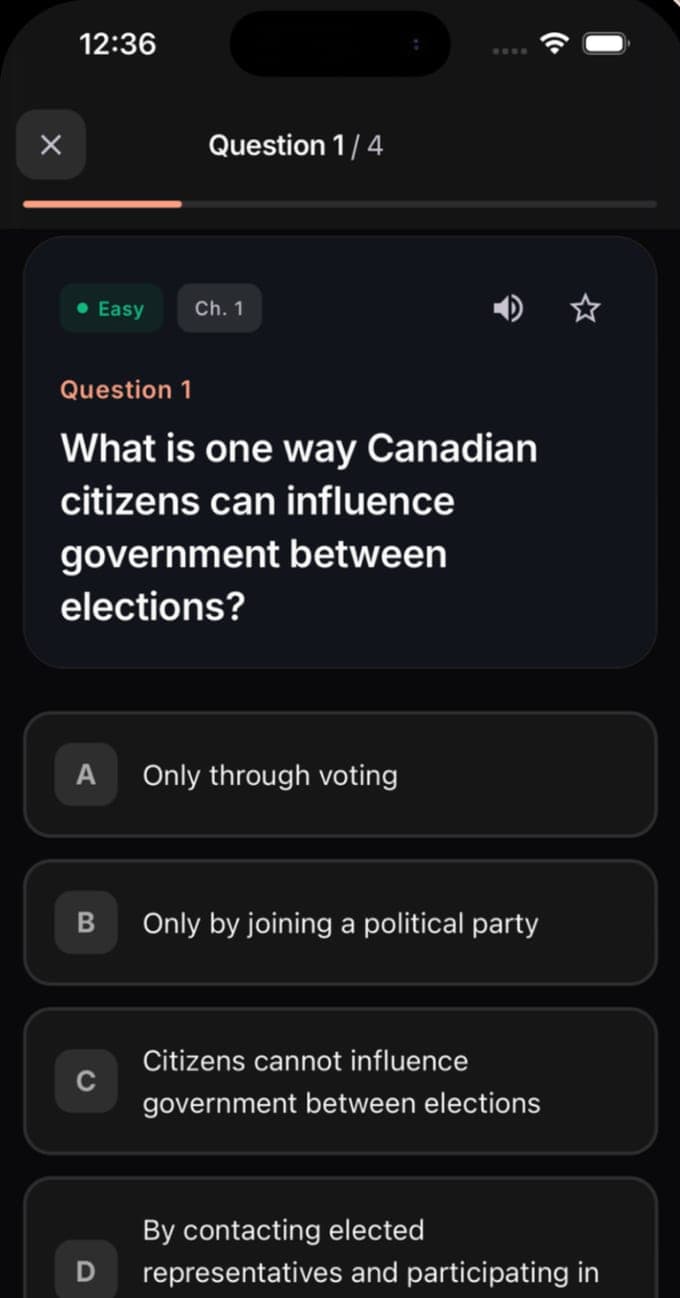
From the app's first chapter. What is one way Canadian citizens can influence government between elections? A, only through voting; B, only by joining a political party; C, citizens cannot influence government between elections; D, by contacting elected representatives and participating in public discussions. The answer is D. Two of the wrong options are true-ish statements ruined by the word only, and one is a flat denial of the chapter's point. That is the standard shape of a distractor on this test.
Example two: a date
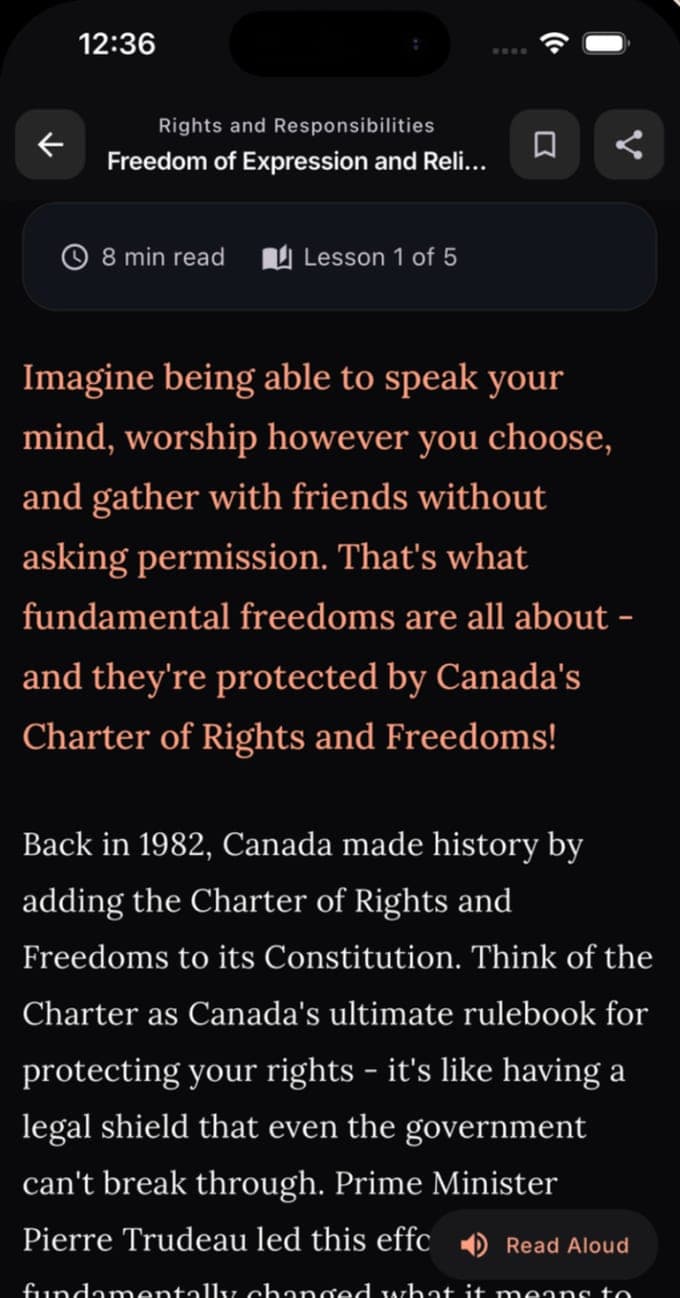
What year did the Canadian Charter of Rights and Freedoms become part of the Constitution? 1982, 1967, 1867 or 1945. The answer is 1982. The wrong options are all real Canadian dates, which is the other standard distractor pattern: 1867 is Confederation, 1967 the centennial, 1945 the end of the Second World War. A question like this rewards having read the guide's account of the Charter rather than a list of dates, because the guide gives you the story that pins 1982 to Pierre Trudeau and the patriation of the Constitution, and the story is what you remember on the day.
Example three: a true-or-false statement
True or false: in Canada, you are obliged to tell other people how you voted. False. Discover Canada's chapter on federal elections describes the secret ballot, and IRCC's study questions ask this one almost word for word. True-or-false items are where careful reading matters most, because the false version of a true fact is usually a single word away from it: obliged instead of free, must instead of may, only instead of also.
The patterns, once you can see them
Practice questions are useful less for the facts they test than for the habits they build. After a few hundred, the shapes are familiar.
- An option containing only, always or never is usually wrong; the guide rarely speaks in absolutes.
- Wrong dates and names on this test are real dates and names from elsewhere in the guide, so learn what each one is attached to rather than the bare list.
- Questions about symbols, holidays and regions are the easiest marks and the most often skipped; the last three chapters are short.
- A true-or-false statement is false if any part of it is false. Read to the end.
- Local questions exist. Know your member of Parliament, your premier, your provincial capital and your region.
Practice questions are not the test
No app, this one included, has the live question bank; IRCC does not publish it, and any site claiming real questions is describing its own. The value of a bank of practice questions is coverage and repetition: enough items across all ten chapters that no section of the guide goes untested, and a review list that keeps returning the ones you missed. Use them with the guide open, and when an explanation and the guide disagree, the guide is right.
Canadian Citizenship is an independent educational app and is not affiliated with, endorsed by, or connected to Immigration, Refugees and Citizenship Canada (IRCC) or any government body. Its content is based on Discover Canada: The Rights and Responsibilities of Citizenship, which IRCC publishes free and calls the only official study guide for the test.
Questions people also ask
Does IRCC publish official practice questions for the citizenship test?
Yes, 31 of them, at the back of Discover Canada under Study Questions, described as similar to the questions found on the test. They are open questions rather than multiple choice, and they are free with the guide. IRCC does not publish the actual test bank.
Are the Canadian citizenship test questions hard?
Most are direct recall of facts in Discover Canada, and the reported first-attempt pass rate is above 85%. The difficulty is breadth rather than depth: 20 questions can land on any of the ten chapters, so the applicants who fail are usually the ones who skipped a chapter rather than the ones who found the questions tricky.