Discover Canada, chapter by chapter: what the citizenship test is based on
Vishwen Labs

Discover Canada: The Rights and Responsibilities of Citizenship is the only official study guide for the Canadian citizenship test, in IRCC's own words, and every question on the test is based on it. IRCC publishes it free online, as a PDF, as an eBook, as audio and in print, in English and French. It has ten content chapters, a chapter of study questions, and a notice about everybody else's study materials that is worth reading first.
The notice at the front
Before the oath, before the message to readers, the online edition carries a notice about third-party citizenship study guides, tests and questions. It says: the only official study guide for the citizenship test is Discover Canada, available at no cost; if you have applied for citizenship and are preparing for the test, your primary resource should be the official study guide; if you use any other material, you do so at your own risk. That applies to this site and to the app it describes. The app is built from the guide and cites it; it is not a substitute for reading it, and nothing here should be read as claiming otherwise.
Rights and Responsibilities of Citizenship
The shortest of the heavy chapters and the most tested per page. Where Canada's rights come from: Magna Carta and the common law, the civil code of France, the unwritten constitution inherited from Britain, and the Charter of Rights and Freedoms added to the Constitution in 1982. The fundamental freedoms of conscience and religion, of thought, belief, opinion and expression, of peaceful assembly and of association. Mobility rights, Aboriginal peoples' rights, official language rights, multiculturalism, the equality of women and men. Then the responsibilities: obeying the law, taking responsibility for oneself and one's family, serving on a jury, voting in elections, helping others in the community, protecting and enjoying our heritage and environment. Expect the study questions on four freedoms, four rights and three responsibilities to appear in some form.
Who We Are, Canada's History, Modern Canada
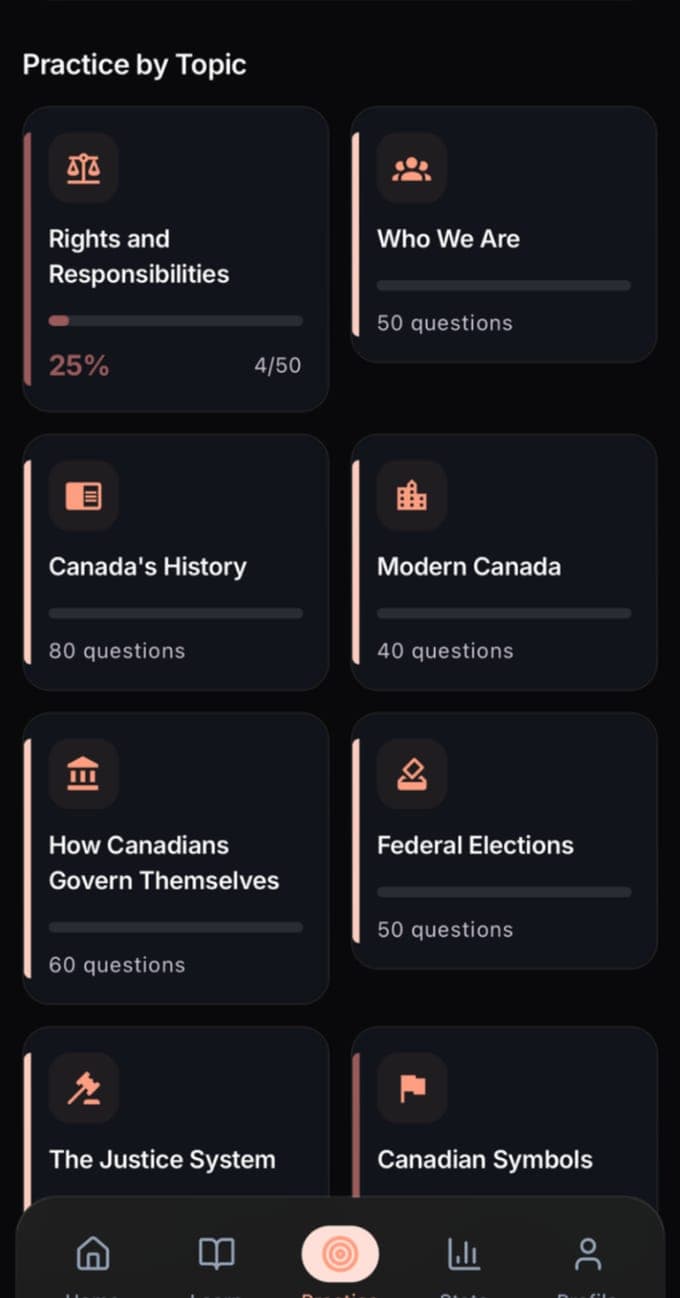
Who We Are covers the three founding peoples, Aboriginal, French and British, the First Nations, Inuit and Métis, official bilingualism, and the immigration that made a multicultural country. Canada's History is the longest chapter in the guide and the one most questions are drawn from: Aboriginal peoples before contact, the explorers, New France, the Royal Proclamation of 1763, the War of 1812, responsible government with La Fontaine and Baldwin, Confederation in 1867 and Sir John A. Macdonald, the railway, the settling of the West, the two World Wars, and the post-war country. Modern Canada picks up from there: the Quiet Revolution, the Constitution and Charter of 1982, the economy and society of the last decades.
Government, elections and justice
Three chapters on how the country runs, and together the second-largest source of questions. How Canadians Govern Themselves: a federal state, a parliamentary democracy and a constitutional monarchy; the Sovereign and the Governor General; the three branches of government; the Prime Minister and Cabinet; the House of Commons and the Senate; the three levels of government and what each does. Federal Elections: who can vote, the voter information card, how a ballot is cast in secret, how a government is formed after an election, majority and minority governments. The Justice System: the rule of law, the presumption of innocence, the courts from the provincial courts to the Supreme Court, the police, and the citizen's right to question them about their service or conduct.
The study questions here are the classic ones: what does constitutional monarchy mean, what are the three branches and three levels of government, who is entitled to vote, after an election which party forms the government, and who is your member of Parliament, which no guide can answer for you.
Symbols, economy and regions
The three shortest chapters and the quickest marks. Canadian Symbols: the Crown, the flag adopted in 1965, the maple leaf, the beaver, the anthem and the royal anthem, the Order of Canada, Remembrance Day and the poppy, the national sports. Canada's Economy: a trading nation, free trade with the United States and Mexico, the three main types of industry, natural resources. Canada's Regions: the Atlantic provinces, Central Canada, the Prairies, the West Coast and the North, with each province and territory, its capital and its economy. The regions chapter carries the local questions the test can ask about your own province.
What is in the guide but not on the test, and what to do with it
The Oath of Citizenship at the front is what you will swear or affirm at the ceremony; learn it, but it is not a test question. The Message to Our Readers and the Memorable Quotes are context. The section on applying for citizenship describes the process, including the line that the test is usually a written test but could be an interview. The 31 study questions at the back are the closest thing to a sample paper and should be answered in writing, from memory, at the end of your reading.
One caution on editions. The guide was rewritten in 2010 and its online edition has had small updates since; download it from canada.ca rather than from a vendor site, whose PDF may be older. As of September 2026 IRCC has not published a replacement guide, and the test remains based on this one.
Canadian Citizenship is an independent educational app and is not affiliated with, endorsed by, or connected to Immigration, Refugees and Citizenship Canada (IRCC) or any government body. Its content is based on Discover Canada: The Rights and Responsibilities of Citizenship, which IRCC publishes free and calls the only official study guide for the test.
Questions people also ask
Is Discover Canada free?
Yes. IRCC publishes it at no cost online, as a PDF, as an eBook and as audio, and you can order a printed copy free from canada.ca. Paying a vendor for a copy of the guide buys nothing the official site does not give away.
How many chapters does Discover Canada have?
Ten content chapters, from Rights and Responsibilities of Citizenship to Canada's Regions, plus the Oath, a message to readers, a section on applying for citizenship, 31 study questions and memorable quotes. Some vendor sites count twelve by splitting sections; the guide's own table of contents has ten.