How to pass the Canadian citizenship test the first time
Vishwen Labs

You pass the Canadian citizenship test by reading Discover Canada properly, all ten chapters, and then proving to yourself with timed 20-question mocks that you can score well clear of 15 out of 20 on questions you have not seen. IRCC gives most applicants one to three months between the acknowledgement of receipt and the invitation, and the invitation itself opens a 30-day window, so there is time for a real plan rather than a cram.
A 30-day plan for the Canadian citizenship test
- Get the guide from IRCC itself. Download Discover Canada from canada.ca, order the free paper copy, or use the audio edition. Copies on third-party sites can be old. IRCC's notice is worth reading too: the guide is the only official study material and anything else is used at your own risk.
- Read it once, cover to cover, in the first week. Ten chapters, some sixty-odd pages. Do not take notes yet. The first pass is for the shape of the thing: which chapters are long, which names recur, where the dates cluster. A chapter a day gets it done with weekends spare.
- Second pass by chapter, weighted. Give history and government the most time: they are the longest chapters and the ones applicants report most questions from. Then elections and justice. Then rights and responsibilities, which is short but heavily tested. Symbols, economy and regions last; they are quick, and the questions about them are the easiest marks on the paper.
- Quiz after every chapter, and keep the misses. After each chapter, answer practice questions on that chapter only and write down, or let the app record, every one you got wrong. The list of misses is the syllabus for the third week. Read the explanation for each, and the guide's page behind it, rather than just the right letter.
- Learn your local answers. Your member of Parliament, your premier, your provincial or territorial capital, your region and its neighbours. The guide's study questions ask two of these outright, and the regions chapter carries the rest.
- Timed mocks in the final week. Twenty questions, 45 minutes, no notes, once a day. Aim for three in a row at 17 or better with no chapter untouched. If one chapter keeps producing the misses, go back to it; if the misses are scattered, you are ready.
- Set up the sitting the day before. Chrome or Safari on a computer or tablet with a webcam, a quiet room, good light, your PR card or photo ID beside you, VPN off. Take the test early in the window, so that a technical failure or a bad day still leaves two chances inside the 30 days.
Why the plan is weighted
Twenty questions across ten chapters is an average of two each, but the average hides the shape. IRCC does not publish the split; applicants and preparation sites report history and government as the heaviest, which matches the guide's own proportions, where the history chapter is the longest by some distance and government, elections and justice make three chapters on related material. A plan that gives every chapter equal time overprepares symbols and underprepares 1867 to 1982.
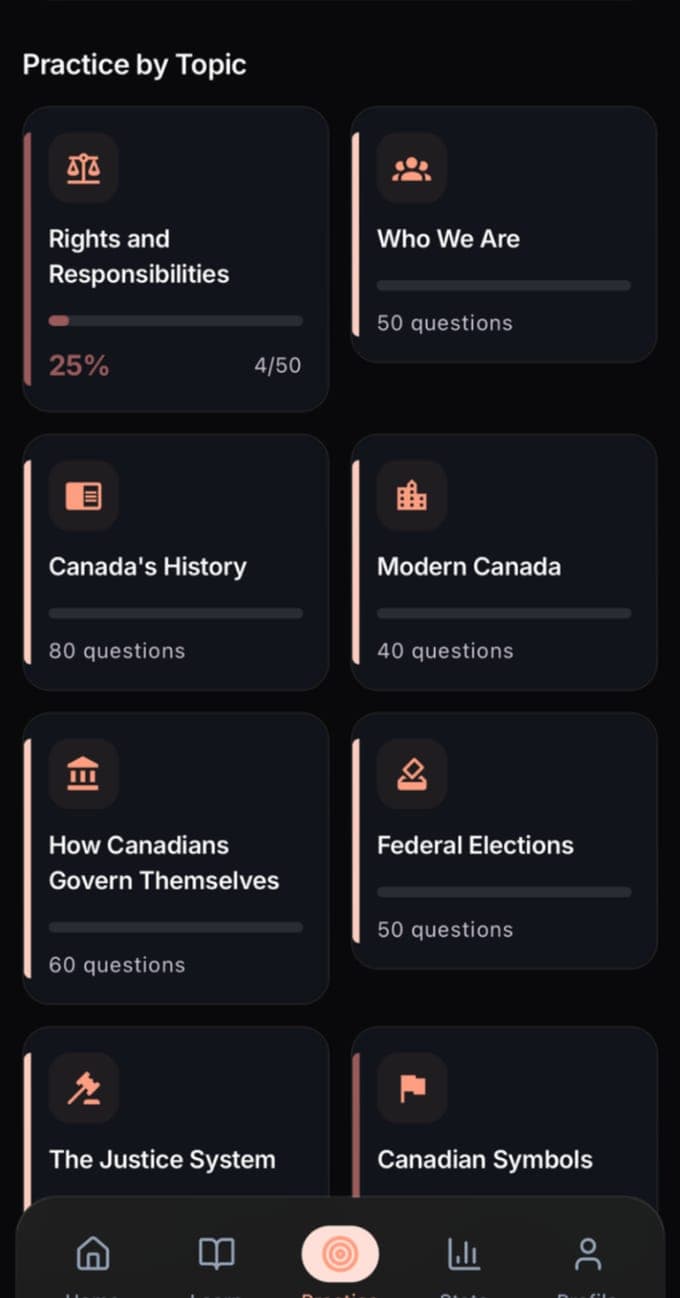
Read the guide as well as doing questions
Practice questions test recall of the guide; they cannot replace it, because the live test draws from a bank you have not seen and the only thing that covers an unseen question is having read the page it came from. The efficient order is guide first, questions second, guide again for the misses. Discover Canada even carries its own study questions at the back, and reading the chapters before attempting them is the difference between recognising an answer and knowing it.

Use the 30-day window well
The invitation gives you a start date and an end date 30 days apart, and three chances inside them. The temptation is to take the test on the last possible day after maximum preparation. The better move is the second week: you have had the months between AOR and invitation to prepare already, and taking it early leaves room for a second attempt, a rescheduled sitting after a connection failure, or simply a better day. The 45-minute timer cannot be paused, so the sitting itself should be the least eventful part of the month.
If English or French is not your first language
The test is in English or French, and applicants aged 18 to 54 must also show level 4 of the Canadian Language Benchmarks in speaking and listening. Discover Canada's audio edition, read by well-known Canadians, is the official version of the guide for listeners, and reading along with it is a language exercise as well as a study one. Government-funded language classes are free for permanent residents, and the guide itself recommends them. Give the plan six weeks rather than four, and use read-aloud practice questions so that the vocabulary of the test, words like ballot, jury, Confederation and Crown, is familiar before the day.
Canadian Citizenship is an independent educational app and is not affiliated with, endorsed by, or connected to Immigration, Refugees and Citizenship Canada (IRCC) or any government body. Its content is based on Discover Canada: The Rights and Responsibilities of Citizenship, which IRCC publishes free and calls the only official study guide for the test.
Questions people also ask
How long should I study for the Canadian citizenship test?
Most applicants report two to six weeks of daily study, longer if English or French is a second language. The invitation arrives one to three months after the acknowledgement of receipt and opens a 30-day window, so starting when the AOR arrives gives you time for a full read of the guide, a second weighted pass, and a week of timed mocks.
Is the Canadian citizenship test hard to pass?
Not for someone who has read Discover Canada. Reported first-attempt pass rates are above 85%, and the pass mark of 15 out of 20 leaves five spare marks. The applicants who fail are usually the ones who relied on practice questions alone or skipped the shorter chapters, which is where the easiest marks are.