How to stop doomscrolling
Vishwen Labs
The way to stop doomscrolling is to make the scroll cost something before it starts, because the habit is not a decision. The reach for the phone happens before you have thought about it, the feed is built to reward it, and a rule you set at breakfast is not present at eleven at night. Three things move the needle: adding friction to the reach, giving the restless feeling something else to do, and making the feed an earned reward rather than a default. Willpower is the fourth, and it is the one that fails, which is why the first three exist.
Why the scroll is not a decision
Nobody decides to spend forty minutes on a feed. The sequence is a twitch of boredom or discomfort, a hand that reaches for the phone before the thought forms, a thumb that opens the app it always opens, and a feed that delivers something new every swipe. Each step is fast and rewarded, and the reward arrives at random, which is the schedule that keeps slot machines in business. Understanding that helps in one way: it tells you that arguing with yourself at the moment of reaching is the weakest possible point to intervene. Move the intervention earlier, to the reach itself, or change what the reach gets you.
Friction first: make the reach slower
The cheapest changes are physical. Charge the phone outside the bedroom and buy a ten-dollar alarm clock. Log out of the apps you scroll so that opening one costs a password. Delete the app for a week and use the browser, which is worse on purpose. Put the phone in a drawer while you eat. None of this is clever; it works because the habit depends on the reach costing nothing, and a few seconds of effort is enough for the thought to catch up with the hand. Apple's own Screen Time limits belong in this group, with the caveat the next guide covers: their Ignore Limit button makes them a speed bump, not a wall.
Give the urge somewhere to go
The reach is usually a response to a feeling, boredom, a hard task, a moment alone in a queue, and removing the phone leaves the feeling in place. So decide in advance what the feeling gets instead. A short physical action works better than a mental one because it does not need the attention the feeling has already taken: ten squats by the desk, a walk to the kitchen, a set of pushups on the bedroom floor. It sounds trivial. It is also the only replacement that leaves you slightly better off every time you use it, which is more than a breathing exercise can say for most people.
Put a price on the feed
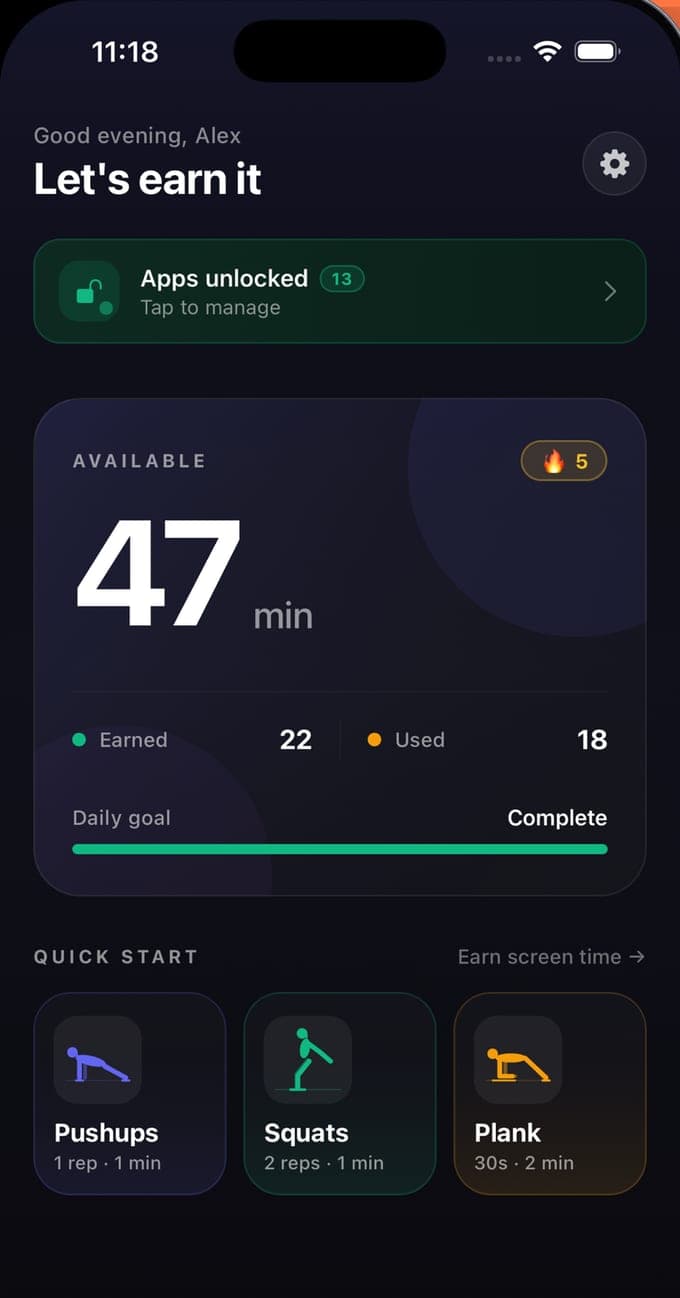
The change that lasts is to stop treating the feed as free. If Instagram costs twenty squats for fifteen minutes, three things happen: you open it less, because the price is visible; you use the minutes you paid for with some attention, because they were paid for; and the evening's scrolling turns into an evening's exercise without a gym. BurnToScroll does exactly this. The apps you pick are locked through Apple's Family Controls while your minute balance is zero, the camera counts pushups, squats and plank seconds on the phone, and each rep pays into the balance at a rate you can see and, with Premium, change. The balance resets at midnight, so tomorrow costs again.
What does not work, and the night rule
Shame does not work; the feed is engineered to beat it. Grand resets, a week off followed by a return to the old defaults, do not work either, because the defaults were the problem. Apps that ask you to wait ten seconds or breathe before opening the feed help some people and train others to breathe faster. What works is a system that holds when you are tired, and a rule for the hour that matters most: the phone charges outside the bedroom, the last scroll is paid for before bed, and the alarm clock is a clock. Keep that for a month and the reach itself begins to fade, which is the actual goal.
Questions people also ask
Why do I doomscroll at night especially?
Because the evening removes the things that interrupt the habit during the day and adds tiredness, which weakens the brake. The reach is the same; the bed makes it comfortable and the dark makes the screen the brightest thing in the room. A phone that charges in another room removes the whole loop.
Does deleting social media apps stop doomscrolling?
For a while, and then most people reinstall or scroll in the browser instead. Deleting is a good first week. A lasting fix keeps the apps but changes what opening them costs, which is why earned screen time works where deletion faded.