Governing law and jurisdiction clauses, explained
Vishwen Labs

A governing law clause says which state's law will be used to interpret the agreement. A forum or venue clause says where a dispute has to be brought. They are different jobs and a contract usually needs both, because a New York court can apply California law and a California court can apply New York law, and the two choices have different consequences for cost and outcome. Courts generally respect these clauses when the chosen state has a real connection to the deal and the choice is not unfair, though some states override them for particular contracts. General information, not legal advice.
What each clause does
Governing law answers a question about meaning: when the contract says a party must act reasonably, or limits liability, or restricts competition, whose rules decide what that means and whether it is enforceable. Forum answers a question about geography: which courts, in which county or district, hear the case. A third clause often sits beside them, saying the parties submit to that court's jurisdiction so nobody argues about being dragged somewhere they never agreed to go. An arbitration clause replaces the courts entirely with a private process, which is a bigger decision than it looks and worth its own thought.
Why the choice matters
The same words can have different consequences in different states. Non-compete clauses are the clearest example: some states enforce reasonable ones, others limit them sharply or ban them for most workers, and the choice of law can decide whether the clause survives at all. Damages caps, late-payment interest, notice periods for ending a lease, deposit rules, warranty disclaimers on a used car, all move from state to state. Picking a law is not a formality; it is choosing the rulebook.
When a clause does not hold
A court can decline to apply a chosen law when the chosen state has no reasonable relationship to the parties or the deal, or when applying it would defeat a strong public policy of the state whose law would otherwise apply. Consumer and employment contracts get more scrutiny than deals between businesses, and several states protect their residents in particular contracts, construction and franchise agreements among them, by voiding a clause that sends the dispute elsewhere. A clause that picks a distant state solely to make suing expensive is the kind that gets tested.
How the app handles it
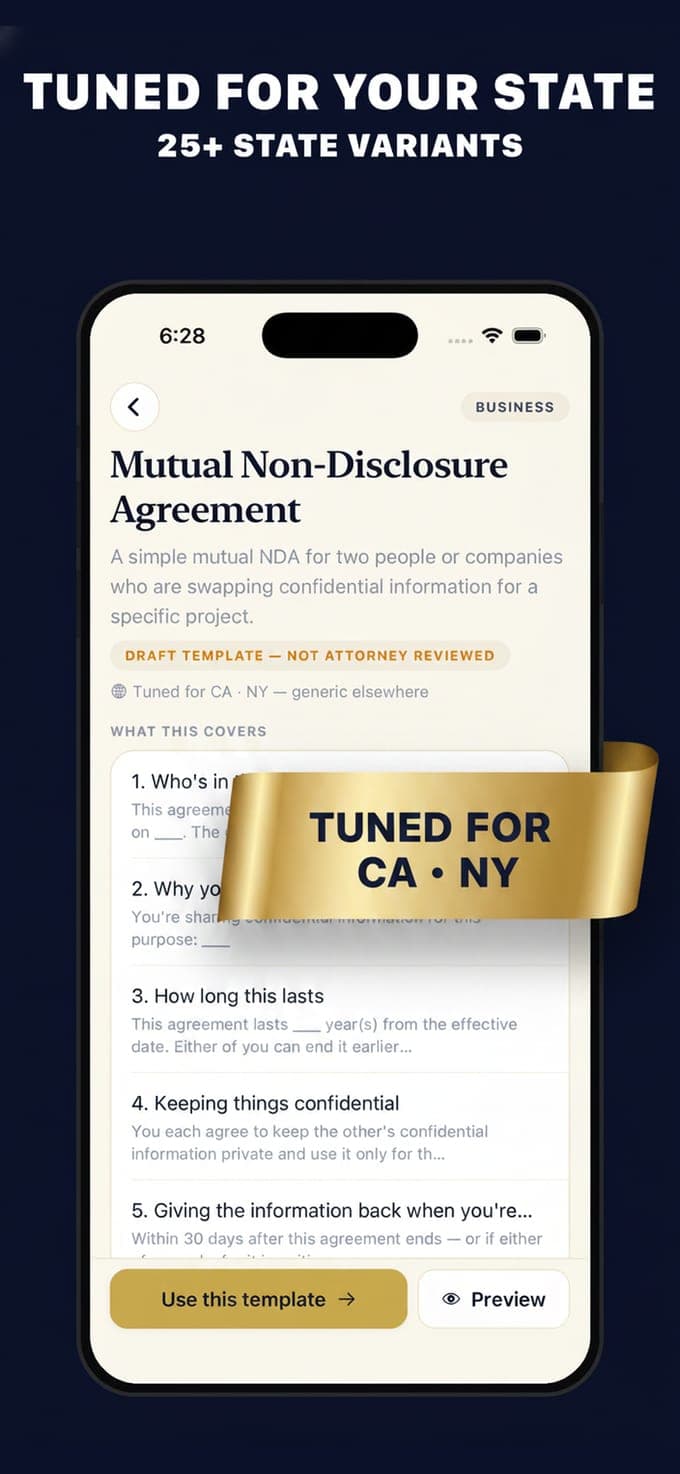
Contract Maker asks which state's law applies as a field in the form, and writes it into the clause that appears in the document, usually a numbered section near the end. Twelve of the 64 templates go further and carry state-specific versions: the residential lease has 14, the non-compete 10, the IP assignment 8, and the employment agreement, general power of attorney, both bills of sale and the month-to-month rental have California, New York, Texas and Florida. The other 52 are a generic US version, and the template says so rather than implying more. Where a state's rule is the whole point of the document, that difference is the one to check.
Choosing sensibly
For a deal between two people in the same state, pick that state and be done. For parties in different states, the usual outcomes are the buyer's state, the seller's state, or a neutral one that both accept, and the negotiating point is usually travel: the party who would have to fly to court is the one giving something up. For anything where the amount at stake would justify a lawyer's fee, this is a clause worth asking a lawyer about, because it decides which lawyer you would need later.
Contract Maker is a drafting tool from Vishwen Labs, not a law firm. The templates are starting points written in plain English, they are not legal advice, and using the app does not create an attorney-client relationship. Every template says so itself: it is a template to get you started, and for anything important you should talk to a qualified lawyer where you live. The pages here explain what documents usually contain; they do not tell you what to sign.
Questions people also ask
Can I choose any state's law for my contract?
In practice you choose a state with a real connection to the deal: where a party lives or works, where the work happens, where the property is. A choice with no connection, or one that defeats a strong policy of the state that would otherwise apply, is the kind a court may set aside.
What is the difference between jurisdiction and venue?
Jurisdiction is a court's power to decide a case involving these parties and this subject. Venue is which particular court, in which county or district, hears it. Contracts often address both, saying the parties submit to the courts of a named state and that disputes are brought in a named county.