What makes a contract legally binding?
Vishwen Labs
A contract is binding when five things are true: one side made an offer, the other accepted it, each side gives something of value, both are legally able to agree, and what they agreed to is lawful. Nothing about that requires a lawyer, a notary or fancy language, and a plain sentence signed by both people can be as binding as forty pages of legalese. What follows is general information rather than legal advice, and for anything with real money or real risk in it you should have a lawyer in your state read the document before you sign.
The five elements
Courts in the United States look for the same short list:
- Offer. One side proposes definite terms: the work, the price, the dates. Vague talk is not an offer.
- Acceptance. The other side agrees to those terms. A counter-offer is a new offer, not an acceptance.
- Consideration. Each side gives something of value: money, work, goods, a promise not to do something. A one-way promise with nothing in return is usually a gift, not a contract.
- Capacity. Both parties are old enough and able to understand what they are agreeing to. Minors and people who cannot understand the deal are treated differently.
- Legality. The purpose is lawful. A contract to do something illegal is not enforceable.
Does it have to be in writing?
Many contracts do not, and an oral agreement can bind. But every state has a statute of frauds that lists deals which must be in writing and signed to be enforced, and the usual members of that list are contracts for land, agreements that cannot be performed within a year, promises to pay someone else's debt, and sales of goods above a threshold set by the state's version of the Uniform Commercial Code. The exact list and the thresholds differ by state. The practical rule is simpler than the law: write down anything you would be upset to lose an argument about, because the writing is what you will have if the relationship goes wrong.
Signatures, notaries and witnesses
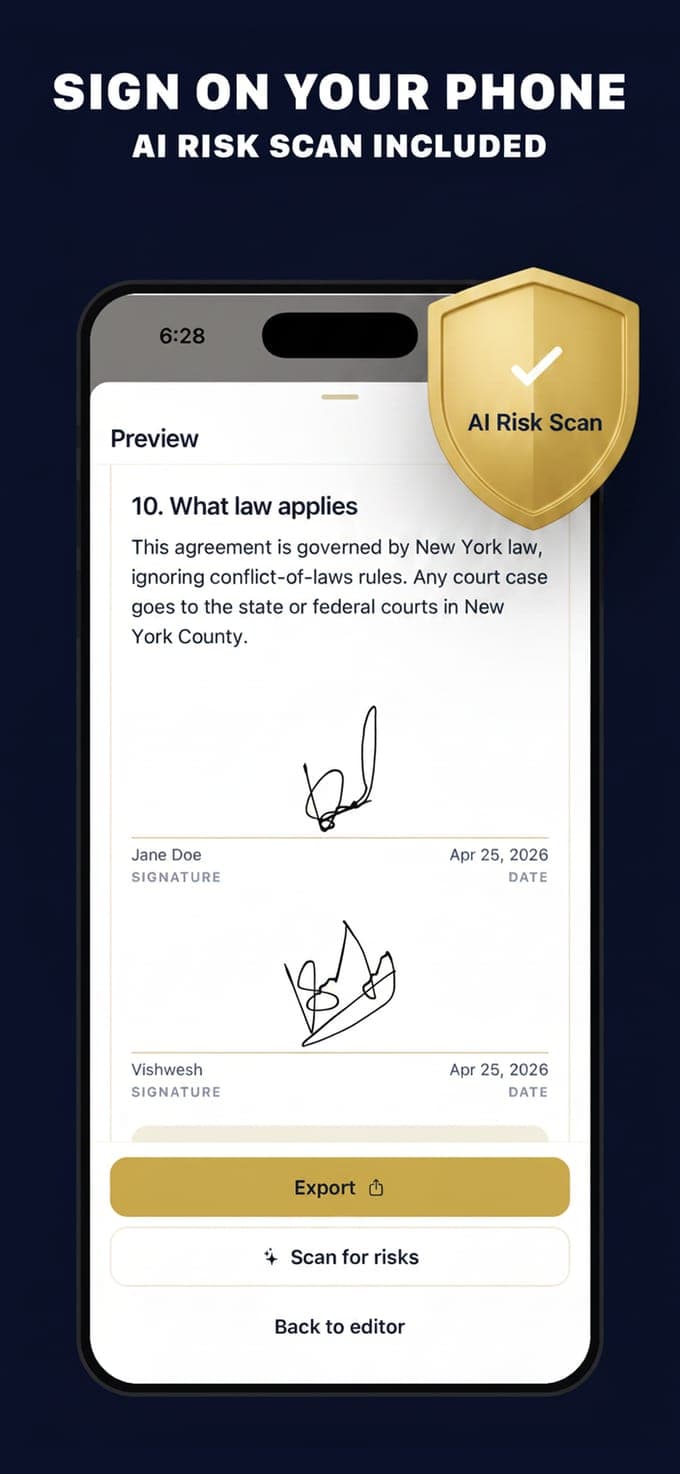
A signature shows that the signer meant to be bound. Most everyday agreements need no notary and no witnesses; a notary verifies who signed, which matters for documents like deeds, powers of attorney and some vehicle transfers, and several states want witnesses for a will. When the document does need one, the requirement comes from that state's law, so the template can only remind you to check. Electronic signatures are recognised across the United States for most documents, with exceptions worth knowing before you rely on one.
What breaks a contract that looked fine
Agreements come apart for reasons that have nothing to do with the wording. Fraud or a material lie about the deal. Duress, where one side was forced. A mutual mistake about something central. Terms so one-sided that a court calls them unconscionable. A party who lacked capacity. An illegal purpose. And the quiet one that causes most disputes: terms too vague to enforce, where the parties never actually agreed what the work was or when payment was due. That is a drafting problem, and it is the one a careful template fixes.
What a template can and cannot do
A good template gives you the structure: who the parties are, what each side owes, when money moves, how the agreement ends, which state's law applies. It cannot know that your landlord is also your employer, that the other party is in another country, or that your state limits the clause you just ticked. Contract Maker says as much on every template, calling each one a draft that no attorney has reviewed, and its own disclaimer tells you to talk to a qualified lawyer where you live for anything important. Read the document you generated before you sign it; the point of plain English is that you can.
Contract Maker is a drafting tool from Vishwen Labs, not a law firm. The templates are starting points written in plain English, they are not legal advice, and using the app does not create an attorney-client relationship. Every template says so itself: it is a template to get you started, and for anything important you should talk to a qualified lawyer where you live. The pages here explain what documents usually contain; they do not tell you what to sign.
Questions people also ask
Is a contract valid without a lawyer?
Yes. Nothing requires a lawyer to draft or review an ordinary contract, and people sign enforceable agreements every day without one. A lawyer is worth the money when the stakes are high, the other side has one, or the deal is unusual.
Does a contract need to be notarised?
Usually not. Notarisation proves who signed rather than making the agreement valid, and it is required for particular documents, deeds, some powers of attorney and some vehicle transfers among them, under each state's own rules. Check the requirement for your document and state.