How to invoice as a contractor on a job that runs for weeks
Vishwen Labs
Invoice as a contractor by quoting the job in writing first, then billing against that quote in stages as the work is done. Each invoice names the job, separates materials from labour, shows what has already been paid, and deducts any retention the client is holding back. The last invoice releases what is left.
How to invoice as a contractor
- Quote the job in writing before you start. Price the work as an estimate broken into the stages you intend to bill, with exclusions and a date the price holds until. Get it approved before you order materials.
- Agree the payment stages in the contract. Fix the deposit, the stage payments, the retention percentage and the completion date in one document, so every later invoice is arithmetic against numbers the client has already accepted.
- Split materials and labour into separate lines. Give each line a quantity and a rate that can be checked: hours at a day rate, square metres of plasterboard, a named boiler. Keep materials on their own lines at cost or cost plus your agreed margin.
- Raise each stage invoice against the whole job. Show the contract total, what this invoice covers, what has already been paid and what remains outstanding, so the client can place this invoice in the sequence without asking.
- Deduct retention, then invoice for its release. Run the invoice to its full total, take the agreed percentage off as a visible retention line, and diarise the release dates. Raise a plain invoice for the held balance when the defects period ends.
Quote the job before you invoice as a contractor
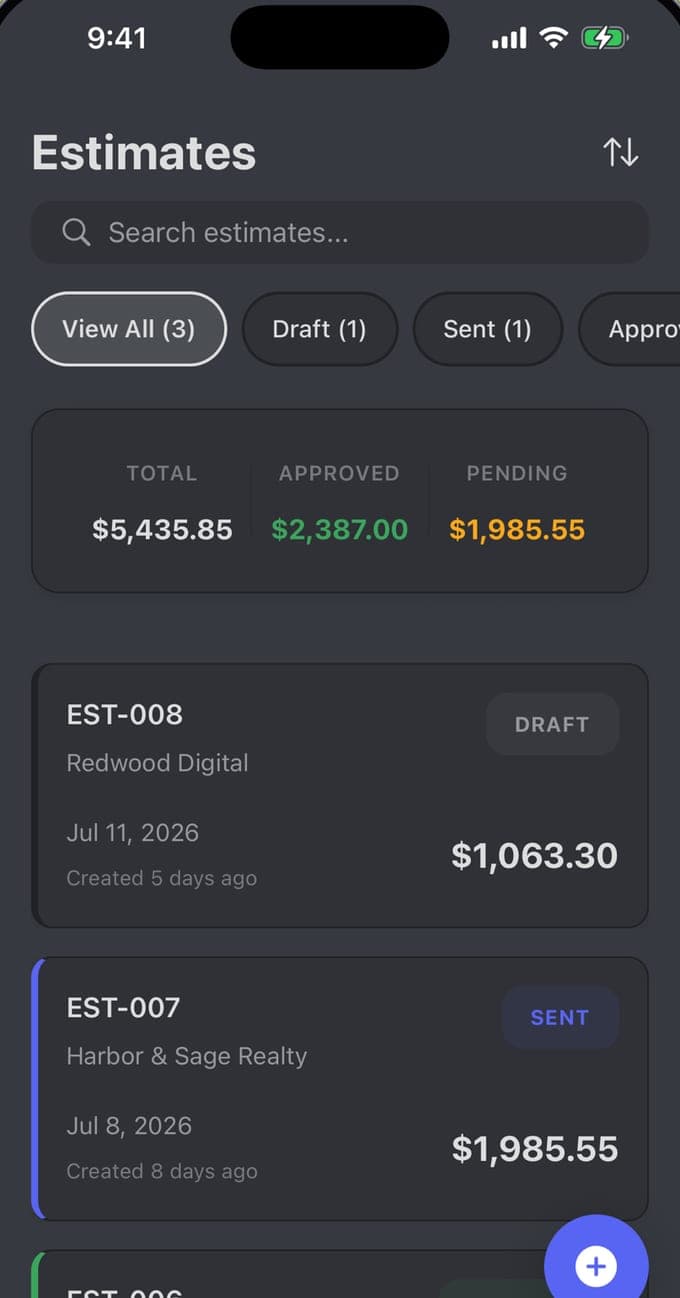
A contractor invoice that lands without argument was settled weeks earlier, at the quote. Price the job as a written estimate with the scope broken into the same stages you intend to bill: strip-out, first fix, second fix, making good. If the client approves that breakdown, every invoice afterwards is arithmetic against a number they have already accepted.
Keep the estimate. You will be billing against it for weeks. Invoice Pro holds estimates in a tab of their own on iPhone and iPad, each carrying its own approval state, so you can see which quotes are still sitting with the client before you order materials. It works with no signal, which matters in a basement or a half-wired new build.
- The scope, written as the stages you will invoice
- Whether the price is fixed, or a day rate plus materials at cost
- What is excluded: making good, skip hire, scaffolding, waste removal
- How long the price holds. Timber and copper move.
Splitting materials and labour when you invoice for building work
Clients query a single line reading "Bathroom refit" with one number at the end far more often than they query eleven lines. Give each line a quantity and a rate that can be checked: hours at a day rate, square metres of plasterboard, a named boiler with its model number. Materials bought on the client's behalf sit on their own lines, at cost or at cost plus the margin you agreed, with the supplier receipts to hand if anyone asks.
There is a tax reason as well as a trust one. Materials and labour are not always taxed at the same rate, and in several countries certain building work carries a reduced rate while the materials on the same invoice do not. That rule is local, so confirm yours before you assume. Invoice Pro puts a tax rate on each line rather than one rate across the whole invoice: 9.25% on one run of lines and 0% on another, with the tax broken out per rate on the finished PDF.
Staged and progress billing on a contractor job that runs for weeks
On anything longer than a fortnight, bill in stages. Agree what those stages are in the contract, before the first invoice, and price them as percentages of the contract value. A percentage is easier to defend than a round number, because the client can see exactly what the money buys.
Each staged invoice also has to be readable against the whole job. Show the contract total, what this invoice covers, what has already been paid and what is still outstanding. Without those four figures, a client three months into a kitchen cannot tell whether your invoice is the second or the fourth, and the safest thing they can do is wait and ask.
- A deposit on signing, commonly 10% to 25%, covering the first materials order
- A payment at each completed stage, priced from the approved quote
- A separate invoice for every approved variation, raised in the week it is agreed
- The balance at practical completion, less any retention
Retention: the money a contractor invoice does not collect yet
Commercial work and larger domestic jobs often hold retention, a slice of every payment kept back until the work is signed off and any defects are put right. Five per cent is common and ten appears on bigger contracts. It is usually released in two halves, one at practical completion and the rest when the defects period ends, which might be six or twelve months later.
Show it as a deduction on the face of the invoice. The invoice runs to its full total, a retention line takes the agreed percentage off, and the amount due is what remains. Quietly shaving your rates to absorb the same money hides it, and you will struggle to claim it back a year on. Diarise both release dates the day you sign, because retention nobody invoices for is retention nobody pays.
The contract dates behind every contractor invoice
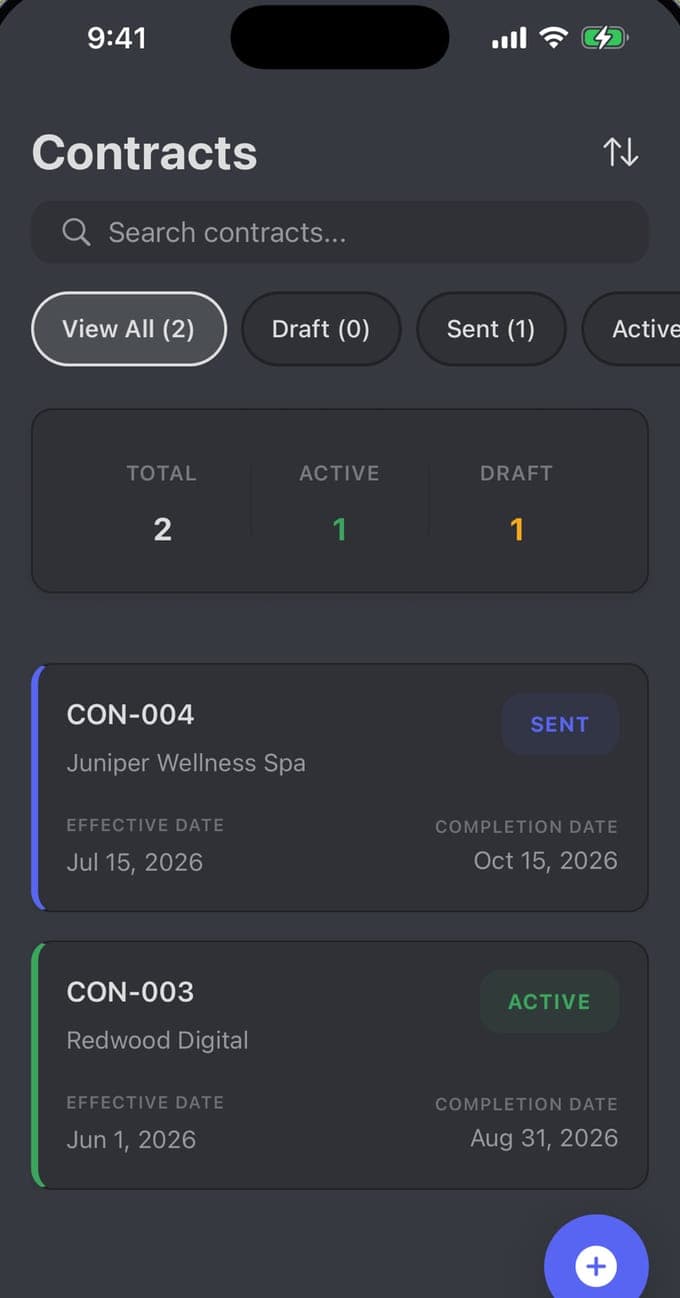
Two dates sit under all of this, and both live in the contract. The effective date is when the agreement starts and your payment terms begin to count. The completion date is what you are working towards, and it is the date any claim for late payment or delay gets measured against. Neither belongs on the invoice by itself, but the invoice is indefensible without them.
Invoice Pro keeps contracts beside the invoices and estimates, in their own tab where each row shows its effective date, its completion date and whether it is a draft, sent or active. When a client asks in week nine why the third stage payment is due now, the answer is one screen away rather than buried in an email thread.
Questions people also ask
How much retention can a client hold back on a contractor invoice?
Five per cent of each payment is usual on domestic and smaller commercial work, rising to ten on larger contracts. Half is normally released at practical completion and the rest once the defects period ends, often six or twelve months later. The exact figure and the release dates are whatever your contract states, and some countries cap or regulate retention, so check the rule where you work.
How do I invoice for extra work a client asked for part way through the job?
Price the variation before you do it and get the approval in writing, even if that is one line in a text message. Then put it on its own invoice line, referencing the date it was agreed and what it replaced in the original quote. Rolling extras silently into the final invoice is where most contractor payment disputes start, because the client is looking at a number they never approved.