How to write a receipt for a partial payment
Vishwen Labs

A receipt for a partial payment states the amount you received, the date it arrived, the method it came by, the invoice it was paid against, and the balance still outstanding after it. Write those five and the receipt does its job: it proves what was paid without implying the account is settled. The balance line is the one people leave off.
How to write a receipt for a partial payment
- Head it as a receipt. Write the word Receipt at the top, give it its own receipt number, and add the date you are issuing it. Do not reuse the invoice number as the receipt number.
- Name both parties. Your business name and contact details, and the client's name exactly as it appears on the invoice the payment relates to.
- Reference the invoice. Quote the invoice number, its date and its full total, so the receipt can be matched to the debt it belongs to months later.
- State the payment received. The amount of this payment on its own, the date the money actually cleared, and the method: bank transfer, card, cash or cheque.
- State the balance due. Subtract every payment received to date from the invoice total and write the remaining figure out in full, with the date it falls due.
- Word it as a part payment. Use 'part payment received' or 'received on account'. Keep 'paid in full' for the receipt that finally clears the balance.
- Send it and file your copy. Share the receipt the day the payment clears, and keep a copy filed against the invoice record rather than loose in an email thread.
What a receipt for a partial payment must state
An invoice asks for money. A receipt records what arrived. On a part payment it also has to record what has not arrived, and that second half is where most receipts fall down.
Seven items belong on it. The last two are the ones that go missing.
The balance line is what stops an argument in November about a payment made in July. Without it, a receipt for $1,571.00 sitting in a client's folder reads like a settled account, and you end up producing bank statements to prove otherwise.
- The amount received, written as the figure for that payment alone, never the invoice total
- The date the money cleared, which may not be the date you typed up the receipt
- The payment method: bank transfer, card, cash or cheque, so you can match it to your bank statement later
- The invoice number it was paid against, and its full total
- The balance due after this payment, as a figure, with the date it falls due
- A receipt number of its own, separate from your invoice numbering
- Your business details and the client's name
How to write a partial payment receipt, step by step
Completeness matters more than order, though the document reads better with the money near the top and the balance at the bottom. Work down the page in this sequence.
If the payment covers a particular stage of the job, say which one on the receipt itself. "Received on account of invoice INV-0042, deposit against frame and glazing" answers a question you would otherwise field by email six weeks later, and it protects you if the client queries a stage they think they already paid for.
Why "paid in full" is the wrong wording on a part payment receipt
"Paid in full" belongs on the last receipt in a series and nowhere else. The same goes for "settled", "account closed" and a friendly "thanks, all square" typed into the notes box without thinking.
The phrase carries weight beyond politeness. In the United States, UCC section 3-311 allows a debtor to discharge a claim by tendering a payment conspicuously marked as full satisfaction, where the amount is genuinely disputed and the creditor banks it. So the wording on a client's cheque or transfer note can matter as much as the wording on your receipt. The doctrine is narrower than it first sounds and the rules differ from one country to the next, so if a client sends a part payment marked "in full and final settlement" of a sum you dispute, take local advice before you bank it.
Safe alternatives are dull and that is the point. "Part payment received" and "payment received on account of invoice INV-0042" acknowledge the money without conceding anything about the rest of it.
Keeping the running balance straight across several partial payments
The arithmetic is simple and still goes wrong, usually because the second receipt was made by copying the first.
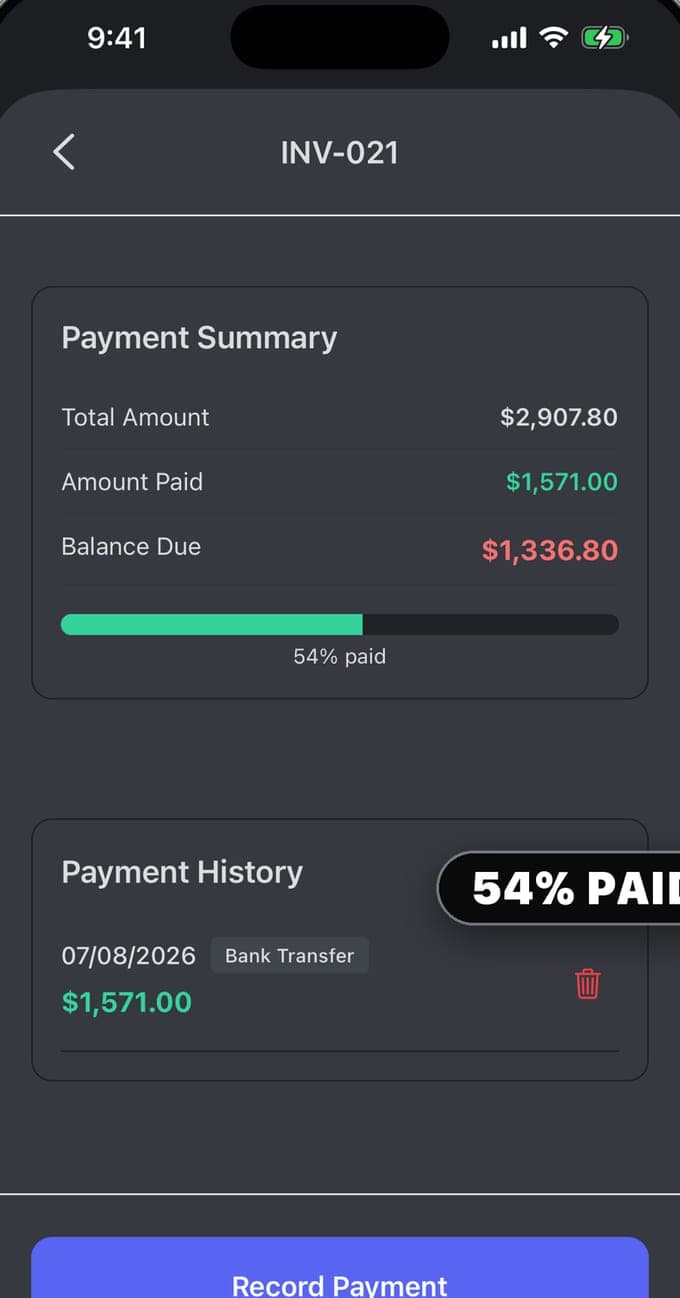
Take an invoice totalling $2,907.80. A bank transfer of $1,571.00 lands on 07/08/2026, which clears 54% of it and leaves $1,336.80 outstanding. Receipt one states all of that. When a second transfer of $800.00 arrives in September, receipt two has to state $2,371.00 received to date against $536.80 outstanding. Carrying receipt one's balance forward unchanged is the error to watch for, and it is the one clients notice.
Treat the invoice total as fixed. If the scope changes halfway through a job, raise a revised invoice or a credit note rather than quietly adjusting a balance on a receipt you have already sent, because the client now holds a document that disagrees with yours.
- Every receipt in the series restates the invoice total
- Show cumulative paid to date, not just the payment in hand
- Show the balance after this payment
- Keep the payment dates, so a late instalment is visible in the record
Numbering, sending and filing your partial payment receipts
Receipts get their own sequence. R-0117 or 2026-0117 both work; what matters is that a query about invoice INV-0042 pulls up three receipts with three distinct numbers rather than three documents sharing one. Each receipt quotes the invoice number, so the link runs in both directions.
Send it the day the money clears, while the client still remembers making the transfer. Invoice Pro records the payment against the invoice and generates the receipt as a PDF you share from an iPhone or iPad; the records stay on the device and the app needs no internet connection to produce them. The free tier watermarks the PDF and premium removes it.
For filing, the useful view is the one that shows part-settled work on its own. The app's invoices list carries a Partially paid filter alongside Draft and Sent, which is where you look before chasing anyone in the first week of the month.
Questions people also ask
Should each partial payment receipt have its own number, or can I reuse the invoice number?
Give every receipt its own number from a separate sequence, and quote the invoice number on it. Three instalments against one invoice means three receipts, and if all three carry the same number neither you nor the client can tell them apart in a dispute six months later.
Is a deposit receipt the same as a partial payment receipt?
Structurally yes, and it needs the same balance line. The difference is timing: a deposit is usually taken before the work starts, so the receipt should also state whether it is refundable and what it is being held against, because that is the question clients ask when a job is cancelled.