How to write an invoice for freelance work
Vishwen Labs
Write a freelance invoice by putting six things on one page: your business details, the client's, a unique invoice number, dated line items describing the work you actually did, the total with any tax, and how and by when you want to be paid. The rest is formatting. The part that decides whether you get paid on time is the description.
Write an invoice for freelance work
- Put both sets of details at the top. Your trading name, contact details and any tax registration number, then the client's legal name and the person or inbox that approves payment.
- Add an invoice number, issue date and due date. Number sequentially and never reuse a number. Write the due date as a calendar date rather than a payment-terms shorthand.
- Describe the work a line at a time. Name the deliverable, the dates it covers and the reference the client already uses, so the line still makes sense to a bookkeeper five weeks later.
- Price it hourly or as fixed milestones. Hourly lines carry the task, the hours and your rate with the amount shown. Fixed-fee work breaks into the milestones you agreed, adding up to the contract figure.
- Show any deposit already paid. Give the full project total, the deposit received with the date it arrived, and the balance outstanding, so nobody pays twice or parks the invoice.
- Add payment details and send it as a PDF. Bank details or payment instructions, notes and terms, then export the invoice as a PDF and send it to the billing contact, keeping a copy for your records.
What goes at the top of a freelance invoice
Start with the parts that never change. Your trading name and contact details sit at the top, with a tax registration number if you hold one. Under them goes the client's legal name as it appears on the contract rather than the shorthand you use in email, and the person or inbox that approves payment. Anything routed through an accounts payable team can lose a fortnight to a wrong addressee.
Then the fields that turn the document into a record. A unique invoice number, sequential from your first job and never reused. The date you issued it. The date payment falls due, written as an actual calendar date, because a shorthand like Net 30 asks the client to work it out and the client will work it out slowly.
Whether you add sales tax, and whether you must quote a registration number to do it, depends on where you and the client are registered. That is a local rule; check it once for your own country and then leave it alone.
- Your trading name, address, email and tax registration number if you have one
- The client's legal name and the billing contact who signs it off
- A sequential invoice number you never reuse
- Issue date and a due date given as a calendar date
- Any purchase order or project reference the client issued
How to describe freelance work on the invoice
A line reading "Design work" is clear on the day you send it and useless five weeks later, when the client's bookkeeper is matching nine invoices against a bank statement and emails to ask what it covered. Write descriptions for that person, who was in none of your meetings and has no access to your inbox.
Name the deliverable, the dates it covers and whatever reference the client already uses: Landing page build, 4 to 18 August, brief v2. If the scope moved halfway through, give the extra work its own line instead of folding it into the original figure. A client who can see what the higher total bought will approve it; a client who cannot will ring you about it.
Write that note while you work rather than at invoicing time. One line a day takes seconds and removes the worst hour of the month, which is reconstructing three weeks of work from a calendar and a chat history.
Hourly and fixed-fee lines on a freelance invoice
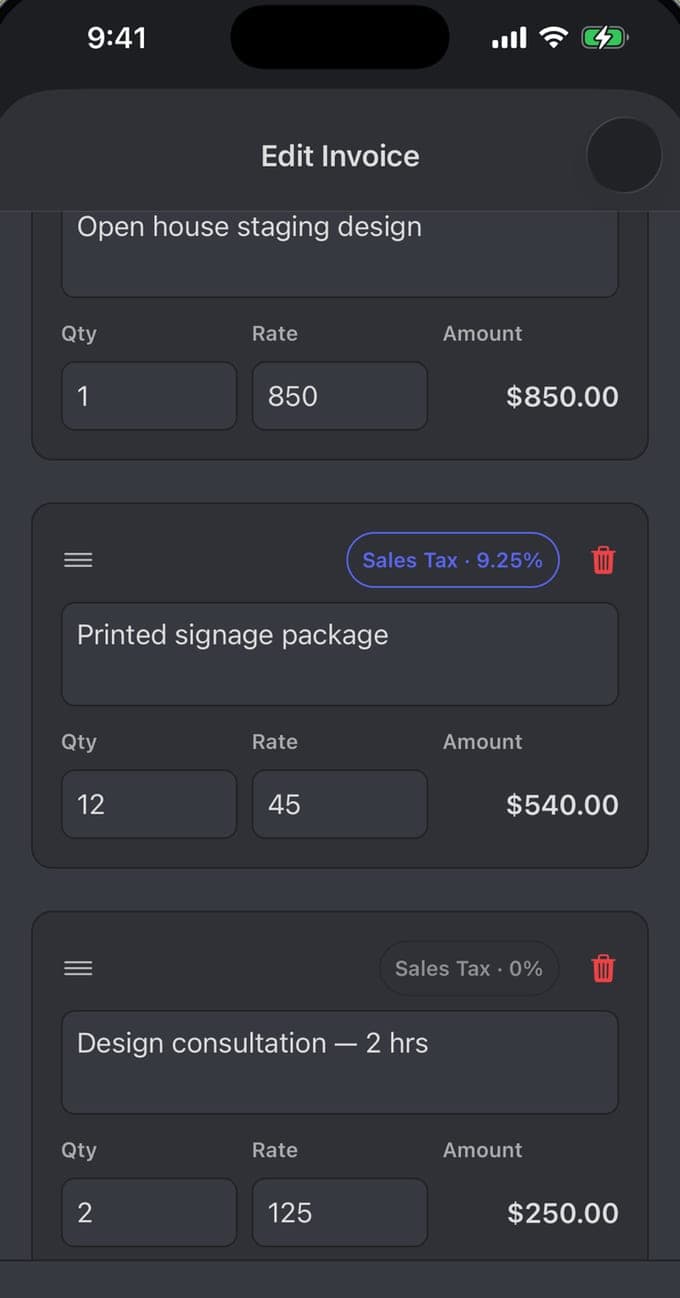
Hourly work needs the task, the hours booked against it and your rate, with the amount worked out on the line so the client can check the multiplication. Round to a unit you would defend out loud, quarter hours or half hours, and say on the invoice which one you use.
Fixed-fee work carries the opposite temptation. A single line reading "Project fee" with a number is technically complete and quietly hard to approve. Break it into the milestones you agreed, each with its own amount, adding up to the figure in the contract. "Wireframes $1,200" and "Build and handover $2,800" get signed off faster than "$4,000".
Mixed invoices are normal. A fixed fee for the agreed scope, then hourly lines for the revision rounds beyond it, reads fine as long as the two blocks sit apart on the page and the hourly rate matches the one in your contract.
Showing a deposit or part payment on a freelance invoice
A deposit invoice is written like any other, with the line saying plainly what it covers: 40% deposit against project fee, balance due on handover. It gets its own number and its own due date. Freelancers who take one usually ask for somewhere between a quarter and a half before the work starts.
The second invoice is where it goes wrong. When the balance falls due, show the full project total, the deposit already received with the date it arrived, and the balance outstanding. Leave the deposit off and accounts either pays the whole amount a second time or, more often, parks the invoice while somebody works out which figure is right.
Instalments paid after the fact behave the same way. Record each payment against the invoice with its date and method, keep the balance visible, and issue a receipt for the amount received. Invoice Pro does this on the invoice itself: an amount paid, a balance due, a payment history showing date and method, and a receipt you can generate for a partial payment.
Keeping a client record so the next freelance invoice takes a minute
The first invoice to a new client is slow. You are typing their billing address, their project reference, your rate and your bank details for the first time, and one of them will be wrong. The tenth should take a minute, which only happens if the client's details are stored once and pulled in, and the last invoice can be duplicated.
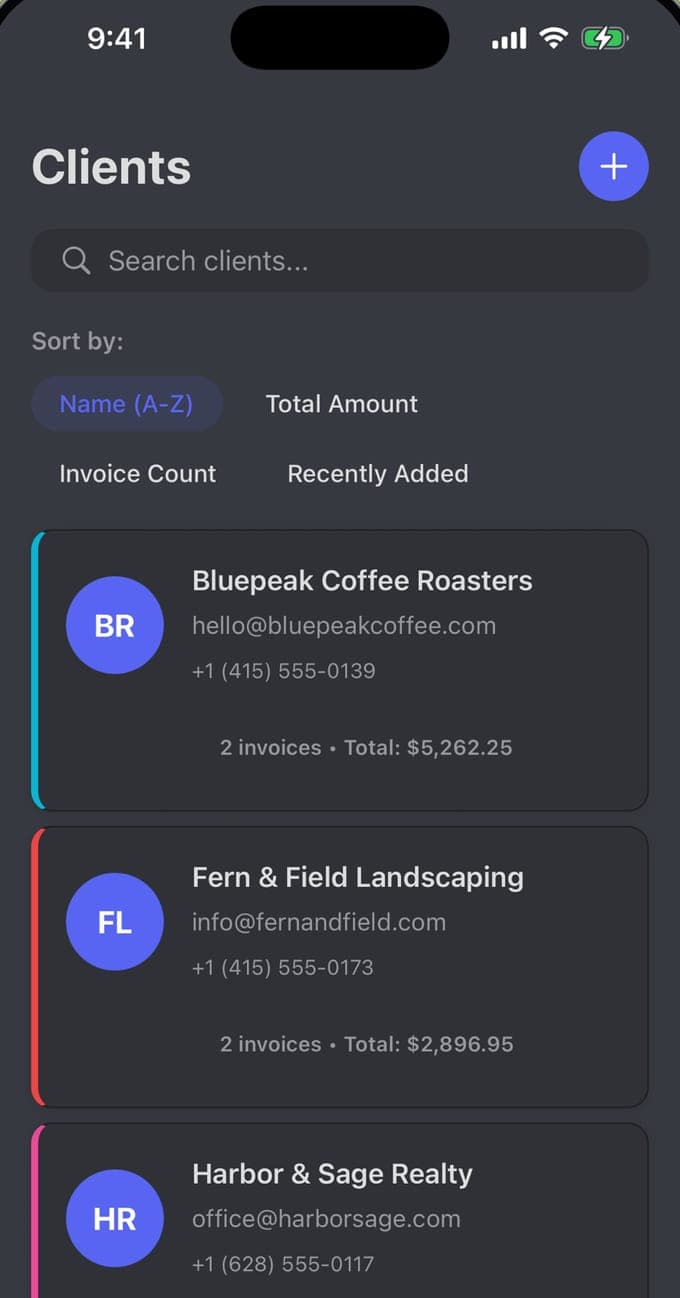
A stored client also answers the questions that arrive later: what that client has paid you across the year, how many of their invoices are still open, when the rate last moved. Invoice Pro keeps a record per client carrying their email, phone, invoice count and lifetime total, sortable by name, total amount, invoice count or recently added. The app works with no internet connection, so a train with no signal does not push the invoice to Monday.
Keep the PDF you sent as well as the record in the app. It is the version you will be asked for in a dispute or at the end of a tax year. How long you must keep it is a local rule, six years for a UK limited company and different elsewhere, so check what applies where you are registered.
Questions people also ask
Do I need a registered business to send a freelance invoice?
In most countries you can invoice as a sole trader under your own legal name and address, with no company registration involved. What changes is tax: past a certain turnover you may have to register and show a tax number on every invoice. The threshold and the wording are set locally, so confirm yours before your first big month.
Should a fixed-fee freelance invoice show the hours I worked?
No, and it usually costs you money to volunteer them. A fixed fee prices the outcome and the risk you took on when you scoped the job, and printing 9 hours next to $2,800 invites a conversation about your hourly rate rather than the work. Show milestones and deliverables instead.