What to include on an invoice
Vishwen Labs

An invoice needs your business name and contact details, the client's name and billing address, a unique invoice number, the invoice date, a due date written as a calendar date, an itemised list of what you supplied with quantity and rate, a subtotal, any tax charged and at what rate, the total due, and payment details the client can pay into. Add a tax ID where your jurisdiction requires one.
What every invoice must include, field by field
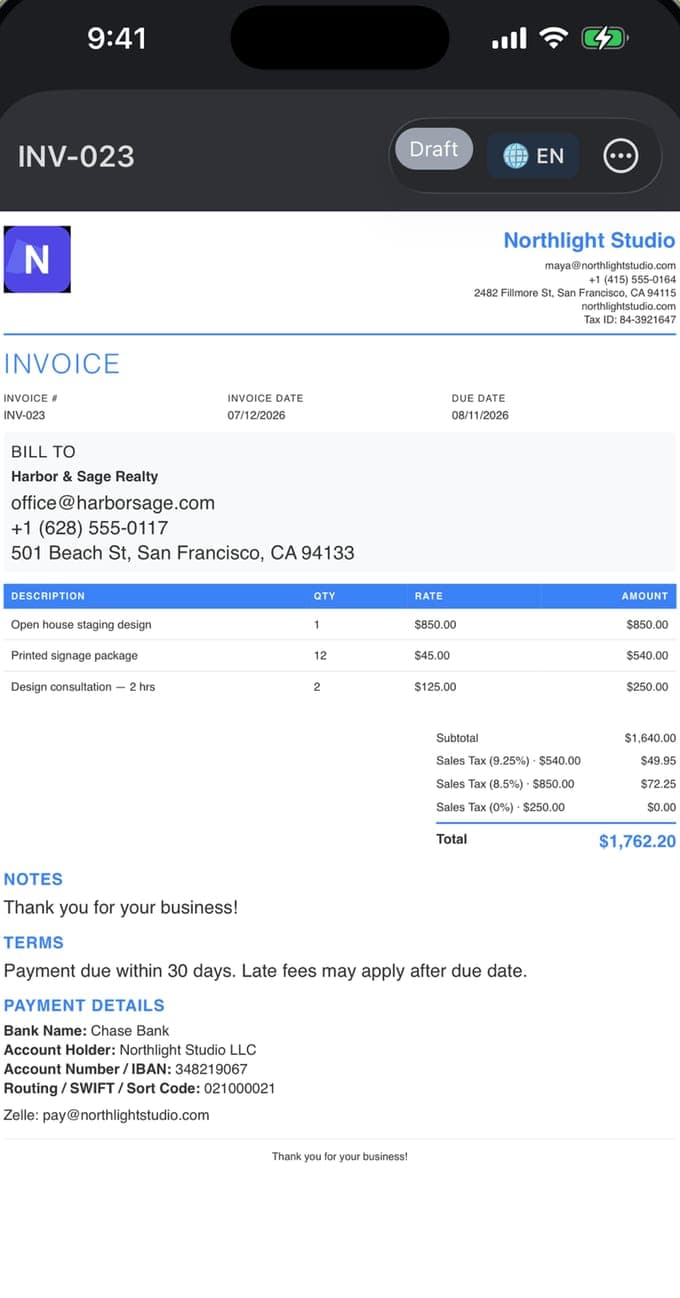
Work down the page from the top. The block at the top identifies you: trading name, address, email, phone, and a website if you have one. Under it sits the client block, usually labelled BILL TO, which should carry the client's registered business name rather than the name of the person you email, along with the billing address their finance team will recognise.
Currency is the field most often left off. If you bill across a border, write USD 1,762.20 rather than $1,762.20, since the dollar sign is shared by the Australian, Canadian, Singapore and Hong Kong dollars among others. Invoice Pro supports 150+ currencies, so an invoice can be issued in whichever one the contract names.
- Your business name, address, email and phone
- The client's registered business name and billing address
- A unique invoice number
- The invoice date, meaning the date you issued it
- The due date, written as a calendar date
- One line per item: description, quantity, rate, line total
- The subtotal before tax
- Tax charged, broken out by rate
- Any discount, shown on its own line
- The total due, and the currency it is in
- Payment details the client can pay into
- Your tax ID or registration number, where the jurisdiction requires it
Invoice numbers and dates: the fields to include carefully
An invoice number does two jobs. Yours is reconciliation: when $1,736.00 lands in your account in November, the number is how you know which piece of work it paid for. The client's accounts payable team uses it as the reference on their side, and plenty of them will not release a payment run against an invoice they cannot cite by number.
Sequential numbering is the convention because gaps invite questions from an auditor. INV-0001 upward is enough for a sole trader. If you carry several clients over long relationships, something like 2026-NORTHLIGHT-014 gives you the year, the client and the count without opening the file.
Two dates belong on the page: the date you issued it and the date the money is due. "Payment on receipt" is not a date, and "Net 30" on its own is arithmetic you have handed to someone else before they can schedule you. Write the calendar date. If your terms are 30 days and you issue on 8 September 2026, the due date field reads 8 October 2026, and the terms line can explain the 30 days underneath.
What an invoice should include for tax
Where you are registered for sales tax, VAT or GST, your registration number belongs on the invoice, and in many jurisdictions the document is not a valid tax invoice without it. The exact rule is local: the fields required in Ireland are not the fields required in California, and a US business selling into the EU has a different set again. Check the wording your own tax authority publishes rather than trusting a template from a blog, this one included.
Break the tax out instead of folding it into the total. Show the subtotal, then each rate on its own line with the amount it applies to, then the total. That matters on a single invoice carrying mixed rates: labour at one rate, materials at another, shipping at zero. Invoice Pro holds a tax rate per line item and prints one summary line per distinct rate, so the client can check the maths without writing to ask for a breakdown.
Payment details to include so the client can actually pay
A client cannot pay an invoice that does not say where to send the money. For a bank transfer that means the account holder's name as the bank holds it, the account number or IBAN, and the routing code: an ABA number in the United States, a sort code in the UK, a SWIFT/BIC for anything crossing a border. Put the bank's name on too, because some corporate payment systems ask for it before they will save a payee.
If you take more than one method, list them all and let the client use the one their finance team already runs. A Zelle address next to the bank block costs a line and can save a week. The one thing the invoice should not do is offer a method you have not actually set up.
What else to include on an invoice, and what to leave off
Past the required set, a handful of fields earn their place with any client who has a procurement process.
Leave off whatever is not the client's business: internal job codes that mean nothing on their side, and two pages of terms that a court would find in the signed contract anyway. A long terms block also pushes the total onto a second page, which is the one thing an invoice should not do.
- A purchase order number, when the client issued one. Their system matches the invoice against the PO, and one arriving without it sits in a queue until somebody chases it.
- A project or job reference, if you run several jobs for the same client.
- A late payment clause naming the rate and the day it starts.
- Notes: a line on what the work covered, or a short thank you.
- A signature, where the client or the contract asks for one.
Questions people also ask
What should an invoice number look like?
Anything unique and sequential works, and the format matters less than the absence of gaps, which an auditor will ask about. INV-0001 upward is enough for a sole trader; a prefix carrying the year and client, such as 2026-NORTHLIGHT-014, is easier to search once you have a few hundred. Never reuse a number, even for an invoice you cancelled.
Does an invoice need a purchase order number?
Only if the client issued one, and then it is usually mandatory rather than optional. Larger companies match every invoice against an open PO before releasing payment, so an invoice without the number is held until someone identifies it. Ask for the PO number before you start the work, not after you send the invoice.