What is on the Swedish citizenship test?
Vishwen Labs

The Swedish citizenship test asks about Swedish society as it is described in Sverige i fokus, the study material UHR publishes with the National Agency for Education: the country, its democracy and how it is governed, elections and parties, law and justice, the media, human rights, the labour market and personal finances, the welfare society, modern history, Sweden and the world, religion in a secular state, and traditions and holidays. UHR writes the questions from that material, and the five example questions it released in July 2026 show the level.
The 13 chapters of Sverige i fokus
The material runs to 48 pages in 13 chapters, and the chapter list is the syllabus:
- The Country of Sweden (Landet Sverige): geography, climate, nature and natural resources.
- Sweden's Democratic System (Sveriges demokratiska system): democracy, popular rule and the fundamental laws.
- How Sweden Is Governed (Så här styrs Sverige): the state, the regions and the municipalities.
- Elections and Political Parties (Politiska val och partier): elections, suffrage, the Riksdag and the parties.
- Law and Justice (Lag och rätt): the fundamental laws, the courts and the rule of law.
- The Role of the Media (Mediernas roll), Human Rights (Mänskliga rättigheter), and Labour Market and Personal Finance (Arbetsmarknad och privatekonomi).
- The Welfare Society (Välfärdssamhället), Sweden's Modern History (Sveriges moderna historia) and Sweden and the World (Sverige och omvärlden).
- A Secular State and a Multi-Religious Country (En sekulär stat och ett mångreligiöst land), and Traditions and Holidays (Traditioner och högtider).
The areas the regulation names
The government's regulation on the citizenship test (förordning 2026:451), in force since 6 June 2026, says that basic knowledge of Swedish society is to cover, for example:
- historical events that have shaped Sweden, and the significance of traditions for Swedish society;
- the Swedish welfare state, and the labour market, working life and personal finances;
- the significance of the climate and the environment for Swedish society;
- Sweden's democratic system of government, the fundamental laws and the Swedish legal system;
- freedoms and rights, including equality, gender equality and the rights of the child;
- world religions, philosophies of life and the significance of religious freedom for Swedish society;
- the role of the media in Swedish society;
- Sweden's geographical and geopolitical conditions, and general knowledge of the EU and other important international cooperation.
What UHR's example questions look like
In July 2026 UHR released five example questions. One asked what the public sector's main task is; one asked the title of Sweden's head of state; one asked which natural resource has long mattered to the Swedish economy; one asked which country was part of Sweden for almost 700 years until 1809; and one described a person criticising a political proposal on social media and asked how freedom of expression applies. Each is a fact or a principle from the material, phrased plainly, with four options of which one is right. UHR compared the level to the end of compulsory school.
How the app's 13 chapters map to it
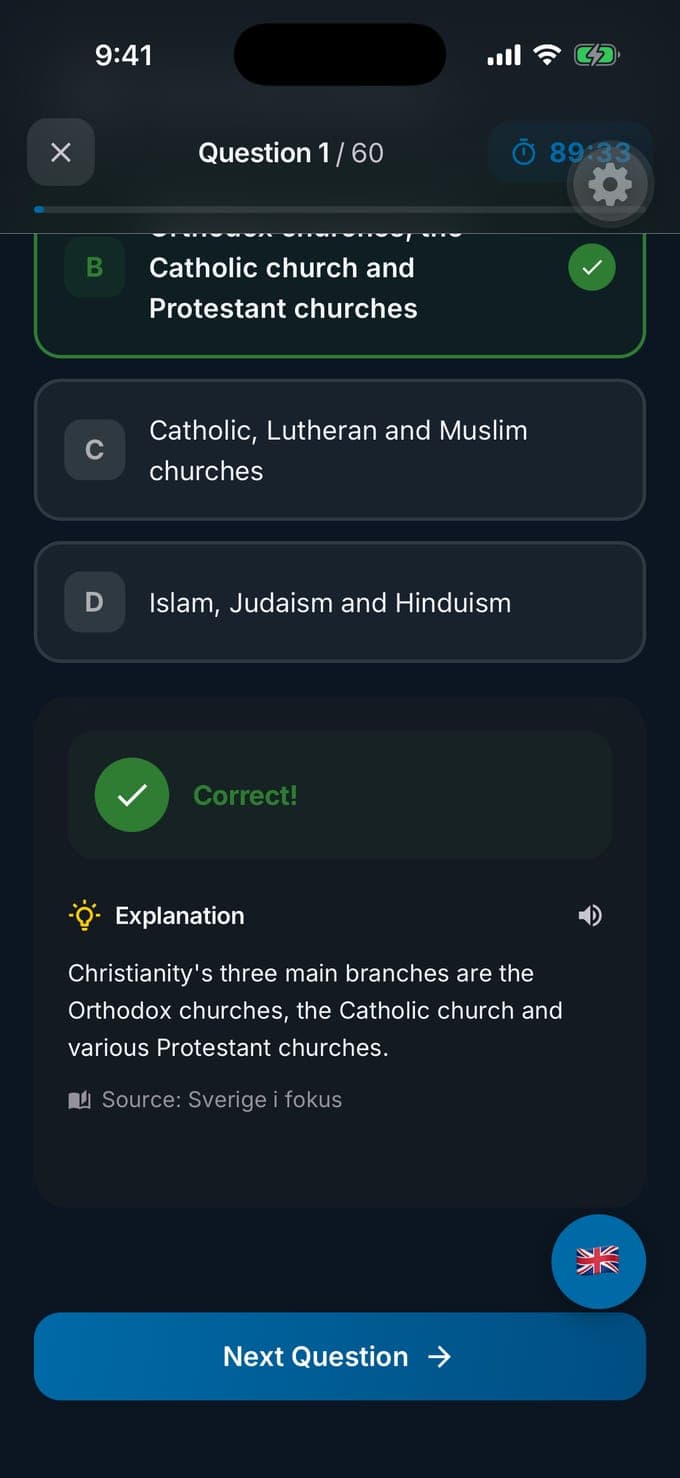
The app's chapters are the material's chapters, in the same order, with 962 questions spread across them and six more on current office-holders that are checked before every release:
- The Country of Sweden 19, Sweden's Democratic System 53, How Sweden Is Governed 69, Elections and Political Parties 47.
- Law and Justice 90, The Role of the Media 52, Human Rights 107, Labour Market and Personal Finance 70, The Welfare Society 67.
- Sweden's Modern History 164, Sweden and the World 72, A Secular State and a Multi-Religious Country 73, Traditions and Holidays 79.
What is probably weighted most
UHR's examples and Sverige i fokus both spend most of their words on democracy, government, law, rights and history; those chapters hold the most detail and the most named institutions. Traditions and geography are lighter. A plan that spends most of its time on how Sweden is governed, the rights and duties of residents, and the last 150 years of history is reading the material correctly.
In which language
In Swedish only. The material is published in Swedish, and the test is written at a level UHR compares to the end of compulsory school. Knowing the content in English is half the work; recognising it in Swedish, where a question about yttrandefrihet or riksdagen uses those words, is the other half. The app shows both languages a tap apart for exactly this reason, and the language guide goes further.
Medborgarskapsprov is an independent study aid and is not affiliated with the Swedish Council for Higher Education (UHR), the Swedish Migration Agency (Migrationsverket) or any other Swedish authority. UHR's citizenship test is based on the study material Sverige i fokus, which UHR publishes with the National Agency for Education; the app's lessons and questions are its own, written from that material, and each question names it as the source.
Questions people also ask
Are the Swedish citizenship test questions published?
No, only five example questions, released by UHR in July 2026. The real questions are written from Sverige i fokus and are not published; every practice bank, this app's included, is written from the same material rather than from the test.
Is Swedish history on the citizenship test?
Yes. Sverige i fokus has a chapter on Sweden's modern history, from farming country to industrial society, the welfare state, the 20th century and EU membership, and one of UHR's five example questions was historical: which country was part of Sweden until 1809.