How many times tables facts are there?
Vishwen Labs
The times tables from 1 to 12 contain 144 facts if 3 × 7 and 7 × 3 are counted separately, and 78 if they are counted once, which is how memory treats them. Take out the 1s and the 10s, and the 2s, 5s and 11s whose patterns children learn in days, and 28 facts remain that have to be learned by heart: the products of 3, 4, 6, 7, 8, 9 and 12 with each other. Up to 10 × 10, the American and Australian target, the numbers are 100, 55 and 21. Up to 20 × 20 they are 400 and 210. The small number is the one to plan around.
144, or 78
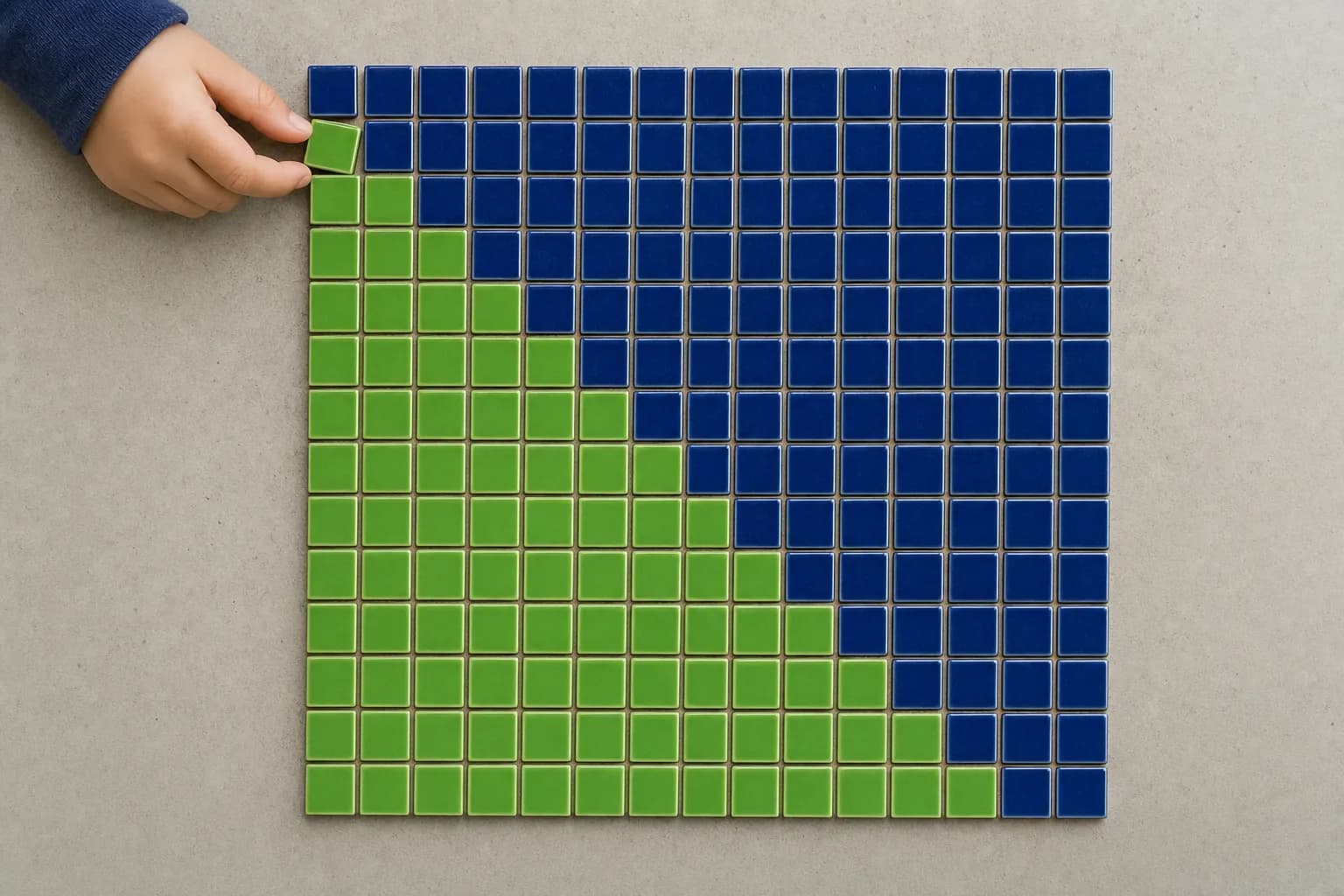
Lay the tables out as a square, 1 to 12 along the top and down the side, and there are 144 cells. The diagonal holds the twelve squares, 1 × 1 to 12 × 12, and everything above the diagonal repeats everything below it with the factors swapped. So the distinct facts are the diagonal plus one triangle: 12 + 66 = 78. A child who learns 7 × 8 has learned 8 × 7 as well, provided the practice asks both ways round, and the school checks do ask both ways: England's Year 4 check draws from 121 items across the 2 to 12 tables and never puts a fact and its reverse in the same form.
The 28 that need real work
Of the 78, the 1 times table is a rule, the 10s are a zero on the end, the 2s are doubling, the 5s end in 0 or 5 and the 11s repeat a digit. Remove those tables and their reverses and 28 facts are left, the products of the seven numbers 3, 4, 6, 7, 8, 9 and 12 with each other and with themselves:
- 3s: 3 × 3, 3 × 4, 3 × 6, 3 × 7, 3 × 8, 3 × 9, 3 × 12 (seven)
- 4s: 4 × 4, 4 × 6, 4 × 7, 4 × 8, 4 × 9, 4 × 12 (six)
- 6s: 6 × 6, 6 × 7, 6 × 8, 6 × 9, 6 × 12 (five)
- 7s: 7 × 7, 7 × 8, 7 × 9, 7 × 12 (four)
- 8s: 8 × 8, 8 × 9, 8 × 12 (three)
- 9s: 9 × 9, 9 × 12 (two), and 12 × 12 (one)
Up to 10, and up to 20
The American Common Core and the Australian curriculum stop at 10 × 10, which is 100 cells and 55 distinct facts; strip the patterned tables and 21 need memory, the same list as above without the 12s. Going the other way, the tables to 20 × 20 are 400 cells and 210 distinct facts, and most of the extra ones are new memory work, since 13, 17 and 19 have no patterns to lean on. That is why no school curriculum asks for them and why an app that offers them treats them as an extra.
What the app counts
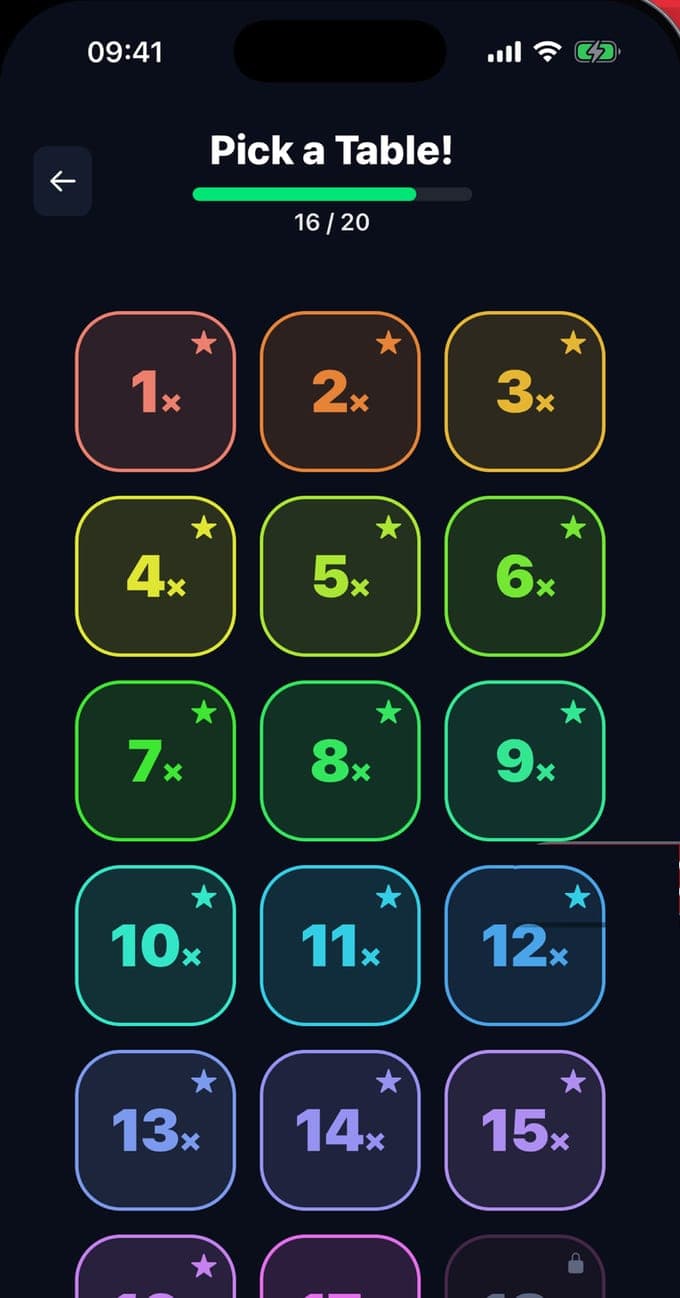
Multiplication: Times Tables counts by table, in one direction: each of its twenty tables holds twelve facts, n × 1 to n × 12, which is 240 questions in all, and 144 for the 1 to 12 tables. It tracks each of them separately, so 7 × 8 and 8 × 7 are two facts in the app, learned in the 7s and the 8s. That is deliberate: a child who knows 8 × 7 does not always produce 7 × 8 without a pause, and the check asks both. Each fact counts as learned after three right answers in a row, a wrong answer resets it, and a table's creature reaches its final form only when all twelve are learned.
Why the count matters for practice
Knowing that 28 facts are the job changes how the weeks look. At ten questions a day, the whole hard set comes round every three days, and the misses come round faster, since a review queue puts them first. A child who has the patterned tables can be through the 28 in a month of ten-minute sessions, and the timed tests and mixed levels after that turn correct into fast. A parent who thinks the job is 144 facts tends to give up; one who knows it is 28 tends not to.
Questions people also ask
Is 12 × 12 the end of the times tables?
For school, yes: England expects the tables to 12 × 12 by the end of Year 4, and the United States and Australia expect them to 10 × 10. There is no natural end; the app goes to 20 × 12 for children who want more, and mental arithmetic beyond that uses place value rather than memory.
Does my child need the division facts as well?
Every curriculum pairs them: the Common Core standard says that knowing 8 × 5 = 40 means knowing 40 ÷ 5 = 8. The app practises multiplication only, and division facts follow from the same 78 facts read backwards; a few minutes of asking them that way round covers it.