Times tables by grade in the US, the UK, Australia and Germany
Vishwen Labs

In England children are expected to know every times table up to 12 × 12 by the end of Year 4, at age eight or nine, and are checked on it in June. In the United States the Common Core standard for Grade 3 asks that by the end of the year children “know from memory all products of two one-digit numbers”, so up to 9 × 9, with fluency within 100. Australia's curriculum expects the 3, 4, 5 and 10 facts in Year 3 and the rest up to 10 × 10 in Year 4. In Germany the kleines Einmaleins, the tables to 10 × 10, belongs to the second and third school years, with the core facts of the 1, 2, 5 and 10 tables and the squares first. The same facts on four calendars.
England: Years 2, 3 and 4, then the check
The national curriculum sets the tables out by year. Year 2 pupils are taught to “recall and use multiplication and division facts for the 2, 5 and 10 multiplication tables”; Year 3 adds “the 3, 4 and 8 multiplication tables”; and Year 4 pupils are taught to “recall multiplication and division facts for multiplication tables up to 12 × 12”, after which Years 5 and 6 “continue to practise recalling and using multiplication tables” for fluency. The multiplication tables check at the end of Year 4 tests exactly that: 25 questions from the 2 to 12 tables, six seconds each, with an emphasis on the 6, 7, 8, 9 and 12 tables. Scotland, Wales and Northern Ireland have their own curricula and no equivalent national check.
United States: Grade 3, to 9 × 9
Common Core, which most states use or have adapted, puts the tables in Grade 3. Standard 3.OA.C.7 reads in full: “Fluently multiply and divide within 100, using strategies such as the relationship between multiplication and division (e.g., knowing that 8 × 5 = 40, one knows 40 ÷ 5 = 8) or properties of operations. By the end of Grade 3, know from memory all products of two one-digit numbers.” Grade 2 prepares the ground with equal groups and arrays. So an American eight-year-old is expected to know 9 × 9 from memory and to be fluent to 100, and the 11s and 12s are not required; many schools teach to 12 × 12 anyway, and there is no national check.
Australia: Years 3 and 4, to 10 × 10
The Australian Curriculum's mathematics strand spreads the tables over two years. Its Year 3 content expects children to recall and use the multiplication facts for 3, 4, 5 and 10 and the related division facts, and its Year 4 content extends that to the facts up to 10 × 10, with proficiency in the related division facts. There is no national tables check; NAPLAN in Years 3 and 5 tests numeracy more broadly. The wording here is a summary rather than a quotation, since the curriculum site is not open to automated reading.
Germany: Klasse 2 and 3, das kleine Einmaleins
Each German state sets its own curriculum, but the shape is shared. The kleines Einmaleins is the tables to 10 × 10, introduced in the second school year through the Kernaufgaben, the core facts of the 1, 2, 5 and 10 tables and the square numbers, from which the rest are derived, and expected to be automatic by the end of the third year. Bavaria's LehrplanPLUS, to take one, sets the core facts for Jahrgangsstufe 2 and the whole small table for Jahrgangsstufe 3, and many schools mark the point with an Einmaleins-Führerschein, a licence earned by passing a class test. The großes Einmaleins, to 20 × 20, is a later and optional extra.
What the app covers, against the four
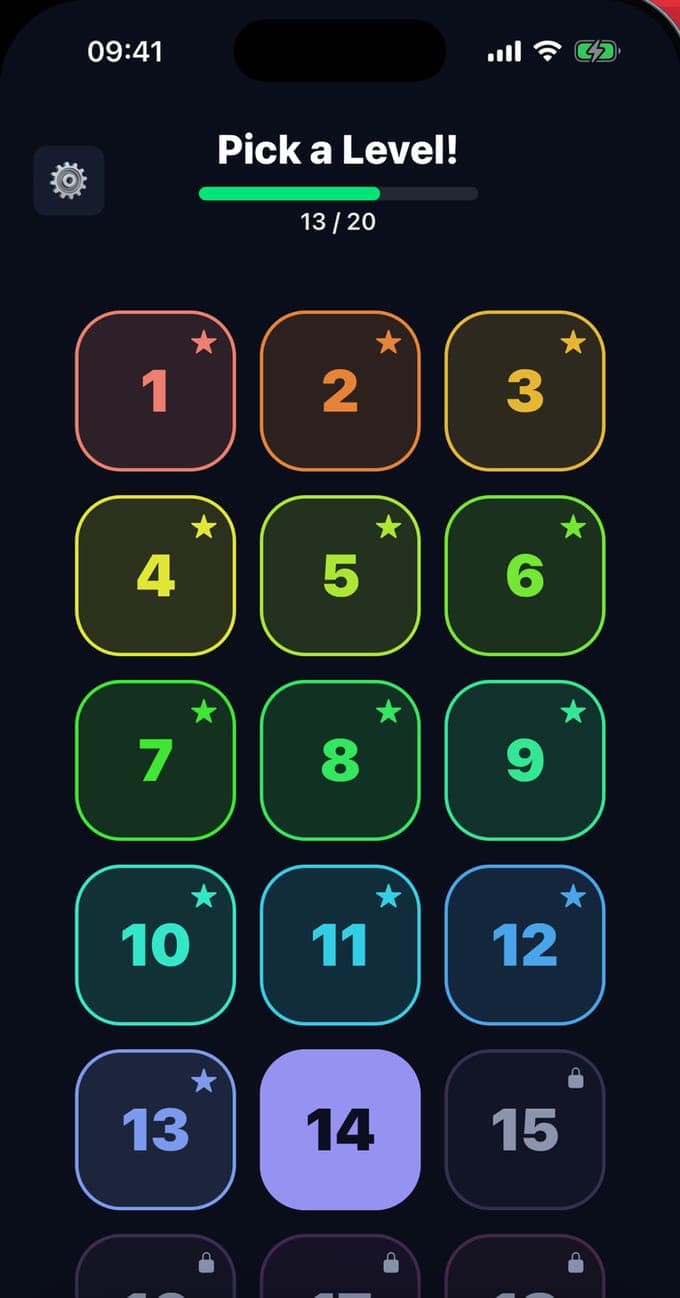
Multiplication: Times Tables has every table from 1 to 20 with twelve facts each, so the English set to 12 × 12, the American and Australian sets to 10 × 10 and the German kleines Einmaleins are all inside it, and the 13 to 20 tables go beyond any of them. Level 10 mixes the 1s to 10s, which is the Common Core, Australian and German target; level 12 mixes the 1s to 12s, which is the Year 4 check. The app comes in fourteen languages including German, and follows the device's language.
Questions people also ask
What grade do children learn multiplication in the US?
Grade 3 for the facts: the Common Core standard expects all products of two one-digit numbers from memory by the end of that year, with fluency within 100. Grade 2 introduces multiplication as equal groups and arrays, and Grade 4 uses the facts in multi-digit multiplication.
When do German children learn the times tables?
In Klasse 2 and 3, ages seven to nine. The core facts (the 1, 2, 5 and 10 tables and the squares) come first, in the second year, and the whole kleines Einmaleins to 10 × 10 is expected to be automatic by the end of the third.