The Year 4 multiplication tables check, and how to practise for it
Vishwen Labs

The multiplication tables check (MTC) is a short on-screen test that every Year 4 pupil in England's state schools takes in June: 25 questions drawn from the 2 to 12 times tables, six seconds to type each answer, a three-second pause between questions, and three practice questions first. There is no pass mark; the school sees a score out of 25 and reports it to parents. In 2026 the check window runs from Monday 1 June to Friday 12 June, with a further week for children who were absent, and schools see results from 22 June. It is a test of recall speed and nothing else, so practising for it means answering single facts out of order, quickly, until the 7s and 8s come as fast as the 10s.
What the check looks like
The Standards and Testing Agency's framework describes it plainly. Each child gets one of several equivalent forms of 25 questions worth a mark each, “not ordered according to difficulty”, every one in the shape n1 × n2 = with a box to type into. “A time limit of 6 seconds per item has been set”, chosen after trials with 1,124 pupils as the time that lets a child recall an answer without leaving time to work it out, and “there will be a 3 second pause before the next question appears”. The questions come from “the 121 items that make up the 2 to 12 multiplication tables”; the 1 times table is left out except as a practice question, and a fact and its reverse never appear in the same form. The tables are not weighted equally: each form carries between two and four questions from each of the 6, 7, 8, 9 and 12 tables, “because these have been determined to be the most difficult”, and none to two from the 2s and the 10s. Under normal conditions the whole thing takes under five minutes.
What it is testing
The framework quotes the national curriculum: by the end of Year 4 pupils “should have memorised their multiplication tables up to and including the 12 multiplication table and show precision and fluency in their work”, and the check “only assesses the instant recall of multiplication facts”. Division, word problems and written methods are tested elsewhere. Six seconds is long enough to read the question, remember the product and type two or three digits; it is not long enough to count up in sevens. A child who reaches 7 × 8 by skip-counting will run out of time on exactly the facts the check is most interested in.
How to practise for six-second answers
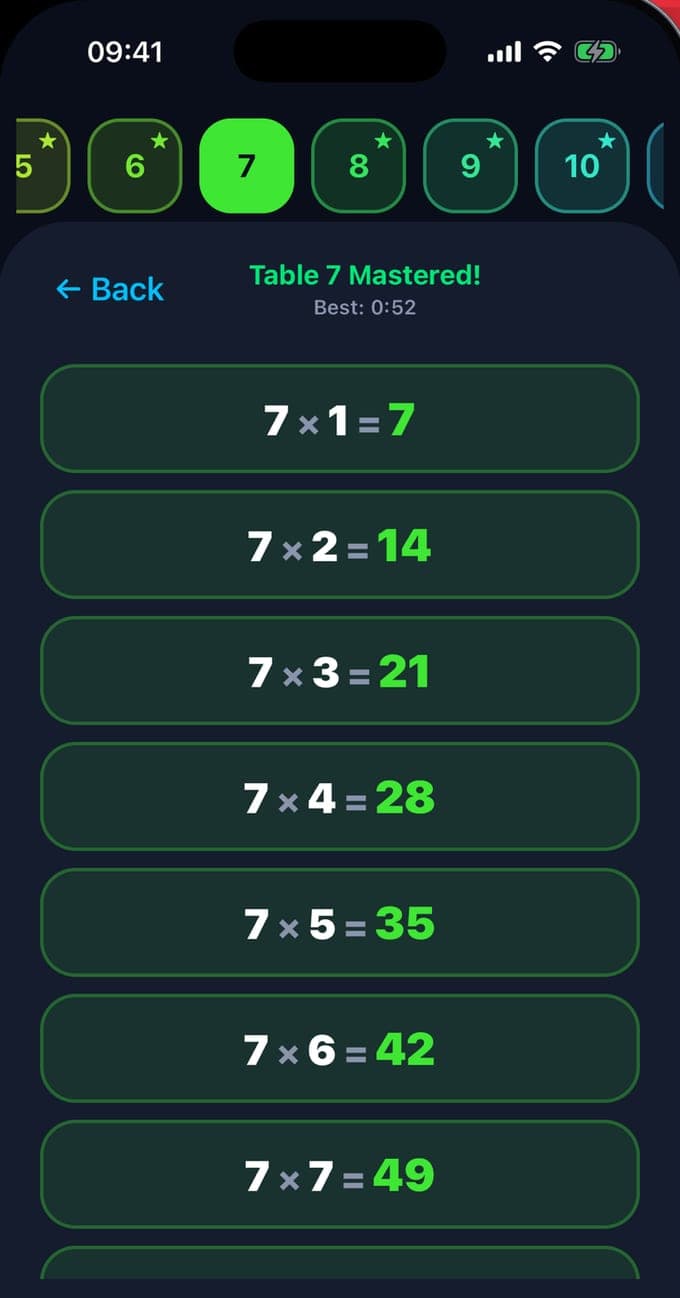
Practise recall out of order, not tables in sequence, from the spring term at the latest. Ten minutes a day of mixed questions from the 2 to 12 tables, with the misses coming back the same day, covers it; the daily-practice guide has a routine. Once the facts are reliable, add time pressure: a timed table test, a mixed test, or a game that speeds up. Multiplication: Times Tables does both. Each table has a timed test whose best time is kept, and its levels mix the tables up to their number, so level 12 is close to the check's content: the 1s to 12s out of order, one fact at a time, with wrong answers going back into review. Its snake speeds up as answers land, which trains the same reflex the check measures.
What the score means
Twenty-five out of twenty-five is the aim, and a child who knows the tables gets it. There is no pass mark, no certificate and no consequence for the child; schools use the scores to see which pupils need more fluency work in Year 5. Parents get the score from the school, not from the government. If the number comes back lower than expected, it is nearly always the 6s, 7s, 8s and 12s, or nerves about the timer, and both respond to a few more weeks of mixed, timed practice.
Tests elsewhere: the US, Australia and Germany
England is unusual in having a national check. In the United States there is no federal test of the tables; the Common Core standard for Grade 3 expects children to “know from memory all products of two one-digit numbers” by the end of the year, and many schools run their own timed fact drills. Australia's curriculum expects the 3, 4, 5 and 10 facts in Year 3 and the rest up to 10 × 10 in Year 4, tested by the teacher rather than nationally. In Germany the kleines Einmaleins to 10 × 10 belongs to the second and third school years, and many schools award an Einmaleins-Führerschein, a tables licence, after a class test; the by-grade guide has the detail for all four.
Questions people also ask
Can a child fail the multiplication tables check?
No. There is no pass mark; the child gets a score out of 25 that the school reports to parents and uses for planning. Higher is better, and 25 is achievable for any child who knows the tables to 12.
Which times tables come up most in the check?
The 6, 7, 8, 9 and 12 tables. The framework gives each of them two to four questions in every form of the check, the 3, 4, 5 and 11 tables one to three, and the 2s and 10s none to two, so about two thirds of the marks sit in the five hard tables.