Tricks for the 6, 7, 8 and 9 times tables
Vishwen Labs
The 9 times table has a finger trick and a digit check, the 8s and the 6s are doubles of tables a child already knows, and the 7 times table, learned last, has only one fact that is new by the time a child reaches it: 7 × 7. The tricks are scaffolding, a way to get an answer while the fact is still forming, and they should fall away within a few weeks as recall takes over. The four tables between them hold most of the facts children get wrong in tests, so they are worth the extra care.
The 9 times table: fingers, then the digit check
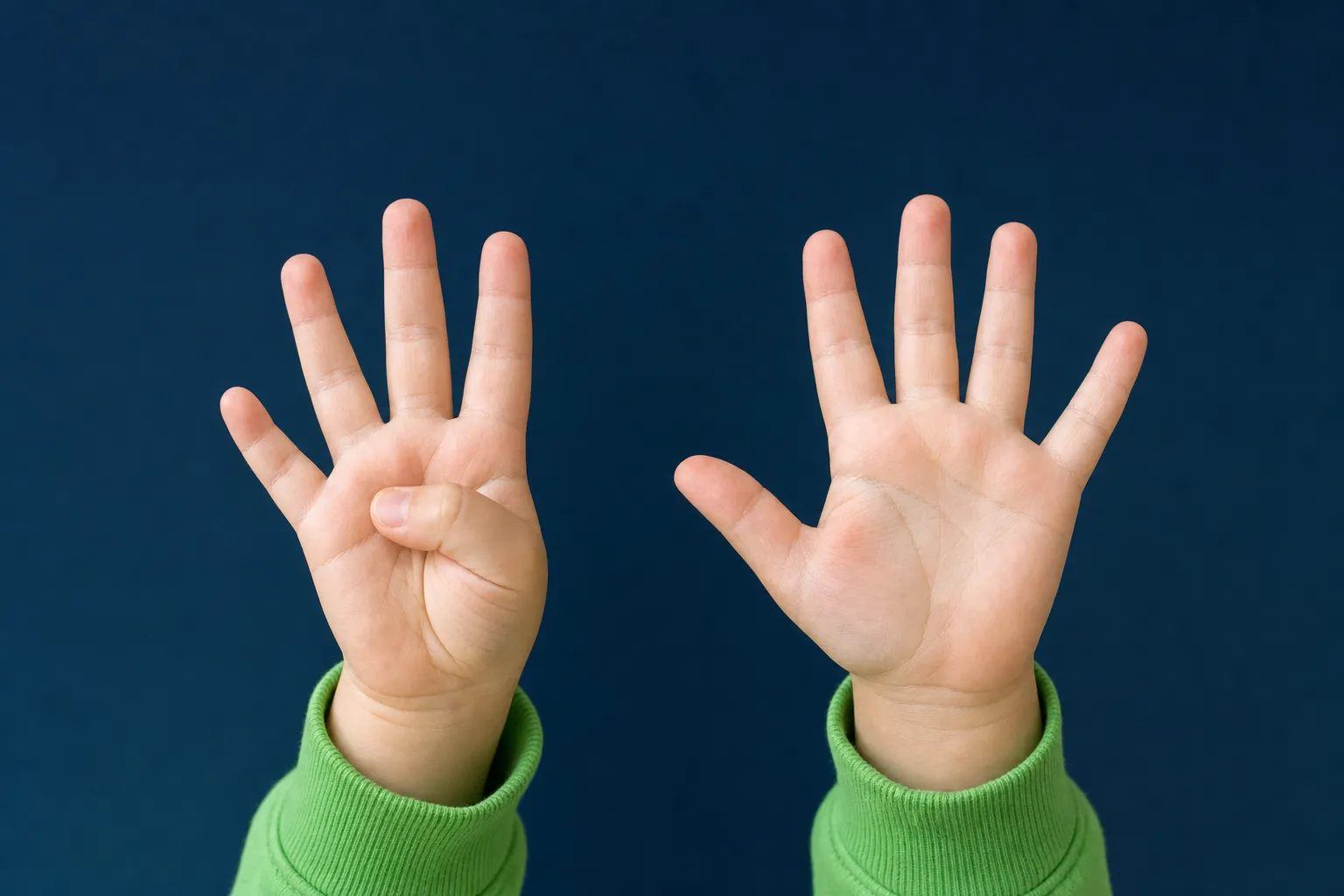
Hold both hands up, palms out, and number the fingers 1 to 10 from the left. To find 9 × 4, fold down the fourth finger: the fingers to its left are the tens, three, and the fingers to its right are the units, six. 36. It works for 9 × 1 to 9 × 10, and it comes with a check that lasts after the fingers are put away: the two digits of every answer up to 9 × 10 add to nine, and the tens digit is one less than the number being multiplied. 9 × 7 is sixty-something, and 6 + 3 = 9, so 63. Beyond ten, 9 × 11 = 99 and 9 × 12 = 108 are learned as two facts, or as 10 × n minus n.
The 8s: double, double, double
Eight times anything is the number doubled three times: 8 × 7 is 14, 28, 56. A child who has the 4s can do it in one step, since 8 × n is 4 × n doubled. The other route is from the 10s: 8 × 7 is 70 minus two sevens, 70 − 14 = 56. The facts that need memory after the doubling is in place are 8 × 6, 8 × 7, 8 × 8 and 8 × 12; the rest arrive from the smaller tables. 8 × 8 = 64 is often the last fact in the whole set to stick, and a rhyme does no harm.
The 6s: double the 3s, or a five and one more
Six times a number is three times it doubled, so 6 × 7 is 21 doubled, 42. Or it is five times the number plus one more of it: 6 × 7 is 35 + 7. There is also a pattern for the even numbers that children like: six times an even number ends in that number. 6 × 2 = 12, 6 × 4 = 24, 6 × 6 = 36, 6 × 8 = 48, and the tens digit is half the number. The three facts that usually need memory are 6 × 6, 6 × 7 and 6 × 8; 6 × 9 comes from the 9s trick and 6 × 12 from 60 + 12.
The 7s: the leftovers
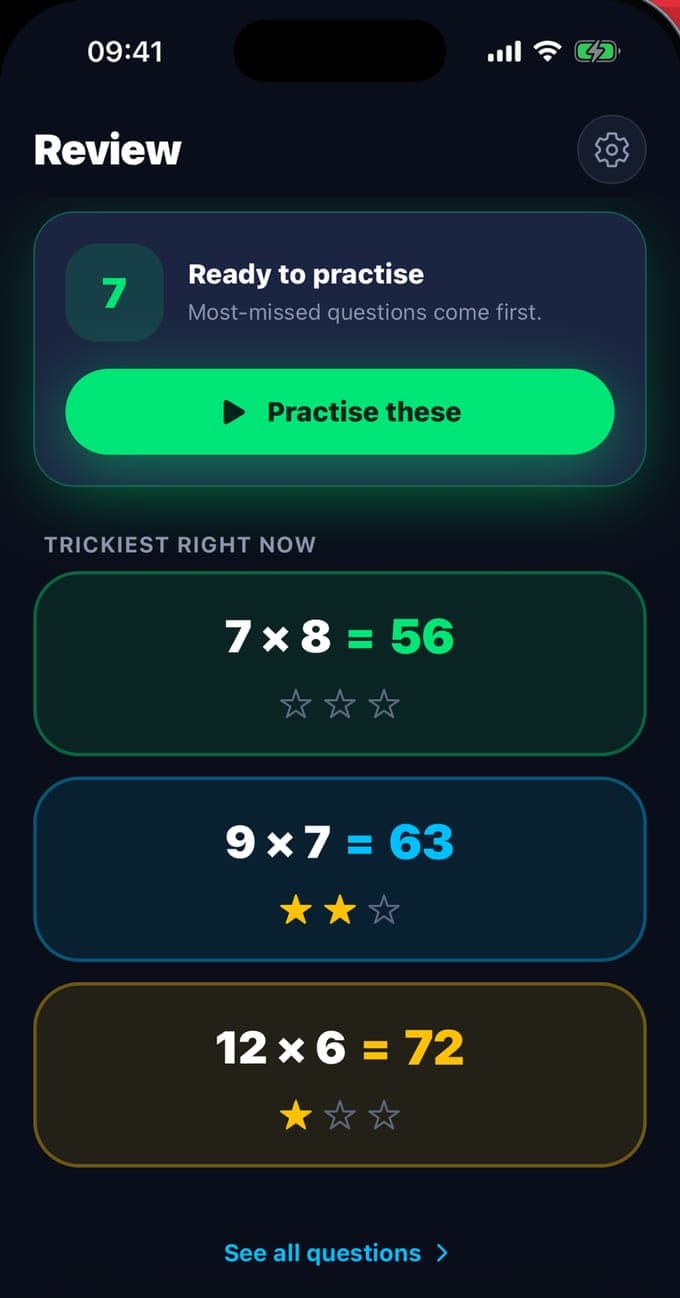
Learn the 7s last and there is almost nothing left to learn. 7 × 2, 7 × 3, 7 × 4, 7 × 5 and 7 × 6 were met with the 2s to 6s, 7 × 8 with the 8s, 7 × 9 with the 9s, 7 × 10, 7 × 11 and 7 × 12 with their tables. What remains is 7 × 7 = 49, which has no trick and needs to be memorised as a single fact, along with the reverse direction of the others, because a child who knows 8 × 7 does not always know 7 × 8 until asked it. The two facts children confuse most are 7 × 8 = 56 and 7 × 9 = 63, both a seven apart from the other, which is why a good practice question offers 63 as a wrong answer to 7 × 8 rather than 20.
Tricks are scaffolding
Every trick above turns recall into a calculation, and calculation is slow: the finger trick takes four or five seconds, which is most of the six the Year 4 check allows. Use them to get correct answers in the first week of a table, so that the child is practising the right fact rather than a wrong one, then push for the answer without the trick. Out-of-order questions with the misses coming back do the rest; the trick is there to fall back on, and a child who no longer needs it has learned the table.
Questions people also ask
Why is the 7 times table the hardest?
Because 7 is the only number from 2 to 12 with no pattern to lean on: it is not a double of a smaller table, does not end in a fixed digit, and has no finger trick. Learned last, though, it has only 7 × 7 that is new, so its reputation is worse than its size.
Does the nine times table finger trick work past 9 × 10?
No; there are only ten fingers. 9 × 11 = 99 and 9 × 12 = 108 are learned as facts, or reached as 110 − 11 and 120 − 12. The digit check also stops at 9 × 10, since 1 + 0 + 8 is nine but 9 + 9 is not.