How to practice times tables at home every day
Vishwen Labs

Practise times tables at home for ten minutes a day, at the same time each day, one table at a time, and make the child produce the answer rather than read it. Keep the misses and bring them back before the session ends, and tie the routine to something visible: a streak on the fridge or in an app, a small goal met most days. That routine kept for a month does more than any single technique, and it survives the weeks when nobody feels like it. Below is the routine as steps, then the reasons behind each.
Daily times tables practice at home
- Fix the time and the length. Pick a slot that already exists, after the snack when school ends or before the bedtime story, and keep it to ten minutes. In the app, set the reminder to that time; it defaults to 6 pm and goes quiet once the day's goal is done.
- Pick one table, or one level. Work on one table until it is reliable, in an order that leans on what is known: 10s, 2s, 5s, 4s, 3s, 11s, 6s, 9s, 8s, 7s, 12s. Once a few tables are in, add a level that mixes them, so the facts arrive out of order.
- Ask, don't show. Questions out of order, answers from memory. Cover the table, or let the game do it: the fact sits above the grid and the snake has to eat the right bubble among near misses. Let the child be wrong; a corrected miss teaches more than a read.
- Keep the misses. Note every miss and ask it again before the ten minutes end. The app does this on its own: a missed fact goes to the review queue and comes back ten minutes later, then the next day, until it has three right answers in a row.
- Set a goal the child can hit. Ten questions a day is the app's default; five is fine for a six-year-old and fifteen for a child who asks for more. A goal met on most days beats a big goal met twice.
- End on a win. Finish with two or three facts the child knows, or with the table's creature: it hatches after ten right answers and grows as facts are learned, and it never shrinks. Then tick the day off.
- Once a week, mix and time it. On one day, replace the table session with a mixed level or the table's timed test, and note the best time. Speed is the last thing to build and the first thing a school check measures.
Why ten minutes
Ten minutes is long enough for forty questions and short enough that nobody dreads it. The learning comes from the daily return, not the length of the session: a fact recalled after a night's sleep is fixed more firmly than one recalled ten times in a row, so seven short sessions beat one long one every time. Ten minutes also fits the attention of a seven-year-old, which is the real constraint, and leaves the child wanting to play again rather than relieved it is over.
The parent's job
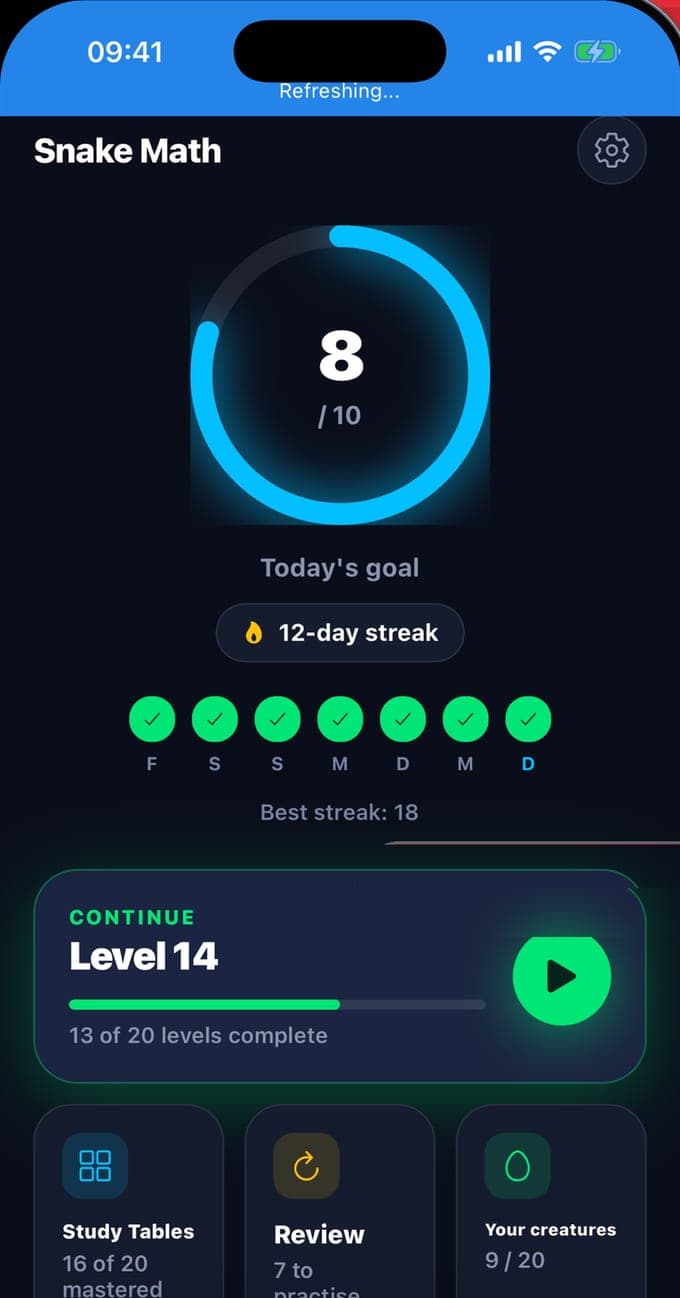
Ask, wait, and keep the list. Do not answer for the child and do not explain a fact while they are still reaching for it; a five-second pause is the memory working. When a miss happens, give the right answer once, plainly, and ask it again a minute later. Keep the tone of a game, not a test, and keep the sessions when you are tired as well, since a routine that skips a day skips a week. When the app runs the session, the job shrinks to being nearby and looking at the home screen at the end: the ring, the streak, and the Review tab's trickiest three tell you what to ask at dinner.
What the app does on its own
Multiplication: Times Tables was built around this routine. The home screen shows the day's goal as a ring, the streak, a tick for each day of the week, the best streak, and a Continue card for the current level. A missed fact goes to review and comes back on a schedule. Each table has a timed test whose best time is kept, and a creature that hatches and grows as the table is learned. The reminder is one notification at the chosen time. Settings and purchases sit behind a parental gate that asks for an adult's year of birth, there are no ads, and it works without a connection, so the session happens in the car as easily as at the table.
When it stops working
Every routine stalls. The usual causes are a table that is too hard too soon, sessions that have crept past ten minutes, or a run of misses that made the child feel stupid. The fixes are the same each time: go back a table, cut the session to five minutes and a goal of five, and end on facts the child knows. Two easy days restore the habit. What does not work is pushing through a bad week; the tables will still be there next Monday and the child's willingness may not be.
Questions people also ask
What time of day is best for times tables practice?
Whichever time already exists in the day and can be kept: after the after-school snack and before bed are the two that survive in most houses. Morning practice before school works for some children and is worth a try if the evenings are crowded.
Should I reward my child for practising times tables?
Reward the routine, not the answers: a tick on the chart, a streak, the creature hatching. Rewards for right answers make misses feel like punishment, and misses are where the learning is. Small and daily beats large and occasional.