Spaced repetition for times tables
Vishwen Labs

Spaced repetition means meeting a fact again just before you would have forgotten it: a missed fact comes back within minutes, then the next day, then after a longer gap, while facts answered correctly are seen less and less. For times tables it is the difference between a child who can chant the 7s and one who answers 7 × 8 in a shop. The idea is old, Ebbinghaus drew the forgetting curve in 1885, and the mechanics are simple enough to run with index cards in three boxes; an app does the scheduling for you. Multiplication: Times Tables asks a missed question again after ten minutes, then after a day, and retires it after three right answers in a row.
Why the gap does the work
Memory strengthens most when recall is a little difficult. Ask 6 × 7 twice in ten seconds and the second answer is copied from the first; ask it again the next day and the child has to reconstruct it, which is the effort that fixes it. Massed practice, forty questions on one table in one sitting, feels productive and fades within days. Spaced practice, the same forty questions across a week, lasts. The research on this stretches back over a century and the effect is one of the most reliable in the study of learning, but no parent needs the papers: anyone who crammed for an exam and forgot it by the summer has run the experiment.
With cards: the three-box method
Write each fact on a card, question on the front, answer on the back. All cards start in box 1, which is asked every day. A card answered correctly moves to box 2, asked every other day; correctly again, to box 3, asked once a week. A card answered wrongly in any box goes back to box 1. Within a fortnight box 1 holds only the stubborn facts and the daily session takes two minutes. The method's inventor, Sebastian Leitner, published it in 1972, and it has not been improved on for a deck of cards; its only weakness is that someone has to keep the boxes honest.
What the app schedules
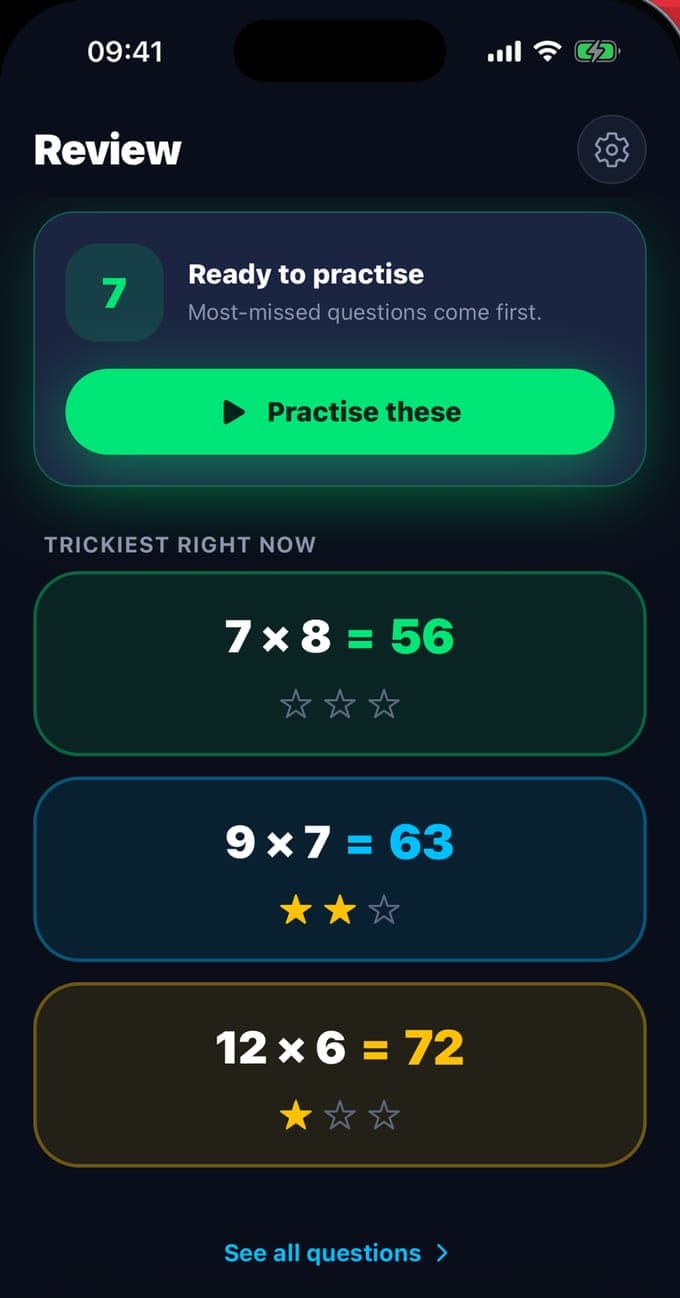
Multiplication: Times Tables runs the same logic without the boxes. A wrong answer in any game puts the fact into the review queue. The Review tab shows what is ready, most-missed first, and builds sessions of up to ten questions from what is due. After a right answer the fact is due again in ten minutes; after a second, in a day; a third right answer in a row retires it, and each is shown as a star, so a fact at two stars is one good answer from leaving the queue. A wrong answer in review sends it back to the start. Up to a hundred facts are tracked at once, which is more than any child will accumulate, and the trickiest three are shown on the tab so a parent can see the week's problem at a glance.
Spacing across weeks: the goal and the streak
Spacing only works if the sessions happen, so the second half of the method is the habit. The app sets a daily goal of 5, 10 or 15 questions, 10 by default, shows the day's ring on the home screen with a tick for each day of the week met, keeps a streak and a best streak, and sends a reminder at 6 pm unless the goal is already done or the time is changed. None of that is clever; it is the fridge chart in software, and it is what keeps day three from being the last day.
When the same fact keeps coming back
A fact that returns to the queue every day is usually confused with a neighbour rather than unknown: 7 × 8 with 7 × 9, 6 × 7 with 6 × 8. Spacing alone will not separate them. Practise the pair side by side for a day, give the child a hook for one of them, 56 as “five, six, seven, eight”, and let the review queue take over again. The tricks guide has a hook for most of the facts that behave this way.
Questions people also ask
How often should a child review times tables?
Every day, briefly, with the gap between reviews of a particular fact growing as it is learned: minutes at first, then a day, then a week. Once a table is reliable, a mixed timed test once a week is enough to keep it, and a game the child plays anyway does that without planning.
Does spaced repetition work for young children?
Yes; the effect does not depend on age, only on the sessions happening. What changes with age is the length of session a child will tolerate, which is why the daily goal is ten questions rather than fifty.