How many cards go in a Yu-Gi-Oh deck, and what the Forbidden & Limited List does
Vishwen Labs
Konami's Official Rulebook fixes the sizes. Main deck: “The Deck must be 40 to 60 cards.” Extra deck: “You can have up to 15 cards in the Extra Deck,” and those cards “are not counted towards the 40-card minimum limit of your Main Deck.” Side deck: up to 15, and “The number of cards in your Side Deck before and after you swap any cards must be exactly the same.” Copies: “You can only have up to 3 copies of the same card in your Deck, Extra Deck and Side Deck combined.” On top of that sits the Forbidden & Limited List, which Konami revises several times a year; the list effective 18 May 2026 names 93 Forbidden, 69 Limited and 9 Semi-Limited cards.
The three decks
The rulebook's Getting Started chapter sets them out. The main deck is 40 to 60 cards, and it adds a piece of advice: “Try to keep your Deck close to the 40-card minimum. Having a Deck with too many cards makes it hard to draw your best cards when you need them.” The extra deck holds Fusion, Synchro, Xyz and Link Monsters, up to 15, in any combination, and does not count toward the 40. The side deck is a separate deck of up to 15 used to change your deck between the games of a match, swapping card for card so its size stays the same. The three-copy rule counts the same card name across all three decks combined.
Forbidden, Limited, Semi-Limited
Konami's list has three categories. Forbidden cards cannot be used in the main, extra or side deck at all. Limited cards are allowed as one copy, counting all three decks together. Semi-Limited cards are allowed as two. Everything else follows the three-copy rule. The list effective 18 May 2026 carries 93 Forbidden cards, among them Maxx “C”, Pot of Greed and Imperial Order; 69 Limited, among them Exodia the Forbidden One, Monster Reborn and Solemn Judgment; and 9 Semi-Limited, among them Droll & Lock Bird. It replaced the list of 2 February 2026, and Konami announces each new list on yugioh-card.com with its effective date.
What the app checks, and what it does not
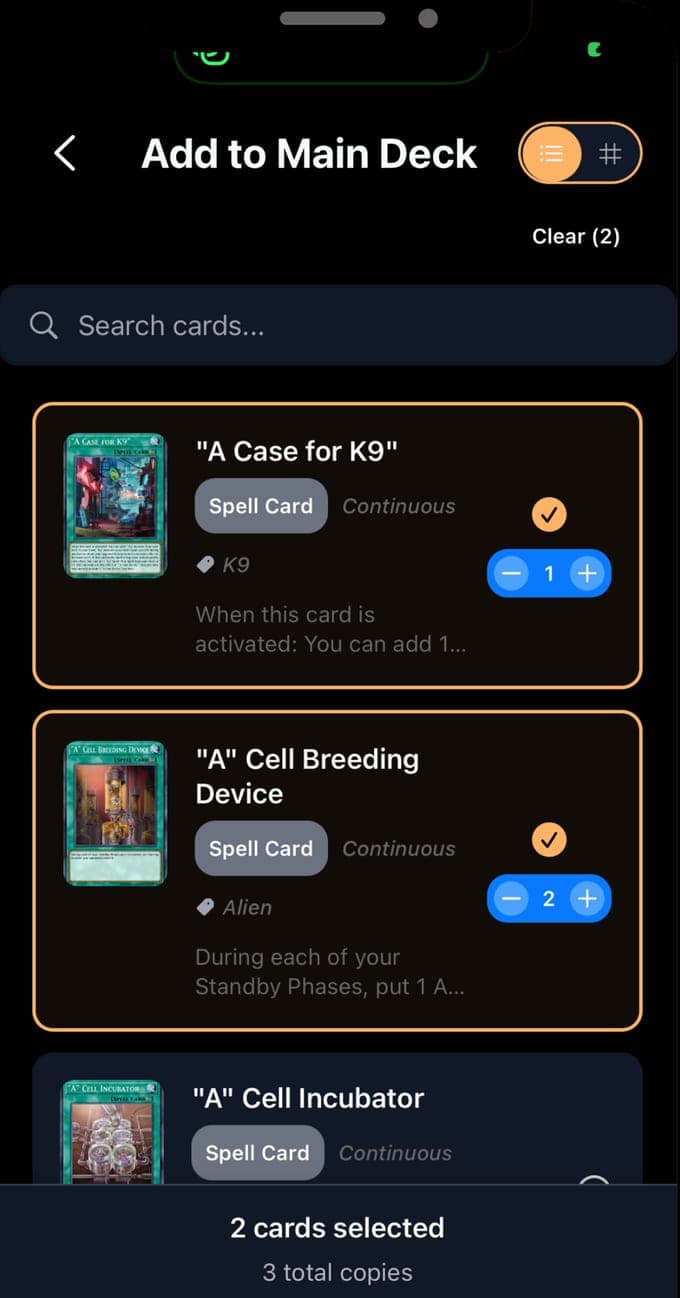
The deck builder keeps a main, extra and side deck and checks the rulebook's structure: it flags a main deck under 40 or over 60, an extra or side deck over 15, and a fourth copy of a card across the three. It does not check the Forbidden & Limited List, so a deck the app accepts can still be illegal at a tournament because of one card. Before an event, read the current list on yugioh-card.com and check every card the app cannot: the Forbidden ones must go, the Limited ones drop to one copy, the Semi-Limited to two.
The list and your collection's value
A card that becomes Forbidden loses most of its price within days, because tournament players are most of its demand; a card freed from the list gains. The list is therefore the single biggest price event in the hobby, and the reason a competitive card's value should be read with the next list date in mind. Old cards on the list, Pot of Greed among them, still sell as collectibles, and a 1st Edition copy of a Forbidden card can be worth more than a legal reprint of it.
Speed Duel and other formats
Speed Duel decks are smaller, 20 to 30 cards with a small extra deck, and use their own card pool and list; the rulebook page on yugioh-card.com links a separate Speed Duel guide. The OCG in Japan and Korea runs its own Forbidden & Limited List on its own dates. The app's builder applies the TCG rulebook's sizes to every deck, which is right for the main game and a reminder to check the format's own rules for anything else.
Yu-Gi-Oh Card Scanner is an unofficial, fan-made app from Vishwen Labs. It is not authorized, licensed or endorsed by Konami, Studio Dice, SHUEISHA or TV TOKYO, and Yu-Gi-Oh! and all related names, marks and card artwork belong to their owners. Card data and prices come from the public sources named on these pages, and nothing here is advice to buy, sell or grade a card.
Questions people also ask
Can a Yu-Gi-Oh deck have more than 60 cards?
No. The Official Rulebook fixes the main deck at 40 to 60 cards, with the extra deck and the side deck at up to 15 each and not counted toward the main deck's minimum.
How many copies of a card can I run?
Three of the same card across the main, extra and side decks combined, unless the Forbidden & Limited List says otherwise: one copy of a Limited card, two of a Semi-Limited card, and none of a Forbidden card.