TCGplayer, Cardmarket and eBay prices for Yu-Gi-Oh cards: what each number means
Vishwen Labs

TCGplayer's Market Price “shows you the value of a collectible based upon actual recent sales, drawing from thousands of transactions daily across thousands of individual sellers on our platform,” in dollars, from the US marketplace. Cardmarket's Price Trend is its own smoothed figure from recent sales in Europe, in euros. eBay's sold listings are the third opinion, noisy but honest. The app shows all three through a public Yu-Gi-Oh data service that publishes, per card name, the lowest price across its versions on each marketplace, and separately a price for each set and rarity. Read the per-set figure for your print and the marketplace you will actually use.
TCGplayer's price points, in its words
Market Price “is compiled from recent sales completed on TCGplayer.com,” “is updated as transactions complete and reflects the best suggested retail price of a product.” It uses sold prices, “while ignoring outliers that would affect the traditional LO-MID-HI scale.” Most Recent Sale “reflects the price of the most recently sold product for the filters applied.” Listed Median “is the median from all listed prices for a product based on listed prices only,” and “especially on older products with lower quantities, it can vary significantly from the actual price that people are paying”; TCGplayer's own example is a card with a Market Price of $354.66 and a Listed Median of $654.72. Every price point “will reflect any selected printings and conditions filters,” so a print in Near Mint and the same print in Lightly Played have their own numbers.
Cardmarket, and eBay
Cardmarket, based in Germany, is where most of Europe buys singles, in euros. Its Price Trend is a weighted, smoothed figure from recent completed sales that filters outliers and reacts to swings with a delay; it is published with an average sell price, a low price and averages over the last day, week and month. eBay has no official price point; its sold listings, filtered to your print and condition, are the raw record of what people paid, including graded copies, which the marketplaces' raw prices exclude. For a card with few sales, a handful of eBay sold listings often says more than any single figure.
What the app shows, and why a famous card looks cheap
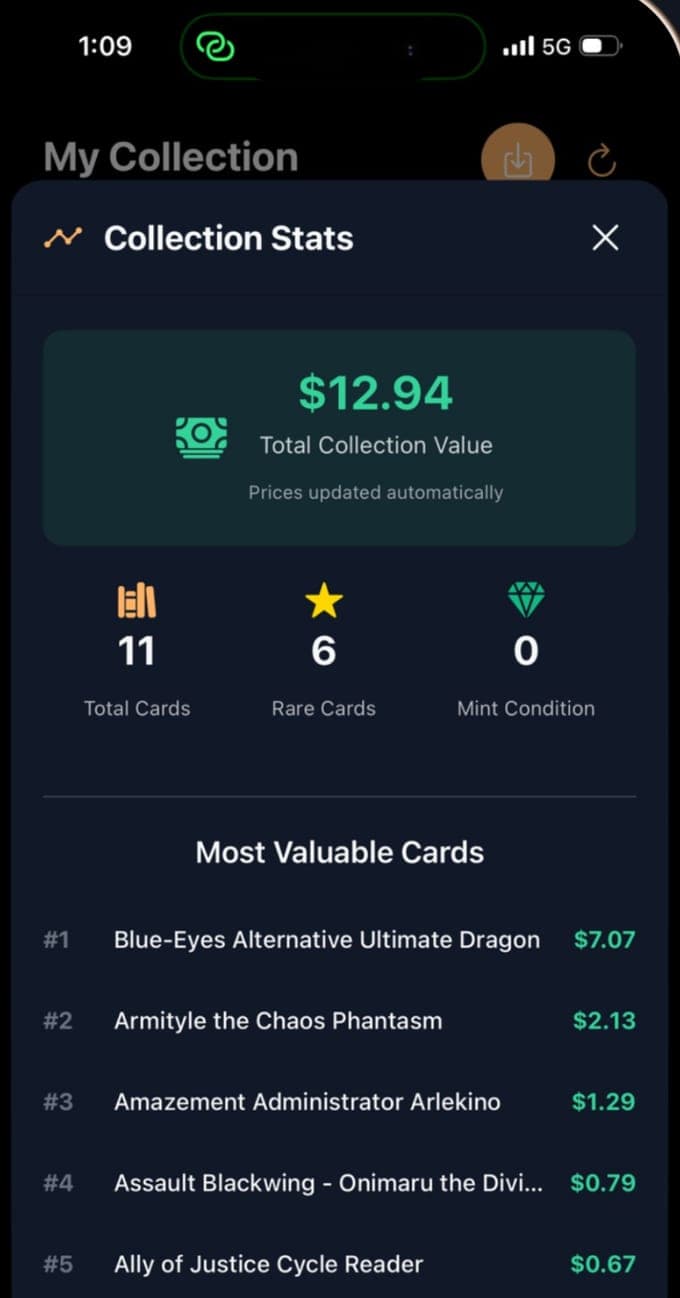
The data service behind the app publishes five figures per card name, from Cardmarket in euros and TCGplayer, eBay, Amazon and CoolStuffInc in dollars, and describes each as “the lowest price found across multiple versions of that card.” It also publishes, for each set the card appears in, the set code, the rarity and a price in dollars. The app's card page shows the TCGplayer figure free and, with Premium, the others and the per-set list. So the headline on a Dark Magician is its cheapest reprint; the set list is where a 1st Edition Ultra Rare shows its price. The service refreshes about daily and the app caches for a day, which matches the “updated automatically” note under the collection's total.
Why the three differ, and which to use
Different buyers, currencies, shipping costs and supply: a card printed heavily in Europe is cheaper on Cardmarket, a US tin promo cheaper on TCGplayer, and eBay swings with whoever listed last week. None is more true; each is what a buyer in that market pays. Use the one for the market you will buy or sell in, glance at the others as a check, and for anything valuable read sold listings for your exact print and condition rather than a single number. A listed price is an ambition.
Prices, the list and the metagame
Yu-Gi-Oh prices move faster than most hobbies' because the game moves: a card that wins a regional doubles, a card that lands on the Forbidden & Limited List loses most of its price, and a reprint in a structure deck resets a chase card to a few dollars. Price history in the app, with Premium, shows the direction for the cards you own, and alerts watch the ones you name. For a competitive card, the next list date matters as much as the last sale.
Yu-Gi-Oh Card Scanner is an unofficial, fan-made app from Vishwen Labs. It is not authorized, licensed or endorsed by Konami, Studio Dice, SHUEISHA or TV TOKYO, and Yu-Gi-Oh! and all related names, marks and card artwork belong to their owners. Card data and prices come from the public sources named on these pages, and nothing here is advice to buy, sell or grade a card.
Questions people also ask
Why is the app's price for my card so low?
The headline per marketplace is the lowest price across every version of that card name, as the data service publishes it. Open the set list, with Premium, for the price of your set code and rarity, and check the condition filter on the marketplace itself.
Is TCGplayer Market Price the same as what a Yu-Gi-Oh card sells for?
It is compiled from recent completed sales on TCGplayer for the selected print and condition, ignoring outliers, so it is close to what copies have been selling for there. Your own sale nets less after fees and shipping, and a rarely sold print's figure can rest on a few sales.