How much are my Yu-Gi-Oh cards worth, and how do you check?
Vishwen Labs
A Yu-Gi-Oh card is worth what buyers have recently paid for the same print in the same rarity and condition, and the number is public. The catch is the word print: Dark Magician has been printed in dozens of sets, and the marketplaces price a 2002 Ultra Rare and a 2016 tin reprint as different products. To check a card you need its set code, printed under the artwork, its rarity, its edition (1st Edition or Unlimited) and an honest view of its condition. Most cards in a shoebox are worth cents; a few are worth the shoebox.
One name, many prints
Yu-Gi-Oh reprints its famous cards constantly, and each printing carries its own set code: LOB-EN001 for the 2002 Legend of Blue Eyes White Dragon, a different code for every tin, structure deck and anniversary set since. Yugipedia's card-number article notes that a rereleased set keeps its original abbreviation and numbers, and that a 25th-anniversary Blue-Eyes would share LOB-EN001 with the original yet be listed separately in the database. TCGplayer's price points “reflect any selected printings and conditions filters,” so the number you want is the one for your set code, your rarity and your condition, not the name's cheapest listing.
Five things that move the number
In rough order of weight:
- Which print: the set code and rarity. A Secret Rare from a new set and a Common reprint of the same card are unrelated prices.
- Edition. 1st Edition, the first print run of a set, sells above the Unlimited run that followed; the gold security foil in the corner marks it, and grading labels note it.
- Condition: Near Mint down to Damaged, on the marketplace scales. Vintage Ultra Rares lose most of their value to a crease.
- Grading. A PSA 10 of a sought-after print sells in a different market from a raw copy; a raw Near Mint is not priced as a 10.
- Play. The Forbidden & Limited List and the tournament metagame move competitive cards week to week; a card that becomes Forbidden can lose most of its price overnight.
How to check a card in a minute
Read the set code under the artwork and the rarity from the foiling: plain text is Common, foil letters Rare, foil art Super Rare, gold letters with foil art Ultra Rare, rainbow letters Secret Rare, and so on. Note the edition text under the artwork or beside the passcode, and whether the corner foil is gold or silver. Judge the condition under a light. Then look up the print: TCGplayer for dollars, Cardmarket for euros, eBay's sold listings for a third opinion on anything expensive. The app does the first step from a photo and, with Premium, lists a price for every set the card was printed in.
What the app's number is
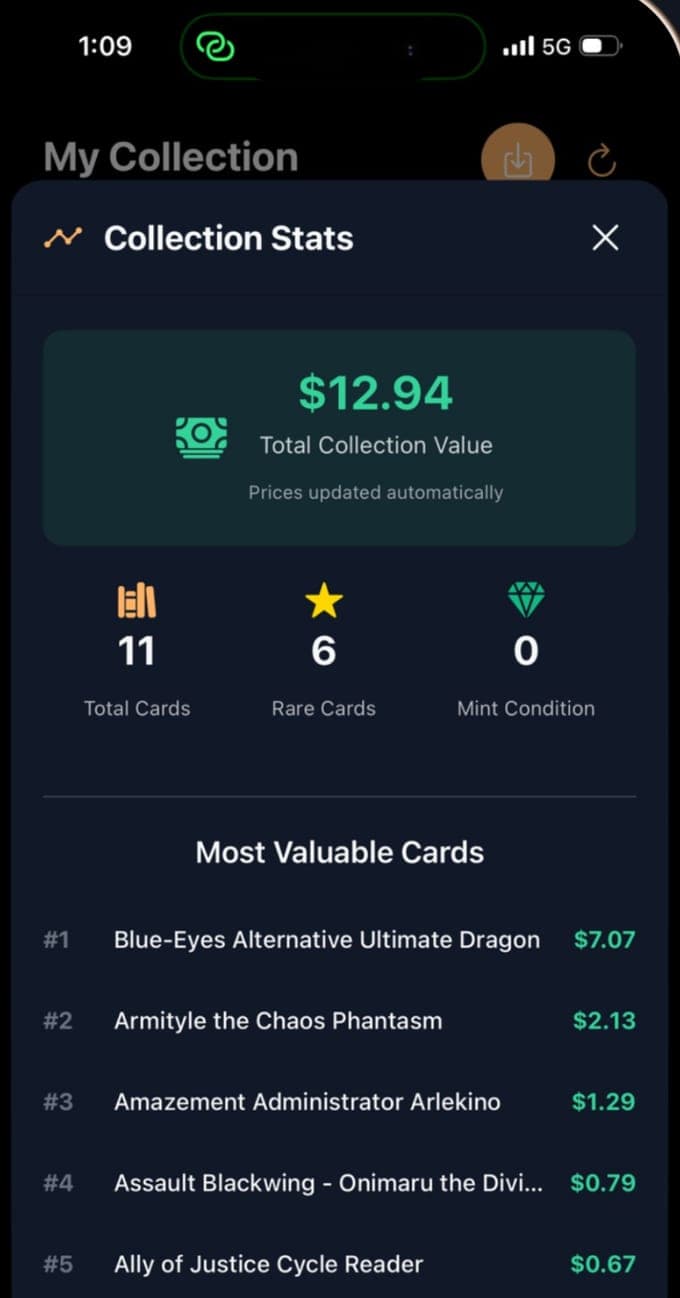
The app takes its prices from a public Yu-Gi-Oh data service, which publishes for each card name the lowest price found across its versions on TCGplayer, Cardmarket, eBay, Amazon and CoolStuffInc, and separately a price for each set and rarity the card was printed in. The card page shows the TCGplayer figure free; with Premium it shows the other marketplaces and the per-set prices. So a headline figure of a few cents on a famous card is the cheapest reprint, and the set list is where a 1st Edition Ultra Rare shows its real number. Prices refresh about once a day.
The traps
Asking prices are not values; TCGplayer's Listed Median “can vary significantly from the actual price that people are paying,” and its own example is a card listed at over $600 that sells for $354. A price for the name is not a price for your print. A Japanese OCG card is a separate product from its TCG print, priced in its own market. And a price is money only when someone pays it, after fees and shipping. For anything valuable, three sold listings on the marketplace you will use beat any single number.
Yu-Gi-Oh Card Scanner is an unofficial, fan-made app from Vishwen Labs. It is not authorized, licensed or endorsed by Konami, Studio Dice, SHUEISHA or TV TOKYO, and Yu-Gi-Oh! and all related names, marks and card artwork belong to their owners. Card data and prices come from the public sources named on these pages, and nothing here is advice to buy, sell or grade a card.
Questions people also ask
Are old Yu-Gi-Oh cards from 2002 worth money?
Some are. 1st Edition Ultra Rares and Secret Rares from the earliest sets, in good condition, sell for serious sums, and graded copies for more. Most Commons and Rares from the same packs are worth cents. The set code, the edition and the condition decide it.
Why does the app show a few cents for my Dark Magician?
Because the headline figure per marketplace is the lowest price across every version of that name, and Dark Magician has dozens of reprints. Open the card's set list, with Premium, to see the price for your set code and rarity.