Is grading Yu-Gi-Oh cards worth it?
Vishwen Labs
Grading is worth it when the graded price, at the grade the card will actually get, exceeds the raw price by more than the fee, the shipping and the wait. PSA describes a Gem Mint 10 as “a virtually perfect card” with centering no worse than about 55/45 to 60/40 on the front, and a Mint 9 as a card with a single minor flaw. The gap between a 10, a 9 and a raw Near Mint copy is the whole game, and it is large only for some prints: early 1st Edition Ultra and Secret Rares, chase cards from tournament packs, and the modern premium rarities. PSA's cheapest levels were paused in June 2026 under a backlog, leaving Regular at $79.99 a card.
PSA's scale, at the top
PSA's grading standards define a Gem Mint 10 as “a virtually perfect card,” with four sharp corners, sharp focus and full original gloss, centered within about 55/45 to 60/40 on the front and 75/25 on the reverse, allowing at most a slight printing imperfection. A Mint 9 shows “only one” minor flaw and centering of about 60/40 to 65/35 on the front and 90/10 on the back. An NM-MT 8 allows slight wear at the corners and centering nearer 70/30. Below run Near Mint 7, EX-MT 6 and down to Poor 1, with half grades and qualifiers such as OC for off-centre. CGC and Beckett grade on their own ten-point scales. Yu-Gi-Oh cards grade harshly on centering, because Konami's print runs are often off-centre out of the pack.
What it cost in 2026
PSA's fees moved several times in 2026. Its Value levels, from about $25 to $30 a card, were paused for new submissions from 2 June 2026 when a surge pushed its backlog toward ten million cards, by PSA's own account; the cheapest open level became Regular at $79.99 a card, with Express and faster levels above it, and PSA tied the Value levels' return to a backlog milestone rather than a date. Add return shipping and insurance, and weeks to months of waiting. CGC and Beckett price their own levels. Check the graders' sites before submitting; these figures are as of September 2026.
The arithmetic
Take the raw Near Mint price for the print, by set code and rarity. Find recent sold prices for the same print at PSA 9 and PSA 10. Estimate honestly which grade your copy would get; most cards out of a pack are 9s or 8s, and vintage cards with any edge wear are 7s. Then: graded price at the likely grade, minus the fee, minus shipping both ways, minus the raw price. If the result is not clearly positive at a 9, keep the card raw. For a $5 card the fee is the whole story; for a 1st Edition Blue-Eyes, a Ghost Rare or a Starlight Rare, the grade can multiply the price and the sum works.
When grading makes sense
Usually one of these:
- A print whose raw price already justifies the fee several times over, where a high grade adds a premium and a slab adds trust for the buyer.
- A card you intend to keep, where the slab is protection and authentication rather than an investment.
- A card whose authenticity a buyer will question, since graders authenticate before they grade, and the corner foil and edition are exactly what a grader checks.
- A modern chase rarity pulled fresh with clean corners and good centering, where a 10 is realistic and the 10 premium is large.
How the app fits in
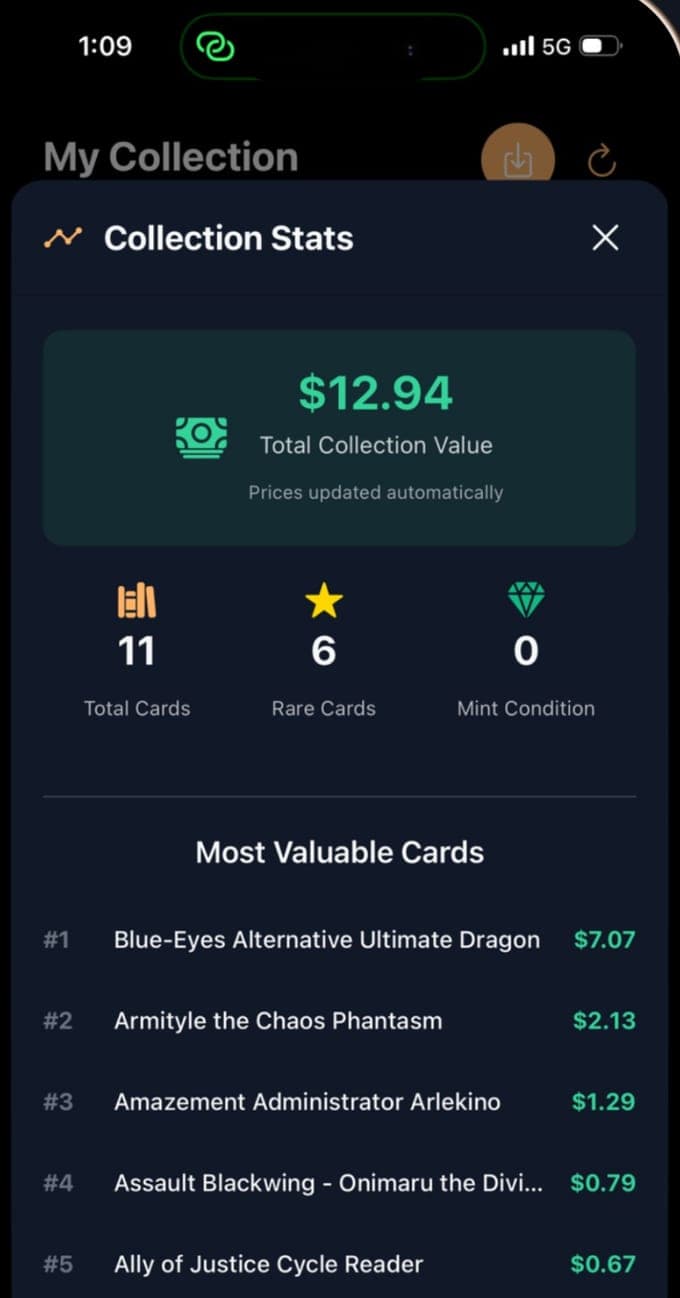
The app prices raw cards: a marketplace price free, and with Premium a price for each set and rarity, which is the starting number. It records the condition you assign, your first honest estimate of the grade. For the graded side you need sold listings on the marketplaces and the graders' population reports, which show how many 10s and 9s exist for a print and therefore how scarce a top grade really is.
Yu-Gi-Oh Card Scanner is an unofficial, fan-made app from Vishwen Labs. It is not authorized, licensed or endorsed by Konami, Studio Dice, SHUEISHA or TV TOKYO, and Yu-Gi-Oh! and all related names, marks and card artwork belong to their owners. Card data and prices come from the public sources named on these pages, and nothing here is advice to buy, sell or grade a card.
Questions people also ask
How much does it cost to grade a Yu-Gi-Oh card with PSA?
In September 2026, from $79.99 a card at PSA's Regular level, its cheapest open level after the Value levels (about $25 to $30 a card) were paused on 2 June 2026, plus shipping and insurance. PSA has said the Value levels return when its backlog falls to a set size. Check psacard.com for current fees.
Which Yu-Gi-Oh cards are worth grading?
Prints whose raw price is already many times the fee: 1st Edition Ultra and Secret Rares from the early sets, tournament prize and chase cards, Ghost, Starlight and Quarter Century Secret Rares of popular monsters. Run the sum with sold prices for your print at the grade you honestly expect.